

When most people hear the word antagonist, at least in the circles in which I most often find myself, they think of literature, a character written in opposition to another. A villain poised in relation to a protagonist. Macbeth and Macduff. Dr. Jekyll and Mr. Hyde. Mrs. Danvers and Rebecca.
But I have an easier time envisioning the relational machinations of the word when I call up its definition in connection with muscles, with muscular functioning. According to Merriam Webster, in physiology an antagonist is defined as “a muscle that contracts with and limits the action of an agonist with which it is paired.” The agonist exerts control, influence, against the antagonist. The agonist muscle acts, the antagonist muscle opposes the movement, usually by operating in an opposite way. When you flex your knee, the hamstrings are the agonist, the quadriceps the antagonist. When you flex your elbow, the biceps contract, the triceps relax. The antagonist acts in opposition to the agonist. There’s a strain, a struggle; an action and a reaction.
I wouldn’t exactly call my maternal grandmother, Hannah, whom I always referred to as Bubbeh, the Yiddish word for grandmother, as agonist to my other grandmother, Grandma Raya. But they do, at times, function that way in my mind, particularly in the roles they occupied over the course of my life. Both died in their nineties, about two years apart, while I was in my early forties. And they seemed like opposites, each helping me define the capacities and limitations of the other. Antagonist, agonist. But they also functioned, at least from my perspective, as a team. Their lives, their presences, their stories—and these days, too, their ghosts—together articulate my life, my presence, my story.
If you dig deeper into how the word is used, there’s an intriguing levelling off. In dentistry, an antagonist is a tooth on one half of the jaw, it doesn’t seem to matter which, that articulates with a corresponding tooth on the other. By articulate, I mean that they operate, in a sense, in opposition. But in reality they’re performing together, to accomplish the same objective, the same goal. Holding a mouth shut tight, chewing on a piece of food: each tooth’s movement complements and defines the other’s.
Now that my grandmothers are dead, I find myself increasingly entangled in twinned inquiries: who am I, and where do I come from? When they were alive, I didn’t speculate so much. My grandmothers were my anchors. I was the one who took them in, who listened, who asked questions. I had them, and I had their stories.
But lately I’ve begun to wonder. If I am no longer the one who is listening to their stories, then who, exactly, am I?
*
After my paternal grandmother Rachel, more intimately known as Raya, died in August 2021, my parents went to clear out her apartment. It was a two bedroom in North Miami. She’d shuttled back and forth between there and Brooklyn for over forty years, with vacation stops taken along the way at casinos in Las Vegas and Atlantic City. For most of that stretch, her longtime partner—the man I’d always known not as grandpa but, simply, Sasha, for she stressed to us that they had never, nor would they ever, marry—accompanied her wherever she went. But he had died some years before the pandemic, and, in the final years of her life, she lived there for the most part alone.
I had some, though not many, concrete memories of that apartment. Walking into it as a child and later teenager, it was impossible not to feel transported back in time. The wallpaper wrapping around the kitchen, winding its way into the living room, was a metallic gray and white, laced in silver half-moons. It was the kind of color-texture combination that, for a certain generation—on the cusp Gen Xers, like me—inevitably evokes polaroids from early childhood.
There were glass side tables tucked into every corner, topped with family photographs, bronze statuettes, and crystal vases; there was crystal, in fact, everywhere you turned. But the favored piece of furniture for each of the grandkids who visited, however irregularly, was the silver coffee table in the living room. It had a heavy glass top, with sets of lightbulbs lining its underside. If you clicked on a nearby oversized button, the lights turned on and you could see replicas of yourself stretched inward for miles.
By the time my grandmother died, it had been ages since I’d been to the apartment. During one of my last visits, I can recall a morning with her in the kitchen, along with my husband. She was looking at him, as always, with moony eyes, announcing, in her thick East Slavic accent, how handsome he was.
She had asked that morning for help resetting a clock on the wall. But when I call up that scene now, the detail I remember best, with some amusement, is the giant jug of vodka nestled on the floor between the legs of two chairs, including the one in which she sat, pulled up to the kitchen table. She was always offering drinks, whatever the time of day, though she herself never seemed to be partaking. This was unlike Sasha, who was a sweet, gregarious, if sometimes lecherous drunk up until the day he died.
Of Grandma’s bedroom and bath area, I can remember mostly framed posters of Marilyn Monroe hung up on every wall. Sasha and Grandma admired, adored, loved Marilyn, though they never shared what so enthralled them. Like many, they must have enjoyed simply looking at her, her glowing skin, her generous curves and pearly teeth. My grandma had had her hair dyed a peroxide blond for as many years as I had known her; I can see from the photographs of my parents’ wedding that it was dyed as early as 1971. Even as an old woman—though she never actually struck me as old—her hair was that same blond, sculpted into a beehive with several stray tendrils always falling.
I remembered, too, the second room, a guest bedroom where I sometimes slept, piled in with two or more siblings in the rare times my family visited throughout my childhood. There were oversized Life magazines gently crumbling with age, forever stored on a bedside table. As a teen I took great interest in these, rifling through them like they held some key to unlocking my grandmother, or my family history. Maybe, I considered at various points, perhaps even while flipping through those magazines, it was some idea of safety, of security, of ease, that appealed to them about Marilyn—something I, American-born suburbanite, well-distanced from my immigrant parents’ earliest struggles, could never really grasp. And maybe for my grandmother, Marilyn also represented something about the possibility of female independence. For though the famed actress-turned-sex symbol may have spent most of her adult life searching, unsatisfactorily, for equal partnership, for love, I don’t imagine—though I might be wrong—that my grandmother ever looked deeply into her idol’s background. In those posters, it was just a beautiful, smiling, sexy woman: independent and free. Lacking in context.

After Sasha died, my grandmother professed that she wished she hadn’t stayed with him so long. She wished she had found someone else, someone who would have taken care of her. This was not the first time she conveyed a deep regret to me, but it was certainly rare for Grandma to admit that she had taken bad turns of her own bidding. She also hated to entertain the possibility that any decision, or outcome, had been outside her control. She liked telling stories in which she was the heroine of her own life.
Once, during a long taxicab ride through Manhattan, in another atypical lament, she confessed that she had had a single great love—a young man she’d known before marrying my grandfather, Jack, who died when I was three. This man had been from a poor family, as was she, and they fell in love as teenagers. He left for the army but sent letter after letter, begging her to wait so they could marry when he returned.
“My parents, my mother, hid the letters, threw them away,” she explained. “I only found out after I was married.”
Grandma Raya, born in 1923 in Gomel, a large city in eastern Belarus, loved to tell me a story about her earliest life with Grandpa Jack, who was older than she. He had fled his hometown of Rivne, Poland—now part of Ukraine, and about three hundred miles from the town where my grandmother was born—on a bicycle at seventeen years old, after Nazis invaded his town. He ended up the lone survivor from his family.
She often told this story about their wedding night. She was afraid, terrified even, she explained, in one of her rare admissions of that emotion. Her parents had pushed her into the marriage, seeing the match as security. But she barely knew him. And there was no one to ease her fears about what was meant to happen between them on their wedding night.
On the evening following the celebration, when they were finally alone together, she challenged him to a drinking contest. They would take shot after shot of vodka. He reluctantly agreed, laughing at the spirited tenacity of his young bride, who couldn’t have weighed more than a hundred pounds. And he was stunned soon after when she remained composed, even as he started to keel over, eventually falling down drunk.
She had taken butter, she explained, with one of her characteristically sly smiles, eaten some so it would line her stomach. And as the night wore on, she’d intermittently excuse herself to go to the bathroom and—here she gestured—throw up the contents of what she had consumed before it could fully enter her bloodstream.
I heard this story many times when I was young, never bothering to consider the likelihood of its truthfulness, its verité. Anyway, if I asked probing questions, or interrupted the flow of the storyteller, I was quickly dismissed; the story was as the story was. It was the tale of a survivor, a woman who, while trapped in the constraints of gender and of poverty, managed to put off an enforced wedding initiation, if only by one night, so she could assert some control over a life that seemed otherwise destined to take away her ability to choose. For that lone night, whether in reality or solely in her imagination—an imagination that came to life with every retelling—she was in charge.
After my parents finished clearing her apartment, my mother called to describe how, in the locked guest bedroom closet, they had found boxes overflowing. The objects packed away included canned food and unopened packages of silverware and dishes. She also found three plastic shoeboxes filled with all variety of individual knives—steak knives, chef’s knives, you name it.
“What were they doing there?” I asked.
“I don’t know.” My mother paused. “Maybe…preparing?”
“Preparing? For what?”
Cooking? Fighting?
Whatever their intended purpose, the hidden supplies were consistent with what Grandma had always told us about herself. As ever, she was ready to make the first move.
*
There are a few anecdotes I call up when I want to tease out the differences between my grandmothers. Their divergences were so conspicuous that I have sometimes felt as though their relationship, the fact that they ever found themselves planted relative to one another, must have been part of some master plan. Of course, as the source of this fabricated plan, I am, predictably, at its center.

There was the incident, sometime around my early to mid-thirties, a little over a decade ago now, when I was several years married and had one child, then a toddler. I found myself that year on a visit to my parents’ house in a New York City suburb on Labor Day weekend, which coincided with my birthday. My grandmothers were staying there, too, unusually at the same time. Bubbeh, my mother’s mother, was, naturally, because she had moved in with my parents a few years earlier, after her husband, Zeideh, died. Grandma Raya, my father’s mother, was there because she, too, was newly alone. With much hesitation, she had agreed to stay in my parents’ house on a trial basis so they could look after her. Unlike Bubbeh, who lived a five-minute car ride from my parents for nearly the entirety of my life, Grandma usually flitted in and out on brief stays, emanating a general antsiness when she had to endure a domestic routine for too long.
On this birthday morning, at breakfast I was confronted, first by Bubbeh, who as always handed me a birthday card she had bought and signed well in advance, with some twenties tucked into it. The card and cash were no surprise. Bubbeh never forgot a single birthday. Grandma, on the other hand, didn’t live by calendars. Grandchildren’s annual celebrations weren’t part of the program. She had her friends, she had Sasha, and she had her adventures. We, her family, were valued, yes, but she was not that kind of grandmother.
On this day, catching the interaction from the corner of her eye—she was always on watch, particularly with a nemesis like Bubbeh nearby—she called for me to come with her into the room where she was staying. She often, in this way, openly traded in secrets, never too shy to pull one of us aside in front of everybody else. On my way out with her, I could see Bubbeh, herself always alert to her antagonist, begin to scowl.
“Tell me, how much did your Bubbeh give you…” Grandma asked, already prying the envelope out of my hands before I could peek inside for myself. “I’ll give you more. I’ll always give you more.”
Later, of course, Bubbeh, in her own complementary display, though only after everyone else had scattered, tactfully pulled me aside to ask what or how much my “other” grandmother had gifted me.
It was part of their epic broil, an incident, one of many, infused with a dose of the slapstick. There I was, delightfully, if somewhat uncomfortably, caught between two matriarchs battling it out to see who could be the highest bidder.
“You’re my favorite, you know,” was one of the last things Grandma Raya said to me over the phone.
She said this, I am certain, to whichever one of her grandchildren called her in a certain mood.
Bubbeh would have insisted on never playing favorites, on giving each of us the same amount, presented in identical packaging, for every special occasion. She baked us carefully wrought, gorgeously decorated cakes delivered right on our birthdays; she made matching dinner and snack plates on those regular afternoons and evenings she was called upon to watch over the five of us. On every holiday, there were her signature dishes: borscht-based meatballs for Passover; homemade jelly-filled doughnuts on Hannukah; salat-bef (a Romanian beef salad) on Rosh Hashana. As children, Bubbeh was part of our everyday domestic landscape. Grandma, on the other hand, was the occasionally swooping in guest star, who also intermittently bore curious offerings: hand-painted Matryoshka dolls; a giant oil portrait likeness of my parents, composed by a painter somewhere in the homeland; chocolate wafers bearing Russian script, which somehow tasted better than anything I could find locally; towels she had swiped from a bathroom at the Vegas Taj Mahal.
Once, Grandma called me a week or so after another birthday, having missed it, as usual. I was neither surprised nor dismayed by this turn of affairs—only taken aback by the unprompted call itself. She must have recently spoken to one of my parents, who had reminded her of the milestone, and for whatever reason felt pulled that moment into confrontation.
“Why didn’t you tell me it was your birthday?” she demanded. And, just before hanging up, she added, “The grandchild is supposed to remind the grandparent!”
There was another patch of time, somewhere in those few years when Grandma was in poor health and reluctantly staying with my parents and Bubbeh, when I came for my own overnight visit and observed, up close, my grandmothers’ cohabitation. Though they had separate rooms, their bedroom doors opened into the same hallway. At night, it turned into a hustling depot, with the two women taking turns shuffling back and forth, every hour or so, from their private rooms to the bathroom, flicking lights on and off as they went. At the same time, their separate televisions blared, one set to English, the other, Russian.
On the evening of my stay, when I walked into Grandma’s room to say goodnight, she complained bitterly about my other grandmother. She told me about trying to assist Bubbeh in the middle of the previous night when she heard her coughing loudly in her room. Bubbeh had, of course, immediately turned her away, insisting she could take care of herself, and wasn’t she the healthier one anyway?
“There’s something my mom used to say, in Jewish,” Grandma began, her face suddenly lighting up with a perverse kind of pleasure, the way it often did when she was about to throw out some juicy gossip or shockingly foul language. “You can roll a pig in honey, but it will still smell like shit!”
*
I don’t mean to suggest that I was somehow more loved, or influenced, or cared for, by one grandmother than the other. Even as I write this, I have yet to unpack the crux of either of these women’s legacies. Was it their secrets, the ways they had to hide parts of themselves in exchange for dependable marriages? Was it their humor—one crass, the other understated—or how they worked to control, through story, the elements of their past lives, the content of their characters?
Each, in her own way, left an indelible impression. Together these formed me into someone both desiring, and, at other times, refusing, of certain things; on the one hand of a domestic, on the other a peripatetic, way of life. I find myself often trapped in the same continual tug-of-wars my grandmothers faced—between reliability and whimsy, fire and melancholy, rage and shame; between the steady and dependable and quotidian, and the creative, the unexpected, the pot-stirring.
What I am trying, here, is to blend my grandmothers’ stories in order to locate the shape, the outline, of my own. I am trying to adapt their means of asserting agency; to see them as I saw them, and also as they wanted to be seen, in order to learn how to shape a story for myself.
If I am not the granddaughter who only miraculously exists—it’s so unlikely that each of them should have lived, had children, and then that those children would have ever found each other; it’s so unlikely that I should have ever been born—then who am I? If I am not here to listen to their stories, to attach myself in that way to the ordeals that formed the foundations of all our lives, then why am I here? What is it that I can do?
There’s only one memory I have of travelling with Bubbeh. We were accompanying my father, a physician, to his annual ophthalmology conference, to which, if he could enlist a chaperone, he always brought a child or two. I don’t remember what city we were in, or how old I was, only that one night the two of us were left alone in our hotel room. And I can still easily call up the great anticipation I experienced when she declared, with jaunty flair, that we were going to get room service and have an extravagant girls’ night in. She ordered a beer—it was the only alcohol I had ever seen her drink—and when it arrived, foaming in a tall glass tumbler and set beside a piled-up hamburger, she offered me some. That was my first taste of the stuff, and though I was repelled by its sourness, I adored the mellow, prickly feel of the froth when it touched my nose.
More often the memories I have of Bubbeh are set in one of my childhood homes, or in her spotless, elegantly furnished apartment, with the plush, seashell pink swivel chairs. There, we would often sit together with a pile of tea biscuits between us, engaged in endless games of backgammon or Rummikub.
Like Grandma Raya, Bubbeh liked to tell me stories, and often she repeated them, to my great pleasure. My favorite was one of the only ones she shared about her early life in the village where she was born, in 1924, close to Baçau, a large city in northeastern Romania. During the war, after German soldiers had left her town, and Russian ones took over, she and her five sisters had to hide in the attic.
“Russian soldiers,” she often told me, her Romanian accent thick and relentless, “were worse than German ones.”
(It would take me years to recognize how this statement was likely meant, at least in part, as a slight directed at my other grandmother.)
The Russians, she explained, would often get drunk and seek out young women. Her house was packed with them. She and her sisters ended up in hiding for a long season.
Her parents, not poor, like Raya’s, owned a bodega, and they kept mostly dry goods up in the attic. Her father and mother, along with her brother—the eldest of the siblings and the only boy—would, from time to time, come up to check in on them, or bring food or water. Once, they were held up for a long time; perhaps there were soldiers nearby, and it was too suspicious to visit. The daughters found themselves by evening delirious with hunger. Finally, one of them decided they would dip into a large vat of simmering cherries propped in a corner. Little did they know, the cherries were fermenting into a liqueur (known as Wishniak). By the time my grandmother’s parents came up later that night with provisions, they found the six girls on the floor, drunk and laughing.
Another time, she said, the girls were told there was a soldier on a rampage. He had heard rumors of young women hiding themselves in the house. As soon as they were warned, the daughters submerged themselves in the giant haystacks dotting the space. The angry, drunken soldier went on a tear, darting from floor to floor, turning over whatever he came across in his path. When he got to the haystacks in the attic, he picked up a pitchfork and sloppily stabbed it into the misshapen piles. One of his blows cut into my grandmother’s sister’s arm. She could never remember which sister it was, but what she did recall—always with a glint in her eye—was how this sister held her tongue even as the long, sharp prongs dug into the top layer of her flesh. Her sister, she liked to tell me, forever bore those scars.
Unlike Grandma Raya, Bubbeh’s role in her stories was not as a lone, courageous heroine, but one of a pack. For the time I knew her, she had long been separated from her family. They lived on the other side of the Atlantic, a twelve-hour plane ride away. She had regularly scheduled phone calls with one or another of them for most of the time I knew her, but she saw them rarely. Mostly, they were relegated to her stories.
As we knew her, Bubbeh was equally devoted and cheerful, and also often irritable, ill-tempered. She might hand over an easy compliment in one moment, and, in the next, sting with a question. In an unassuming voice, she’d look you in the eye and ask: “Have you gained weight?” Or, “Is that a pimple?”
On Friday afternoons, before every Sabbath, Zeideh brought her a bouquet of red roses. It was hard to identify whether, or how, there had ever been strong love between them—certainly, there weren’t visible traces of passion—but the ritual was steady, dependent. He’d hand her the flowers and kiss her on the cheek. She’d soundlessly accept, laying the bouquet on a nearby surface as she went to find the crystal vase they kept into which it could be carefully arranged.
When she was still alive, I used to tell people, including my two children, because they asked, that Bubbeh had been waiting to die for as long as I knew her. “I don’t know if I’ll be here much longer,” she’d tell me, or anyone else within earshot, when they inevitably caught her in a mood. She did this for decades, well before her serious decline in late life. She would complain about various aches and pains—the arthritis in her legs and feet, which had disturbed her for years; the wearing eyesight; the tender hands. She had been a masterful seamstress when she was younger, a fashionista of sorts. In fact, my mother told me, she had gone to high school—a trade school of sorts—in Romania, a place that prepared young women for sewing and designing clothes. There, and even after graduation, she had worked as a model, too, though she stopped when the war broke out.
Bubbeh always wore beautiful clothes—silk scarves and linen suits in purples and reds and buoyant browns. Everything she wore she had either made herself or altered to suit her perfectly. You would never find the slightest wrinkle or tear in any of her clothes.
Sometimes, when she saw me, she would futz with an item I was wearing—the collar of a shirt, a belt—so that its appearance transformed and suddenly I looked presentable, maybe even, uncharacteristically, fashionable. It was a touch she had. Her make up, her hair—a shock of gorgeous white that appeared ever more beautiful as she aged, and upon which people often commented—was always seamlessly done up before she left the house.
At her funeral, in April 2023, I told another, my favorite, story. Soon after she first met my grandfather, he had come to her apartment to pick her up for their first date, on a hot Mediterranean day. He, like Grandpa Jack, and like my two grandmothers, was also a refugee who had fled from Eastern Europe to Israel and would eventually make it to the United States. In his case, he was one of two survivors of a family who had been sent to concentration camps from their hometown in Slovakia, all but his little sister, the youngest, murdered there. The marriage to my grandmother had, in its way, been another kind of transactional exchange. He needed a family; she, the fourth of her siblings, and one of the final two still single ones, needed to settle down. The handsome and sweet young man, completely unattached, was as good a fresh start as any.
When my grandfather went to pick my grandmother up, undoubtedly in an effort to impress her he wore a crisp white linen suit. It looked sharp on him, she always told me, the admiration still detectable in her voice. In his front pocket he had stored a bar of chocolate—a rare commodity in those days—that he intended to offer up when he greeted her. Of course, by the time he arrived, it had melted all over the front of his suit.
My grandmother explained that she and one of her sisters took the suit jacket and thoroughly cleaned it while he waited, so that by the time they returned it to him, before the date could resume, it looked brand new.
Soon after Bubbeh died, I found a photograph of her, from back when she was still a young woman in Romania. I had never seen this photo. In it, she walks alone, proud and confident. She looks fearless, like the protagonist in one of my other grandmother’s stories.
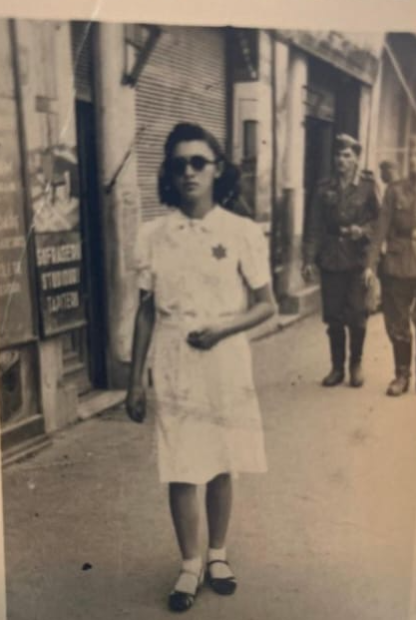
Her dress is lightly pleated, falling just below her knees. She sports fashionable sunglasses, white socks neatly folded over, and black Mary Janes. Behind her, if you study the photograph well enough, as I have, you can see three German soldiers, two walking. One seems to be eyeing her with his gaze. A large star, the Star of David that Jews were required to wear in public, sits on her lapel. A professional strutter, she walks with one arm pleasantly bent at the waist, as though posing for the person who was taking the picture—most likely one of her sisters.
Bubbeh continued to complain, eventually almost ceaselessly towards the end of her life. She was ready to go, she would say, looking you straight in the eye, trying to elicit a response. She died in her bed, with my mother, her only child, close by, tending to housework in another room in the house.
My mother once told me that her mother had confessed to having fallen in love at some point with a German soldier. He kept showing up at her house in Romania, asking for her. Her father chased him away. I don’t know how to integrate this information alongside everything else I know of her, the melancholic force who still sometimes appears. I want to ask this apparition if it’s true, and whether one of the soldiers in the photograph is the same one. I want to ask for the source of her chronic discomfort.
At other times, the ghost of my other grandmother, Raya, emerges. The words she said to my father, in the final days of her life, when she was still fighting with everything to stay alive just one more day, echo in my ears:
“I’m not ready to go. Life is too beautiful.”
*
Recently, in the hours following the one-year anniversary of Bubbeh’s burial, her unveiling, I found myself seated in a car with my mother, waiting for a train that wasn’t scheduled to arrive for at least half an hour. I took advantage of our time together to shower her with questions—I had been interrogating her and my father endlessly about their mothers, especially in the year since they’d both been gone.
In the car my mother told me about an incident involving Bubbeh, which had occurred when she was somewhere in her late seventies. “She was caught stealing from a Lord and Taylor,” she told me. “She stole a shirt. I came to pick her up. They put her picture on display in the security room and wouldn’t let her return for four years. It had been her favorite place.
When I asked her, she said she didn’t know why she had done it.”
Somehow, after this admission, the conversation turned to my other grandmother.
“She was always stealing,” my mother recalled, her voice slightly softened as she went from remembering her mother to remembering her mother-in-law. “For as long as I knew her. I remember how once we went to a store, a home goods store, and she saw a plate she liked. She dropped it into her purse, like it was nothing, and kept on walking.”
“Another time,” she said, “we were in the middle of a pharmacy with your father, and I showed her a mascara brush I liked. She snatched it; it disappeared. I made your dad get it from her so he could pay for it.”
Though I had never before thought of it, exactly, as theft, I remembered Grandma Raya’s pilfering well. Once, when I met up with her fresh off the train in the lobby of a hotel in Atlantic City, she greeted me thus: “You want some shrimp? I have lots of shrimp in my purse.” It was an anecdote I often cited with amusement, in line with what I saw as her resourcefulness, her ever alertness.
She always had swiped items in her bag, more than I could have kept track of, and in her apartment, too, I sometimes found them: soaps and shampoo bottles and magazines, taken from hotel bathrooms, from waiting rooms. There were also more valuable things, including a fair amount of towels of all colors and sizes, dishes and knick-knacks, too. Lots of items that could have been missed.
One of the stories she used to tell me of her life in the old country, when she was forever—as she described it—singlehandedly saving her family from the ravages of poverty, involved a loaf of bread. They were starving, and her father was away in the army for years at a time. She was sixteen, small, and easily swiped the bread from a vendor in town. By the time she returned home, breathless, her mother’s eyes wide when she saw what her daughter had procured, she was convinced she had been followed. She told her mother to answer the door. Sure enough, the police started banging, and upon entering they turned over every piece of furniture, every last item, however little there was in that modest place they called home. Eventually, tired and defeated, the officers left empty handed. Stunned. They had been certain of what they’d seen, but there were no traces of evidence.
“Did I dream it?” her mother asked once they’d left.
My young grandmother, waiting until she was sure everyone was well out of the vicinity, ran to the field behind the house. She had chucked the bread out a window when the knocks first came; she had thrown it as far as she could. It would take hours of searching in the dark to find, but eventually she would. There was the loaf, untouched, enough bread to nourish a family.
*
There’s a photograph of my grandmothers, the only one I can find of the two of them alone together. They look, here, like they might have been, however briefly, friends.
They’re standing in front of a suburban home I recognize as the first house I ever lived in. As my mother tells me, it’s April, and they’re visiting for Passover. They are both far from the places in which they were born, both far from the families who raised them. They are also, each, uncoupled, orphaned husbands nowhere to be found.
In the photo, they’re wearing matching long fur coats, and boots, standing together in the snow. Their arms are linked, their other hands warming inside pockets.
I have never seen them so casually, or cheerfully, side by side.

I want to say that my grandmothers are linked in all kinds of ways, ways that I, with my limited experience and imagination, cannot begin to comprehend. They’re linked through regrets, and opportunities lost; through the adoration they passed on, however complicated and conflicted, to their children, and grandchildren. They’re linked, too, in the secrets they carried, and in the stories never passed along. And I am linked to them, in endless, unpredictable ways.
Lately, since their deaths, I’ve begun to see I’m so tuned in to the past that I’m constantly in my own way, taking myself out of the present. I, too, am a thief. I have stolen their stories, filched them without permission to turn over for my own use. It’s a mode that’s been passed along, a way for me to feel like the heroine of my own life.
For a long time, when I wasn’t listening to my grandmothers’ stories, I lived mainly in music and in books. Once, as a teen, maybe even just a pre-teen, I was in a music store at a local mall. In those days, the late 1980s/early 1990s, cassette tapes were often encased in large anti-theft devices. These were usually made of clear plastic, and you could hold them in your hand like a stiff, pointed purse. Each had to be removed by the cashier with a special magnetic device that released the rectangular cassette tape held within.
I remember leaving the store, walking mindlessly through the mall. I was alone, or if anyone was by my side, I don’t remember it. In my hand, I suddenly realized, was a cassette tape I had deliberated over, then decided not to purchase. It was still in its protective casing, the handle perfectly cradled in my palm.
I was halfway out the building. I could see the heavy glass doors leading out onto the street, and I could have easily gone free.
Instead, I quickly turned back, experiencing a sudden, hefty feeling of guilt. Though I hadn’t intended to take the tape, this feeling was, perhaps, no different from that experienced by someone who had intentionally stolen something they desperately wanted, something they felt they rightly deserved but gotten caught in the process.
Though I hadn’t gotten caught, and instead returned the tape to a mostly disinterested cashier, for a stretch afterwards I carried with me that guilt—for months, for years, even. For the longest time, simply calling that scene to mind filled me with a deep, unshakable sense of shame and dread.
*
Now that both of my grandmothers are dead, something has loosened within me, something I never fully realized I have been carrying with me all along. In writing this, I have asserted my role. I have taken their material—the best each of them gave me—and, by threading it all together, I have made it mine. I am now the lone storyteller.
This is who I am, or who I have become. Born a listener, here now are my articulations of all they had in common, and all that distinguished them. Their will, their depression. Their anxiety, their luck.
I judge my life, at forty-five, by theirs, only recently ended, mapping my actions and behaviors onto what I know of theirs. In my grief I steal from their griefs. It feels good to loosen control, to walk confidently through those doors.
My thefts, like theirs, bear traces of the impulse to survive against all odds. Stories helped them live, but only after that existence was no longer in constant peril.
I present these stolen items now, rearranged to better suit me. I am trying to pin myself down, the girl who once was but is no longer between them.
I am wondering what year this photograph was taken. I am wondering where, in that moment, I might have been.

Tahneer Oksman (tahneeroksman.com) is a writer, teacher, and scholar, with a specialization in memoir studies. She is author of “How Come Boys Get to Keep Their Noses?”: Women and Jewish American Identity in Contemporary Graphic Memoirs, and co-editor of Feminists Reclaim Mentorship: An Anthology. Tahneer is Associate Professor in the Department of Writing, Literature, and Language, with a joint appointment in the Department of Communication and Media Arts at Marymount Manhattan College in New York City, where she teaches classes in writing, literature and comics, and journalism. She regularly writes and delivers talks for both academic and public audiences on her topics of interest.


