

I.
My dad tells us about the Hindenburg while we’re following the Goodyear blimp on our way to the dump. We’re in the back seat of the old red Saab, my brother and me, strapped into our super-duper seatbelt contraptions, the ones my dad bought at Sears, the ones that crisscross over our chests and pin us there to the cracked vinyl seats, the seats that smell of my dad’s Vantage cigarette smoke, cut with the spice of the pink Canada mints he keeps up near the emergency brake.
Even though he straps us in with the super-duper seat belt contraptions, even though he pulls the straps so hard we can’t catch our breath, even though he’s aways telling us to cover our heads if we fall; “you can live without an arm or a leg,” he says, “but you can’t live without your brains,” even with all of this he still picks up random hitchhikers while we fidget in the back seat, and he still drag races up the highway while we’re on our way to Maine each summer.
The Goodyear is on its way from downtown Boston, from taking arial shots of Fenway Park, and making its way out here to the suburbs, to Hanscom Air Force Base, which is next to the dump. It seems like every Saturday now we are following the Goodyear on the way to the dump.
It wasn’t that long ago that Gerald Ford flew into Hanscom for the bicentennial, came to watch the parade downtown, the one where all the girls had to wear Betsy Ross mop caps and carry Betsy Ross flags, while the boys got to wear tricornered hats and carry fake wooden muskets.
This is Lexington, Mass, where it all started, the “birthplace of American liberty.” Every Patriot’s Day we are supposed to get up at 4:00 am to make it to the historically accurate 5:00 am battle reenactment, where the Redcoats line up in formation, regimented lines of bright red British uniforms with bright brass buttons. The Minutemen though, wear regular farmer’s clothes, and later in the day they will hide behind buildings and bushes and rocks, blend in with their surroundings. The original guerrilla warfare, I read once, was devised by the Minutemen of Lexington, though I’m not sure that’s true. The Minutemen are led by Captain John Parker, with his famous call, “Don’t fire unless fired upon, but if they mean to have a war, let it begin here.”
No one knows, still, who fired the first shot.
While we’re following the Goodyear my dad tells us about all the people on board the Hindenburg and who escaped and who didn’t and about how it never would’ve blown up if it hadn’t been for the weather and all the delays. He makes you wonder about every small decision, the decision to fly, to linger, to land, to tack and wrangle the ropes. Every decision of every passenger and crew member, those who jumped and those who hung on. “Oh, the humanity!” the radio announcer cries, anguished. In my dad’s telling you can hear the whip of wind and feel the burst of flame and see the falling ash and smell the acrid smoke. He tells us, too, about the possibility of sabotage, about the possibility of Nazis on board.
He is always talking to us about Nazis, and Stalin, and Rasputin.
Later, he talks to us about Pol Pot and Idi Amin, too, but by then we have a different car, a bright Yellow Le Car that he won in a Poker game, or that’s what he lets us believe, anyway.
When he talks about Rasputin, you can almost smell the “mad monk’s” scraggly unwashed beard and you wonder why a princess would fall under his spell the way she did. But my dad says people do desperate things when they are trying to save their children. Still, he lets us know he expects us not to fall for charlatans, not now and not ever. Later, he tells us about Stalin and the purges so vividly that we wonder if we would have had the courage to resist informing on our friends and neighbors. This is always his lesson. Don’t assume you would do the right thing. Don’t assume you would act with courage. It’s always more complicated than you think.
II.
The Le Car has a sunroof and a tape deck, Fleetwood Mac’s Rumours stuck inside, clicking on each time the car starts, over and over, the soundtrack to my parents’ final years together, “I can still hear you saying you would never, never break the chain.”
Michael is 10 and I am 12 when they announce the divorce to us at the dining table, and at first, I think they are joking. It’s like the time my dad told us about the great molasses flood, how that vat of molasses had exploded, sending great waves of sticky goo through Boston’s North End, the smell of burning sugar, how people and horses were sucked under, how the smell lingered for years afterwards, how some people say you can still smell it on extra hot summer days.
When he first told us that story, I thought he was joking, that it was too ridiculous to be true. But then I’d realized he wasn’t using his joking around voice.
It’s exactly like that with the divorce, from smiling at the ridiculousness of it all to the slow realization that it’s true, we’re about to get sucked under a muck we can’t escape from.
Afterwards we are sent to Maine to live with our grandparents for three in weeks in their house by the cove. The house has a big picture window that overlooks the Lupine field and the cove below, dotted with bright pot buoys bobbing against whitecaps, the red nun buoy standing tall in the distance. There are all the classic Maine things, the slow morning chug of lobster boats, the magic sweet of pine mixed with sharp sea brine. We dig for clams to bait our droplines and fish for mackerel for dinner. We ride the waves to Boothbay Harbor for saltwater taffy and ice cream.
My parents had never argued, except about French grammar and word derivations, but those weren’t real arguments, of course. My mom stayed at home, sewing our clothes and baking bread from scratch, walking with us to the East Branch Library and the secondhand bookshop and to the food co-op, where we would mix our oily all-natural peanut butter. She didn’t drive, so we walked or took the #77 bus everywhere we needed to go.
My dad worked from his office in the basement, a self-employed headhunter, matching job seekers with the new tech jobs out on Route 128, his unpredictable income augmented by Poker nights and pool hall winnings. Some weeks were flush – Charlie’s pizza and Brigham’s ice cream cones and Pu Pu Platters at the Aku Aku in Fresh Pond Circle — and others it was back to powdered milk and baked tuna balls for dinner.
Even when we were broke, we didn’t fully know it. We camped on the floor in front of the fireplace when the furnace was dry. We made our own board games out of cardboard and magic markers. We made donuts together on Sunday mornings when the rest of the neighborhood was at church, and slow simmered baked beans in the afternoons. My dad made an indoor hopscotch board from masking tape set down on the hardwood floors. He rigged up a wooden police car frame, painted blue and white, complete with a working siren, that fit on top of our Big Wheel so we could zip up and down the street with the neighborhood gang, all of us taking turns blasting the siren and flashing its lights.
Later, we had all the key Star Wars figurines, molded by my dad in plaster of Paris, hand painted in painstaking detail, and those same figures jig sawed out of plywood and painted just as carefully.
We had a full-size playhouse made of plywood, too, a perfect replica of our own house, white with red shutters and a red front door. In the real house we had books on two tall shelves on either side of the fireplace, Ms. Magazines on the end tables, plus a dictionary stand and a special shelf for our Collier’s encyclopedias, and a record player that played Bach and Beethoven, Handel and Haydn, The Beatles, Jimi Hendrix, The 5th Dimension and the Stones, Free to Be You and Me, Bambi, and one Bill Cosby record.
The dining room was plastered floor to ceiling with our own colorful artwork, magic marker flowers and houses and Christmas trees, cats and dogs and families made of four people, all colored on old Xerox paper and taped to the walls. Cut out snowflakes and paper doll chains, too. Construction paper Valentines with accordion arms and legs. At Easter my mom would puncture the tops and bottoms of a dozen eggs with a pin, and we would blow out the yolks and carefully paint and shellac each one, so they’d last for years. On special occasions, we would make cheese fondue and dim the lights and dip our homemade bread into the cheesy pot with long forks while the Sterno flickered below.
My dad was our Little League coach, and during the tee ball years he let every kid play every position, let every kid get a turn at bat. We lost every game, but by the time we got to farm league we were champions, and then again and again for years, racking up trophies for the homemade shelves our dad built for us.
Our parents were the hippy parents of the neighborhood, my dad’s hair curled over his ears, we didn’t go to church on Sundays, we had a huge overgrown vegetable garden out back, our grass grew tall, the rules were lax. Once, during a neighborhood Halloween party hosted at our house, my dad filled a bunch of cupcake wrappers with whipped cream and let all of us kids try to pelt him with it. He stood behind an imaginary line and made funny faces at us, sticking out his tongue and raising his eyebrows and jamming his thumbs into his ears while wriggling his fingers in the air, a teasing wave. We had a great time, flinging those cupcake wrappers at him, and occasionally, when he let us, making contact. Afterwards, another neighborhood parent accused him of “undermining parental authority.”
When I say there weren’t many rules, what I mean is that my parents were not strict, except about the following: table manners, junk food, teeth brushing, and book reading. Also, grammar. One time, sick with a fever, I told my mom, “I don’t feel good.” “You don’t feel well,” she corrected me, though she did bring me the thermometer, a cold glass of frozen concentrate orange juice, and her famous sweet and buttery cinnamon toast, cut into narrow strips to make it taste even better.
But the important thing was, we were together, the four of us, almost all the time.
Until they decided we needed more money. Until my dad went to work for Data General and my mom to Perkins School for the Blind. That’s when the other people creeped in, the dancer, the psychologist, and cleaved the whole thing apart.
The summer before the divorce my grandfather penciled all our names on the inside of the cellar door of the house in Maine, his and my grandmother’s, my brother’s and mine, and my parents’. He wrote “Joe loves Peg loves Joe,” all up and down in a row so read backwards or forwards, they still loved each other. The same for my brother and me, “Andrea loves Michael loves Andrea.” And for my parents, “Paul loves Marge loves Paul.”
Now these words are painted over with a thin coat of white paint, just the faintest trace of them left behind, the glimmer of a past life.
III.
My dad gave up the Vantage cigarettes, switched to Winstons, was missing for a lot of our teen years but came back around later, became the world’s number one grandfather. Until the cigarettes caught up with him. He died on the makeshift hospital bed in my living room in Maine, a few days shy of Patriot’s Day 2014. We’d first noticed his illness on Patriot’s Day of 2013, when we’d headed to Boston to do all the Boston things but had instead wound up on lockdown in my mom’s Cambridge condo after the bombs went off at the finish line. Normally in a crisis, my dad would fill the water bottles and check the flashlight batteries, normally he’d crack silly jokes to try to distract from the worry, but he did none of that, not even when he broke curfew to go out and look around and found that everything had been ordered closed except the packie and Dunkin’ Donuts. There it was, every last business shuttered but the liquor store and Dunkin’ Donuts, the most Boston of Boston cliches, ten easy jokes there for the taking, but he reported the information in a straight voice, and I knew immediately something was wrong.
IV.
Now, ten years after his death and one month after Trump’s election to a second term, I still can’t believe my dad has missed it all, this new rise to power, all the ways everyday people did and did not react, all the ways we did and did not act with courage. It was the case study he’d always wanted, a chance to solve the mystery: why do people fall for charlatans, why are they swayed by strongmen, tyrants, dictators, and despots?
Now that it comes down, once again, to the red caps versus the pink hats, I’m afraid that I have lost my fight; that I won’t dig out the poster board and take to the streets again; that I will once and for all finally relinquish my emails to my longtime senator Susan Collins, it never seems to make a difference anyway; that I’ll stop following the news as we slip into Gilead.
My friend Jodi says she’s going to focus on building relationships with all her neighbors, and I think of that study I read recently that something like half of U.S. citizens don’t trust their neighbors and of course I lay that at the feet of Fox news and the gun lobby.
What are you supposed to do, I ask my brother, when someone falls for a cult, and he says you are supposed to treat them with compassion, but I have no more room for compassion. I need to hang onto my anger; it would be too easy to slip into walks in the woods, ruffling through the fallen leaves, inhaling the sweet citrus scent of pine and spruce and fir, catching a glimpse of the western sky at sunset, and the briny breeze from the river that winds its way twelve miles, past oysters farms and osprey nests, to the Gulf of Maine and open sea.
Last week the Maine Supreme Court ruled in favor of more public beach access after a family from New Jersey moved here and tried to keep the locals from walking in front of their house. A few months back a wealthy family from Missouri poisoned the trees of some of L.L. Bean family members so that they could get a better view of the harbor and now all the chemicals have leached into the water.
I can’t stop thinking about Jodi’s plan, about building relationships with our neighbors. That this might be the answer to everything. I mean, if you know your neighbors, you’re probably a lot less likely to poison their trees or watch and do nothing as they’re sent to the gulag.
V.
In the summer I live at my grandparents’ old house in the cove, where the beach is shared by my cousins and three neighbors. We jump off the dock and float on fluorescent green floaties and look for shells and sea glass and drag the kayaks down the ramp and paddle out to the red nun buoy and back, or sometimes over to Witch Island, which is named that because it was once owned by an early female Wall Street investor, a woman who did so well that it was blamed on witchcraft. The Witch of Wall Street, she was called. Mostly though I just paddle out into the middle of the cove and lean back and let myself float where the currents will take me, I let the gentle waves rock me, I listen to them lap against the shore, it’s almost like a breathing exercise, listening to the waves break gently over the sand at low tide. I inhale the salt; let it tickle the sides of my tongue. I watch for the seals who sometimes pop up out of ripples, they never break eye contact, their faces like puppies, until sometimes they roll over and show you their undersides, just like puppies, too. They dive and resurface, flirting in a way, and you can lose yourself there in the wonder of it all.
VI.
I can’t let myself get lost in nature bathing and practiced breathing, I need to stay ready for action. I’m just so tired. This is what they want, I read over and over, they want to distract us, they want us to succumb to fatigue.
VII.
My son Isaac was seven years old in 2009 when we started our annual pilgrimages back to Massachusetts for Patriot’s Day weekend, except we always skipped the 5:00 am Lexington reenactment and headed straight to Concord, which starts at a much more civilized 9:00 am. We’d drive down on a Friday night, check into the Concord Inn, where we’d eat clam chowder and grilled cheese in the dark tavern. I’d sip a Malbec while Isaac threw back a heady root beer and we’d retire to our lumpy beds. In the morning we’d join the throngs marching through town and toward the Old North Bridge so we could watch Redcoats and Minutemen shoot at the air, because while we are okay letting schoolchildren cower behind desks in real life, there are, apparently, strict rules about not firing pretend rifles on national park land.
After the reenactment we will head back downtown to the toy store that sells fancy plastic knights, and then next door to Lexington, where we will stare at the huge wall of jellybeans at Candy Castle, debating between green apple and pina colada, key lime and cherry. The decision feels impossible. We will visit the old belfry behind the main library, read the plaque under John Parker’s statue, swing by Tower Park for the 2:00 pm reenactment in which the reenactors are allowed to point their guns at each other, to shoot from behind stonewalls and bushes, to pretend to die. East down Mass Ave, past the East Branch Library, past the old neighborhood, past the secondhand bookshop and the #77 bus depot, making our way toward my mom’s condo in Cambridge, retracing the route of the Redcoats’ retreat.
The thing is, it wasn’t until I started taking Isaac to the Concord reenactment that I really thought about what happened at Lexington, which is that we lost. We lost, and that’s why the British kept marching toward Concord. There was some mix of hometown pride and natural aversion to stories involving men and their guns that had prevented me from following the throughline. It wasn’t the troops in my own town who turned the Redcoats back, it was our next-door neighbors.
VIII.
One night, just before the election, I open the door to let the dog out and notice my neighbor Randy staring up at the sky behind our houses. “Look at that,” he says, “It’s the Northern Lights.” And I look up and see the swirl of pink and we stand there together for a time. “Meghan called and told me about it,” he says. We start wandering toward the head of our dead-end street for a better view, and we see Laura and Jade standing outside their house, too, with cameras. We whisper and watch as the colors deepen, then haze. Oranges and reds and hot pinks and twinges of green, white strobes of light tunneling toward us. Laura says, “I think I’ll go get Kristie and Kevin,” and she wanders across the street and taps on their door and they come out, pushing their arms through coat sleeves as they make their way toward us and we all tilt our heads up together.
Somewhere up there is my dad, his particles swirling in the mix with all the other particles of all the other people, the Hindenburg passengers, the redcoats, the minutemen, Captain John Parker, and yes, Rasputin and Stalin and all the rest of them too, all of us made of the same stardust. We fall to earth and rise again, we are carried by the rivers and the streams and the sea, we are lifted on an afternoon breeze or sink into the soil to grow a daisy. We turn to nectar and dew.
IX.
I read once that 30% of all people at any given point in history bend toward fascism. Did my dad know this when he was warning us all those years ago, or did he just feel it in his gut?
X.
Three months into this new second Trump administration, the pope has died. Pope Francis, the most progressive pope in a long while. Fighting for immigrants and climate justice. My aunt emails my brother, a few of our cousins, and me. She tells us that the pope’s grandmother shares our last name. That she is from the same region of Italy that we are from. I watch images on the screen of Trump attending the funeral in a blue suit. My aunt sends an article about Rosa, the pope’s grandmother, the one with the same last name as ours, the one with whom, presumably, we have some shared shred of DNA.
I wonder if that’s all it comes down to, a thread of DNA that pays close attention to injustice, to the threat of concentrated power. The article says Rosa and her husband owned a café in Turin. That they fled to Argentina to escape Mussolini. That the first ship they were set to depart on sank off the coast of Brazil, and that when they finally made it on a second ship, they arrived under the blazing Buenos Aires sun, Rosa wearing a full-length fox trimmed coat, all their life savings sewn into its lining.
And I wonder how they found the courage to leave, and how did they know when to do it? And I wonder, which of their neighbors followed suit, and which of them had already left, and how did they warn each other? What secret communications did they have?
XI.
Last week, ICE nabbed a mother in Portland, Maine who was dropping her child at school. They followed her home and dragged her off, away from her other children who were watching from an upstairs window. It’s not been long since Christmas. She was wearing a sweatshirt that said, “Cookie Baking Crew.”
I call my friend C. “They hauled off a mom wearing a ‘Cookie Baking Crew’ sweatshirt,” I say.
Today I think I better drive to the hardware store, price out gas masks and eye protection, buy myself a whistle.
I think of the supplies my dad used to store in the cellar, bottled water, cans and cans of tuna fish, a gas mask, but just one. I often wondered what good one gas mask would do for our family of four, but I never asked.
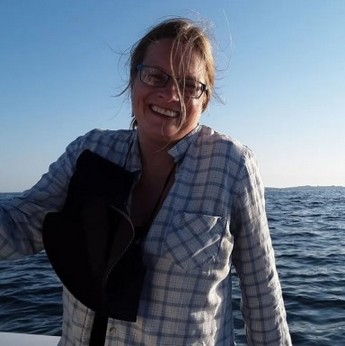
Andrea Vassallo is a 2020 graduate of the Stonecoast MFA Program. She has been named a Maine Literary Awards finalist, a Pushcart nominee, and a Best American Essays notable. In 2024, her essay collection, Home State, was named a runner-up in the Maine Chapbook Series contest. Her work has appeared in Solstice, Stonecoast Review, Multiplicity Magazine and others. She lives on the coast of Maine.


