

Each day a stream of new lost souls succeeds
the last. I number the innumerable hosts
in triplicate. My office door should read:
“Through me the road unto a town of ghosts;
through me the way to join an endless war;
through me a path among the Lost Almosts:
Abandon hope, all ye who enter here.”
But what it really says is “U.S. Eng-
rs,” an unlikely ensign to inspire
the many tribes of man, that motley bunch
of carpenters, machinists, plumbers, cooks,
barbers, statisticians, butchers, spooks, trench
diggers, metallurgists, welders, WACs,
doctors, draftsmen, scientists, and wives
who wash up on my doorstep among stacks
of suitcases and trunks, some only half alive,
some screaming for a missing Van de Graff
or Steinway grand. Most, thinking they’ve arrived
at last, collapse into a chair and, only half
in jest, refuse to budge. “You’re nearly there!”
I point out, brightly, earning a dark laugh.
“Bus leaving for the wilderness up yonder!”
I hustle them outside and pack them in
the Army’s surplus schoolbus. The GI driver
ties the front door handle shut and grins.
“The General hisself said I mustn’t lose ’em.
Seems they’re scarce.” I wave and they begin
the long descent, as the desert’s dusky hues send
purple shadows up the Pecos and
the Jemez float in gold. Where Santa Cruz bends
to meet the waters of the Rio Grande
in Nambe valley, they will turn to climb
the dark escarpment, over coral sand-
stone and old lava beds, white pumice, time-
etched tuff, along a road scrimshandered
in the bones of what one tired soldier termed,
“That beat-up land.” But my horizon’s bounded
by mops and mirrors, boxes, bags, and parcels,
cots, cribs, potted plants, and candles. Stranded
here on earth, I sort and catalog the mortal
fragments of a flock of scientific gods.
I man the gate, forever at the portal,
paused, poised to ferry, usher, prop, or guide.
I’m operator, concierge, den mother,
babysitter, bus stop, getter of rare goods,
dog walker, comforter, solver of other
people’s problems, everyone’s best friend.
Fractured by war, which one of us knows whether
we’re doing right? I cannot guess what ends
they’re aiming for, or if they will succeed,
but I believe they’ll make me whole again.
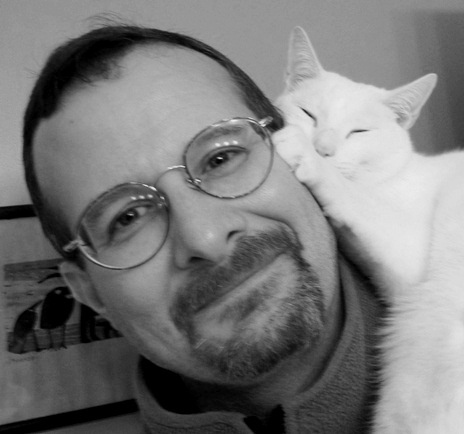
John Canaday’s poems have appeared in Poetry, The New Republic, Raritan, The Hudson Review, Slate, The Paris Review, and The Bulletin of the Atomic Scientists, among other journals and anthologies. The Invisible World, a book of poems set in the Middle East and New England, won the Walt Whitman Award from the Academy of American Poets. He is also the author of a critical study, The Nuclear Muse: Literature, Physics, and the First Atomic Bombs. “Dorothy McKibben: Gatekeeper” and “Brigadier General Thomas Farrell Bears Witness” are from Critical Assembly, a collection of poems in the voices of the men and women—scientists, spouses, locals, and military personnel—involved in the Manhattan Project.


