

A total eclipse of the sun illuminates the order of the cosmos.
Eclipses should reassure humans that the solar system on which our lives rely is extremely reliable. Gravity and orbits are so trustworthy that eclipses can be predicted centuries ahead of time, right to the second they will begin, the moment and duration of totality, and the second they will end. The pathways of eclipses across Earth are predictable to exact borderlines and centerlines, along thousands of miles. The reliability of the solar system means that people can make reliable plans, months or years ahead, to meet an eclipse, to travel hundreds or thousands of miles and place themselves on the exact centerline for the longest duration of totality. Eclipses can remind humans that our lives are part of something much greater than ourselves, a graceful dance of the sun and moon and Earth, an ancient and majestic cosmos.
And yet, for most of our history humans saw eclipses as outbreaks of chaos, the end of the world, terrifying.
The cemetery was aligned with the sky.
The long lanes, a dozen of them, ran north-south, and the cross lanes ran east-west. The gravestones were aligned with the north-south lanes, long lines of gravestones, nearly straight lines, pointing to the North Pole, all of them facing west. When the sun sets, a line of light creeps up the gravestones, the light reaching into the inscriptions more deeply than it had at noon, light fingers tracing names, trying to grasp them, not wanting to surrender them to darkness, but the line of light exists only because of the shadow accompanying it, shadows rising out of the grave, climbing up the gravestones, until darkness claims these lives, again. Yet this ritual testifies, like the precisely ordered stones of Stonehenge, to the precise order of the cosmos. The gravestones are performing eclipses every evening.
This cemetery was a miniature version of towns across America, which were plotted with long straight streets, with grids of square, equally sized blocks, often aligned north-south and east-west. In Europe many cities had grown haphazardly, their streets obeying the curving rivers or coastlines that had founded and shaped these cities, streets crooked and horse-narrow, oblivious to the straight-ahead logic of future trains and automobiles. American towns were designed rationally, for we were an Enlightenment nation, reflecting a rational God who designed the solar system with Newtonian order, and our towns were miniature solar systems, ready for bigger and better futures.
Yet the westernmost lane of this cemetery was not north-south but ran at a northeasterly direction, for it closely followed the railroad tracks of the Frisco Line, which ran as straight as possible from Oklahoma City to here, Quanah, Texas, and a few miles further to the town of Acme, whose huge gypsum deposit gave rise to the largest cement plaster factory in the country. Today Acme was a ghost town, and some of its ghosts lived here in the Quanah cemetery. Quanah has a mile-wide grid of streets and square blocks with orderly names from First Street to Sixteenth Street, but it was not aligned north-south and east-west. It was crooked. It was aligned with the railroad tracks, mainly the tracks of the Fort Worth and Denver City Railroad, which ran as straight as possible from Ft. Worth towards Colorado and its mines, many abandoned long ago. The Frisco and FW&DC tracks met at a railroad-correct right angle but an angle that aligned the entire town with economics and not the sky, with Texas beef and not Taurus the bull constellation.
The cemetery defied money and declared that your ultimate destination was not a town full of economic decline and struggle, a town that has lost half its population since 1950, but an alignment with heaven. Some of the gravestones declared appointments with God.
Thus, I was walking in straight lines, like the trackway that a few days ago had delivered the moon and its shadow to the precise alignment where it was supposed to be. I was searching for the grave of an Apollo astronaut who was supposed to fly to the moon on a perfect alignment and walk a straight line through asteroid rubble but who died when he crashed his car into the earth, like an asteroid.
The moon’s perfectly reliable speed and rotation and orbit and eclipse schedule, and the moon’s perfect size and distance for covering the sun perfectly, may not be the entire story. In the last moments before the moon finally covers the sun, there are flickers of light around the moon’s edges, where sunlight is flowing through valleys between mountains and crater rims. The moon is far from being a perfect ball. The moon is saturated with craters, some of them dozens of miles wide and more than a mile deep. With no atmosphere to defend itself against asteroids and no waters to heal wounds, the moon holds billions of years of craters and impact debris.
From an astronomical perspective, this chaos could still be counted as order. An asteroid of a specific size will fall with a predictable velocity and hit the ground with a predictable force, smashing out a hole of predictable width and depth, throwing rubble predictable distances. An asteroid twenty-five miles wide should leave a crater thirty-two miles wide, with rims two or three thousand feet tall, with a debris field hundreds of miles wide. Astronomers might even be able to diagnose the direction from which the asteroid arrived.
Yet it’s unlikely the dinosaurs would define asteroid impacts as proof of an orderly cosmos. Nor would the millions of other species obliterated by asteroids, not even enduring as fossils or dinosaur fame. They experienced only the ground shaking, the sky pouring down debris and going dark and cold, their food dying out. Astronomical order can leave little room for biological order, can become chaos, velocities getting translated as suffering and death and extinction.
Ed Givens died because he believed in straight lines. He believed America was an Enlightenment nation, a microcosm of the Newtonian macrocosm. He was acting as if streets were plotted rationally, like the streets in the Quanah cemetery, like the rows of gravestones. Even Quanah’s streets, if askew from the compass, ran straight from end to end.
In June 1967, Givens was training to fly to the moon, and one evening he attended a meeting of a pilot’s fraternal order with the tongue-in-cheek name Ye Ancient and Secret Order of Quiet Airmen. Givens wasn’t drinking, for he had an important meeting early the next morning. When he left, he offered a ride to two Air Force pilots who had early-morning flight training, and they set off.
Recent showers had left the roads wet and steaming. Givens wanted to turn left to head for a Houston freeway, but heavy traffic trapped him in the wrong lane through several traffic lights, and when he finally turned left it was onto a minor road, Knapp Road, with few houses and no streetlights. Half a mile later there was no warning that the road was about to make an abrupt 90-degree turn, and in the dark Givens could not see the black skid marks from all the other drivers who had failed to recognize the turn. A small rise in the road pointed his headlights into the air, and when they pointed onto the road again, it was too late. He wasn’t speeding, but his brakes didn’t grab the slick road, and against thousands of hours of quick-thinking, machine-smart piloting skills, his car ran straight ahead and plunged into a wide drainage ditch four feet deep and slammed into the opposite bank. The passenger in the back seat was leaning on Ed’s front seat to talk and his weight pushed Ed’s seat forward even harder, slamming Ed into the steering wheel, crushing his chest and its organs. He died in the ambulance.
Drainage ditches exist because clouds are eager to return to the waiting room from which the sun god will resurrect them into clouds.
Humans look at clouds from both sides. When humans became farmers, clouds became sacred bringers of life, sent by the most important gods, encouraged by elaborate prayers and rituals. Clouds became blessing symbols in rock art and pottery. Lightning became justice. Yet in coastal areas like Houston, clouds became destruction—hurricanes and floods.
For eclipse seekers, clouds are evil. An hour of clouds can ruin long plans and travels. I learned this when I went all the way to Europe for an eclipse. I studied the eclipse route for a meaningful, poetic viewing location and selected the street where Albert Einstein was born in Ulm, Germany. An eclipse in 1919 had proven Einstein’s general theory of relativity and made him world famous as the revealer of subtle and strange cosmic order. But now chaos was heading for Einstein’s street, according to the TV weather forecasters and maps: heavy chances for rain. I studied the weather maps for better chances. All of Europe was looking poor but northeastern France seemed the least poor. I decided to make a run for it. Thinking I might benefit from wide-open public lands, I aimed for Verdun, for its battlefield park.
Instead of my eclipse being presided over by the Ulm cathedral, the world’s tallest church spire, just down the street from Einstein’s birthplace, it would be presided over by the tower of the ossuary that displayed the broken bones and skulls of some 130,000 men, bodies so artillery shattered and rain and mud rotted that they could not be identified. Outside, in long and very straight rows, were thousands and thousands of gravestones.
At eclipse time the sky was entombed in clouds. Most of Europe missed the eclipse. But with half an hour to go before totality the clouds parted and we saw the moon-parted sun and we watched the cosmos display its perfect motions and order, perfect totality. We were surrounded by the ghosts of chaos, of futile, mindless battle. Twenty minutes later the clouds returned for the rest of the day.
For an eclipse eighteen years later, my top priority was clear skies, so I selected the zone with the best chances for clear skies in an eclipse route crossing the entire United States, a zone of central Oregon safely away from coastal rains. This zone included John Day Fossil Beds National Monument, a badlands of odd shapes and colors, a suitably primordial setting for such a primordial event. The odd colors became even odder as the eclipse progressed. The odd colors were a graveyard full of mammals that had filled lands left empty by the dinosaurs, by an imperfect universe. The eclipse skies were tainted odder by forest fires a few dozen miles away, dismantling carbon into chaos. In other parts of the country the eclipse was rained out, rain that became sunflowers and luna moths.
For the eclipse of 2024, stretching from Texas to New England, I again made clear skies my decisive priority and selected a narrow zone in south Texas, the Edwards Plateau, which had the best chances for clear skies on the entire eclipse route, even if the Edwards Plateau was on the edge of the totality zone and offered a shorter duration than the centerline.
But two days before the eclipse, the weather forecasts turned upside down. A storm was coming out of the Gulf, and now Texas had the worse chances for clear skies, and predictably cloudy New England had the best chances. It was too late for me to change plans. On the eclipse morning I awoke to heavy clouds.
I was seeing the clouds from only one side now, as chaos, but of course I was imposing my own values, and only momentary values, onto them. For farmers and gardeners, April showers bring blessings. For Southwest ranchers enduring a drought, rain was urgently needed. For the Texas counties that had recently suffered the worst prairie fires in Texas history, clouds might have brought salvation. Back home, where I live in a log cabin in a forest prone to wildfires, clouds are always friends. But now I was condemning the clouds, and by extension condemning the entire planetary moisture system that had nourished life for eons, for the sake of one creature’s psychological goals.
The moon has no clouds and no rain, nothing to stop the boulders from watching Earth eclipse the sun, watching the perfect order of the cosmos. The moon has no rivers or fonts for baptisms, no way to save the boulders from an eternity in chaos.
The funeral service for Ed Givens was held in Quanah’s First Baptist Church on Main Street, aligned not with sunrises and sunsets but with the railroad. The pallbearers were six Apollo astronauts, including the crew of Apollo 7, which would be the first Apollo mission to fly. They were not supposed to be the first crew. The planned first crew had been killed four months ago in a fire in the command module during a ground test. These grim deaths of friends weighed on the six astronauts as they lifted Ed’s heavy coffin. Givens had been selected in the most recent group of astronauts, and NASA managers thought he was one of the most promising of all. These four deaths would reshuffle the prospects of all the other astronauts. The other three pallbearers, Thomas Stafford, John Young, and Eugene Cernan, would now become the crew of Apollo 10, the final practice for the moon landing, testing the lunar lander in lunar orbit. Young would go on to command Apollo 16, and Cernan Apollo 17, both walking on the moon.
For now, they only walked down the aisle of the First Baptist Church and down the stairs to the hearse, and then they walked from the hearse to the grave, walked on the soft earth and green grass, walked to a hole gouged not by asteroids, a hole not roughly round but carefully rectangular, aligned with the cosmos. These footsteps further imprinted in the astronauts’ minds the contrast between Earth and moon, so when they were walking on the dead grey dust and pebbles that hadn’t moved in a million years they were registering, if only subconsciously, that the moon held no green cemetery lawns and gravestones aligned with the cosmos but only asteroid graves, only boulders that never knew what it felt like to live and hope and die, never tasted the strangeness of the fates that sent some lives to their graves and others to the moon.
Cemeteries are history books, if only you can read them. For the families with graves here, the graves tell family stories, and for Quanah residents, the graves speak of town history. If I could see beyond mere names and dates and read the memories buried here, I would recall the last of the Commanche warriors, Quanah Parker, whose name, in a frequent American paradox, was proudly adopted by his enemies, as if Americans missed having deeper connections with the land. Decades later Quanah Parker, his spirit broken and absorbed, came to town and declared to a crowd: “I used to be a bad man. Now I am a citizen of the United States. I pay taxes the same as you people now…I hear somebody say something about Quanah; that not good country, all prairie dogs; all snakes. That not so. Quanah town good town…all nice houses in there.”
I could read the story of a Wild West town, with all its hopes and chaos. At the gravestone of Joe Earl (a misspelling of Joe Earle), “Slain by Indians, May 12, 1870,” I’d see the reason the cemetery was here, where he fell, and not somewhere else. I’d see the feuding Sheriff Jonathan Matthews and Texas Ranger William McDonald shooting one another. I’d see a bank cashier absconding with $47,500, bankrupting the bank. I’d see fires and floods, booms and busts and a long decline. The town remained. Ordinary lives went on.
Where is Ed Givens? I walked row after long row of graves.
He does have a room devoted to him at the county historical museum in the elegant old train depot. It tells how Ed’s grandfather came here in 1890 from the Tennessee hills to seek his fortune and worked in cattle drives to Dodge City, then opened a lumberyard. His son, born in 1904, was seriously late for the California gold rush but went prospecting there anyway, then returned to Quanah and became a bookkeeper and realtor. He married Helen, whom the town history describes as “a brash young schoolteacher,” and she gave birth to Ed in 1930. Astronauts tend to be both brash and smart. Ed caught airplane fever and worked at the grocery store and washed cars to earn money for flying lessons in a nearby town, to which he hitchhiked. He got into the U.S. Naval Academy, where one of his classmates was Tom Stafford, the start of a good friendship. Ed became a test pilot and instructor at Edwards Air Force Base, and one of his students was Tom Stafford, and soon they were astronauts working together. Ed invited Tom to ride with him to the club meeting from which he returned dead, but Tom had other commitments.
In 1977 Tom Stafford, veteran of four space flights, came to Quanah to dedicate the museum’s Givens history room. Stafford and NASA developed a substantial space museum in Stafford’s hometown, Weatherford, Oklahoma, but the Givens room gets few visitors, for Givens has largely been forgotten, seldom mentioned even in space history books.
I had a bit of a connection with Tom Stafford. Stafford’s dentist father shared a small Weatherford office building with an insurance salesmen named Malvern, who had four children, one of whom, Mary, married my uncle Nils. When I went through Weatherford I’d visit Mary’s sister Marjorie, who had been the high school secretary, working her way through college, when Tom was in high school. Marjorie fielded quite a few phone calls from Tom’s “hands-on” mother about Tom’s doings, some of which never got into his NASA public relations profile, such as him throwing firecrackers into the police station. Marjorie’s and Mary’s brother Donald also caught airplane fever and eventually became president of the aircraft division of McDonnell-Douglas, builder of the Mercury and Gemini space capsules —Tom Stafford flew two Gemini missions. Don Malvern earned this company presidency by being the project manager in charge of building the F-4 Phantom jet fighter. One evening in 1966 the huge building where both the Phantoms and Gemini capsules were assembled was shaken as if by an earthquake, and the roof was ripped open and debris rained down. Two astronauts, Eliot See and Charlie Bassett, coming to McDonnell for training, got disoriented in heavy fog and missed the nearby runway and struck the assembly building and crashed beside it, dying. Into NASA’s meticulous planning for who should go to the moon, chaos had intervened again. For minutes, no one was sure which of two astronaut jets had crashed. The jet that didn’t crash propelled Tom Stafford and Eugene Cernan towards carrying Ed Givens to his grave and propelled them to the moon.
A few days before the eclipse, Tom Stafford was buried in the Weatherford cemetery, near my Malvern relatives.
I was heading home through Quanah only because after the eclipse I had gone to visit my cousins, Mary Malvern’s children, who were also being visited by chaos. One cousin was going through a cancer ordeal, scheduled for radiation treatment during the eclipse. The other cousin was declining from kidney failure and would be dead four months later.
On my way to the eclipse, I’d paused beside a modest lake on which a few ducks and geese cruised. At night, the lake would record, but only in dementia waters, the moon’s orbiting and phasing. The geese took off.
Astronaut Theodore Freeman loved geese and often bicycled five miles to the bay to watch snow geese. Freeman was the only astronaut who bicycled to work at NASA, while others drove their silver Corvettes. The Italian journalist Oriana Fallaci, writing her inquiry into the Space Age, If the Sun Dies, was skeptical about America’s obsession with technology until she met Freeman, who bicycled because it immersed him in nature’s endless beauty, the same reason he flew planes into the beautiful sky. Freeman gushed on and on about wonderous nature and how he was sure the moon would not be an ugly desert but wondrously beautiful. One Saturday morning when he would usually bicycle to the bay to watch the snow geese, he needed to catch up on his flying time and took off in his T-38 jet. He was coming in for a landing when a flock of snow geese flew into his path and one goose smashed into his plexiglass canopy and shattered it, and the debris was sucked into the engines, which flamed out and failed. The goose shot into the unoccupied back seat of the cockpit and left a bloody crater. Freeman had only moments to eject but he saw that his jet was aiming at some houses, and he managed to maneuver towards an open field, but this kindness to strangers cost him his life.
I was surprised the Quanah cemetery was so large, maybe as populous as the town. If I had paused at the entrance map, which appeared to hold only lanes and numbers, I would have found that it did offer three names and grave locations, one of them Ed Givens. I only drove around awhile, then started walking, very long rows. Many names, only glimpses of stories.
I eventually found a cluster of Givens graves, three generations, aligned straight. Ed’s grandparents had lost two children before age five: “We loved her, yes we loved her, but angels loved her more, and they have gently called her to the golden shore.” Ed’s grandmother Rena died at age thirty-one, in the year between her two children. The town history reported of Mr. Givens: “So much sorrow in so short a time seemed to sap his energy, and it was only in his later years with his grandchildren that he seemed to really enjoy living again.” But one of those grandchildren, Ed’s younger brother Don, who followed Ed into the Air Force, was soon killed in a faulty-engine crash. It seemed that Ed and his wife Ada had two stillborn children, with only one date inscribed for each: “But those who hope in the Lord will renew their strength. They will soar on wings like eagles.” Here was Ada, who died at age fifty-one: “Jesus said come unto me, all ye who labor and are heavy laden, and I will give you rest.” And here was “Astronaut Edward Galen Givens.” No prayer.
No rest for the moon, no rest for billions of years, the moon now speeding towards its rendezvous with the sun.
There is rest for humans, but only because we wear out every day. When I awoke on eclipse morning, the sky was thoroughly cloudy. As I drove towards the totality zone eighty miles away, dark clouds continued streaming in. Yet when I got to the edge of totality at the town of Junction, the skies abruptly went mostly clear. I had planned to head further into the totality zone, but this was too good to leave.
I was in the correct galaxy anyway, for the local hamburger hangout was called The Milky Way. I ordered a milkshake; a very rare planet’s dirt transformed into grass transformed into cows transformed into nutrients for life. As I waited for the eclipse I explored the town, its mostly abandoned and decaying downtown and once-elegant hotel, and its historical museum, which explained that Noah’s Ark had passed overhead here and someone had accidentally dropped a hammer overboard, which American pioneers discovered.
When the eclipse began, the skies were mostly clear, but as the eclipse advanced, so did the clouds, and as totality approached, streaming bands of clouds continually hid or revealed the sun and moon.
As the moon advanced so steadily over the sun, I saw the order of the cosmos, the graceful motions always there but eclipsed by the usually cloudy human mind, the primordial motions that had become the motions of our cells and heartbeats and footsteps and music and mythologies, the motions of Apollo spacecraft to the moon.
On the moon I saw the footprints of twelve humans, and the ghosts of astronauts who were supposed to walk on the moon but who died on Earth.
I saw Theodore Freeman’s lunar lander touching down, the lander he named Snow Goose, his spacesuit bearing a mission patch showing a snow goose flying from Earth to the moon. Ted looks at the lunar surface, at nature’s genius and beauty, with awe. Later, to the cameras, he gets out a snow goose feather and his geology hammer and explains Galileo’s laws of mass and motion, and he releases the feather and hammer, and they drop at the same speed, and he declares: “How about that: Mr. Galileo was right!”
I also saw Ed Givens hovering over the lunar surface, searching for a safe landing spot and seeing chaos everywhere, craters and rubble everywhere, no straight lines anywhere, only curves, Knapp Road everywhere, steep ditches everywhere, craters like the Verdun battlefield, like skulls with empty eye sockets, seeing nothing. Momentum is pushing him forward, gravity is pulling him downward, and he is nearly out of fuel.
As totality started, the cloud bands were thicker than the gaps, but at least they were moving fast, so I got several views of totality, if hazy ones. My eclipse was being eclipsed. Cosmic order was being muffled by Earth disorder.
The perfect and majestic order of the cosmos, from the orbits of atoms to the orbits of planets and moons, from the strength of nuclei to the strength of stars, had married small and large perfections, married the geometries of atoms and solar systems into cells, but something had gone wrong, harmonies had given birth to disharmonies, to hunger and disease and accidents and death, to crooked roads and gravity-filled ditches, and to snow geese who loved to swim and fly, snow geese in whom the oblivious flight of the planets and moons had been accelerated into will and joy, but who remained oblivious that their flight might eclipse the flight of a human to that round white light shimmering on their home waters.
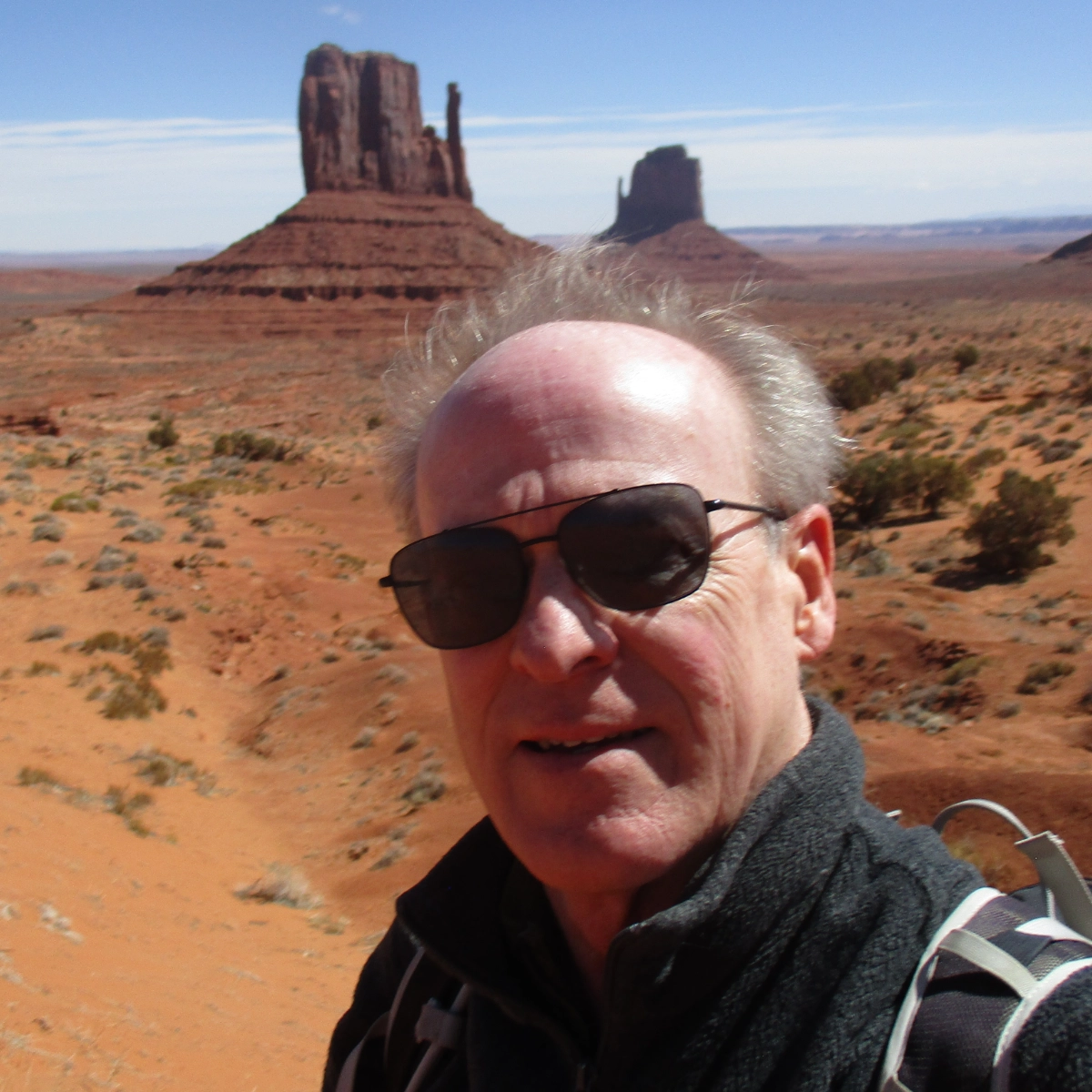
Don Lago is the author of Canyon and Cosmos: Searching for Human Identity in the Grand Canyon (University of Nevada Press, 2025), which uses the Grand Canyon as a Walden Pond for exploring the place of humans in the grand scheme of things. It includes Native American spirituality, as several tribes regard the canyon as their place of origin. He is also the author of other book of literary nature writing, including Where the Sky Touched the Earth: The Cosmological Landscapes of the Southwest, which holds a Monument Valley sunrise on the cover. He lives in a cabin in the forest outside Flagstaff, Arizona.


