

I leaf through an old world atlas my grandmother gave me when I was thirteen. Published in 1942, the red-brown cover is thick and hard, protecting a hefty five hundred pages. I’m intrigued by the countries whose boundaries have since relocated and the nations that no longer exist. In the eighty-plus years since the maps were compiled, islands have appeared and disappeared, mountains have changed shape, lakes have formed and dissolved. Through this, I understand that a map captures only one moment in time.
When I turned forty, I found a new primary care doctor, my first in over a decade. I recounted my history to her, so practiced and condensed now: first period at age ten, debilitating abdominal pain through my grade school and teen years, my first abdominal surgery at nineteen, subsequent diagnoses through my early twenties of endometriosis, fibroids, interstitial cystitis, vulvar vestibulitis, ovarian cysts; absence from school, absence from work, absence from life. Hormonal birth control to manage my cycle, then basilar migraines from the birth control, then stroke-like symptoms so no artificial hormones at all. Doctors decide this for me when I’m twenty-eight. In lieu of solutions, opioid painkillers are prescribed for fifteen years that somehow, miraculously, I never become addicted to. Children: zero. Pregnancies: zero. Trust in western medicine, in its endless insistence that I am abnormal and broken, in its chronic inability to fucking fix me: zero.
Mid-pandemic, and mid-winter, I move into a new apartment to reduce expenses. I meet my new neighborhood’s creek for the first time. The city has protected it and the wetlands adjacent to it by creating a long series of parks with trails, bridges, and raised wooden boardwalks. I introduce myself to a majestic old red cedar tree, then I stop halfway across a footbridge to look down at the water below me. I spend a while watching the quick flow, guessing it’s maybe ten feet deep, and wondering who decides what’s a creek, what’s a stream, or what’s a river.
I received my first COVID-19 vaccination from inside my car at the airport in Portland, Oregon. An entire unused economy parking lot was converted into a snaking system of traffic cones and stations. I was one of thousands of women whose menstrual cycle hiccupped after my first vaccine dose, and again after the second. When I asked my doctor about this blip and whether it was the vaccine or perimenopause, she looked at me, then squinted at my chart on her computer screen. “You’re…forty-two?” she asked through her medical facemask. I nodded in mine. “Well, it would be earlier than usual, but not unheard of.”
Through spring and a hot, rainless summer, I watch the creek waters shrink from fifteen to twenty feet across to about five or six. The late winter flow subsides, revealing a row of flat-topped stepping stones that allow a nimble-footed adventurer safe passage to the other side—though they are still left with a steep muddy bank to climb. I peer over the footbridge into my reflection in the water, dropping a leaf or a flower blossom to gauge how quickly it comes out the other side. At times, it is clear from the yellow-green pollen layer along the surface that the current has nearly stalled, the water’s movement imperceptible or nonexistent.
At each suburban trailhead there’s a map. Trails are indicated by yellow lines, water indicated by blue, a red pointer says YOU ARE HERE. In the corner, a warning: Some trails may close due to flooding in winter and spring.
The changes in my cycle were minimal at first: starting a day or two sooner in May, ending a day or two later in June. Then in July I was thirteen days late and bled intensely. In August came the change that surprised me the most: the sudden and inexplicable absence of pain. After thirty-two years of consistent pre-menstrual and mid-cycle agony, there was…nothing. Instead of the usual seven days of warning pain and ten days of cramping tended with heating pads and drugs and electrical stimulation, I simply…bled? I tried not to get too excited, but when September came, then October, without any pain even on my heaviest days, I secretly started to delight in what was happening.
The rainy season begins again in October. My walks along the trail see the creek picking up again, more water and faster movement. The winter “atmospheric rivers” arrive, the Pacific Northwest’s long waterways in the sky that drop inches upon inches of rain over the course of several days. In no time the stepping stones are submerged again as the water gets higher, deeper, faster. The creek gets loud enough to scare me a little.
After many months consulting with healers, wise women, and elders, I become confident that I’m experiencing not a vaccine blip, but perimenopause. I am so excited by this shift that I consider throwing myself a perimenopause party, a joyous celebration. Without fifteen days of pain each month, I feel like a completely different person. I don’t know if it will last, but I revel in it while I can. Is this what periods are like for normal people? I wonder. Could it have been like this all along? I am perplexed by not being couch- or bed-ridden, by not being tethered to an electric heating pad, at not needing to know where my pain pills are at all times—a bottle in each room and a few in my purse. I begin to not plan my grocery shopping or travel plans or relationships around a calendar of expected pain levels. I still bleed, but with such freedom now.
During a break in the storm, I put on my raincoat and walk the trail in a light drizzle. As I approach the wooden boardwalk I can tell something is different: the usual tall grasses on both sides of the walkway are flattened under a foot of water. The creek has completely blown its banks. At last the raised boardwalks make sense to me, now that I see the floodplain in action. I’m still forty or fifty feet from the footbridge that marks the creek’s typical path, but as I approach I can see that the water is very, very high. Other rivers in the area are expected to crest this evening, and I guess our creek will too. I nervously finish my walk, keeping my routine visit with the cedar tree brief, worrying that I could get stranded on what is essentially an island now, where even the trees are up to their ankles in flood waters.
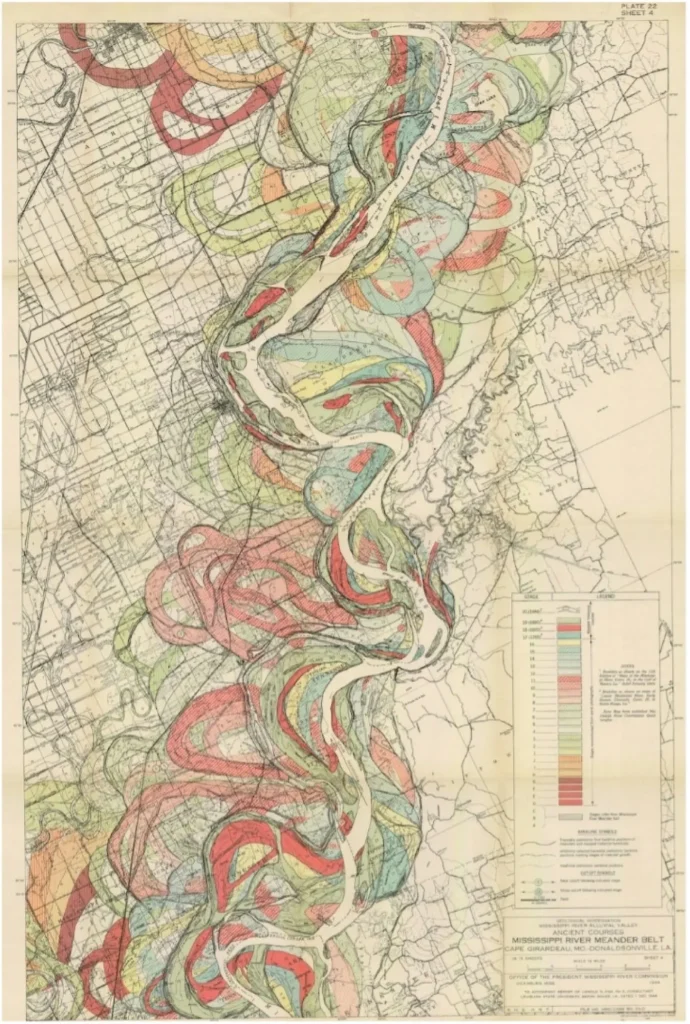
The first time I saw Harold Fisk’s hand-drawn maps of the Mississippi River, I was captivated. What are all these colors, loops, layers? Reds and pinks and blues and greens bending and looping and crossing in a variety of shades, stripes, patterns. Fisk, working in the 1930s and ‘40s, found a way to incorporate time into his geological cartography. He handcrafted an image of the mighty Mississippi not as a singular waterway cutting through the continent, but as a multitude of pathways, tributaries, and floodplains over the last many centuries. Meander maps, they’re called, for the water’s winding deviation from a single linear course. Each color represents the river’s curves and bends and wandering advances at a particular moment in time, all of them layered on a single page to show changes over millennia.
Month after month, I am in awe and tearful gratitude that I am not in pain. I am not in pain, I repeat to myself in disbelief. I am not in pain! My half-used bottles of Ultracet and Tramadol collect dust on the shelf. Without pain or drugs that numb, I begin to sense my body’s signals in new ways: gentle tugging on my insides, tightness in my back, natural fatigue levels. In this unfamiliar territory I can’t quite anticipate when my torrent will begin, my cycles no longer predictable in any way. I never know how long I will bleed, or how intensely. I begin to bleed so heavily with so little warning that I stain my favorite sweatpants, the sofa, my office chair. I take to sitting on dark brown towels, just to be safe.
The next time I walk the trail, the pedestrian bridge is caked in mud and debris. I understand this to mean that the waters crested higher than the bridge span, making the deepest parts of the creek something like twenty or twenty-five feet. Parts of the wooden boardwalk also have a coating of silty muck. I imagine walking the boardwalk as water rises up through the wooden slats beneath my feet. It would take so little of the cloudy, rushing floodwater to obscure the pathway, the current cold and quick enough to knock me off my feet, sweep me away. I wonder how the trees stay grounded, and venture to ask the wise old cedar, but I gasp at the sight of her. Her many boughs are orange instead of waxy green, her wide red-brown trunk now grey like elephant skin. It’s evident that the cloudy, rushing floodwater breached her boundaries, overpowering her natural defenses. I hold my fingertips out to hers, and let her rusty fronds tangle in the curls of my hair as I back away, heart full of sorrow. I want to believe she will pull through somehow, but I’m not sure that she will.
Mid-winter, I get a nosebleed and shrug it off. I blame the heat for blowing dry, hot air. When my fingernails break one after the other, I simply clip them all short and ask no further questions. For the sores that develop in my mouth and on my tongue, I take an antihistamine, certain I ate something I was allergic to—though I’m not clear on what. My fatigue I attribute to winter’s low sunlight and not sleeping well; headaches must be from stress. After twenty-two days of continuous surging, my menstrual blood changes from a deep red to a pale pink with an orange-yellow hue. I’m short of breath going up and down the stairs. But I don’t see what’s happening yet. I don’t put the pieces together.
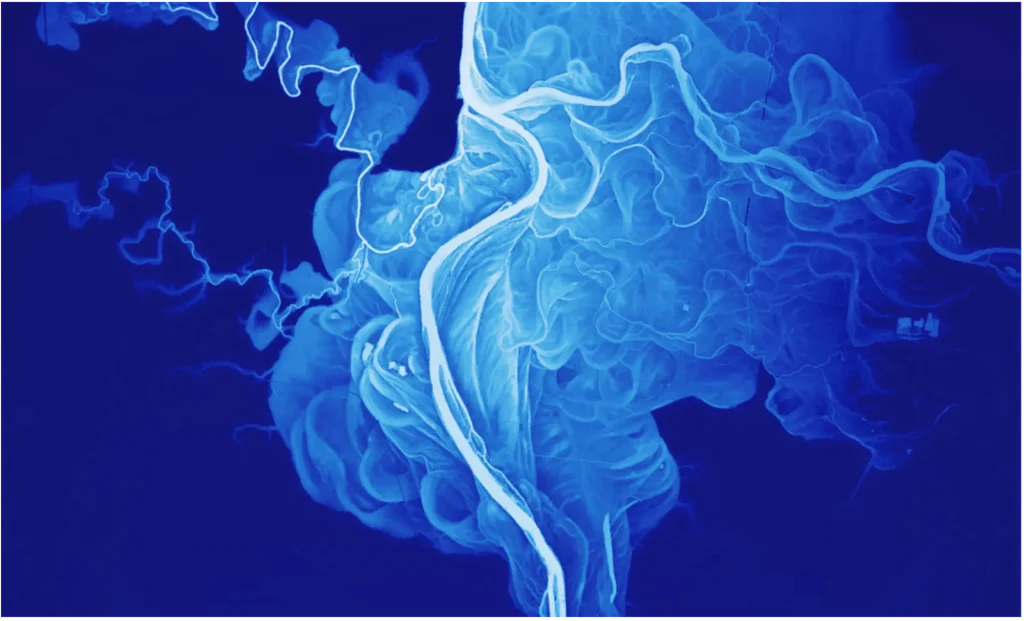
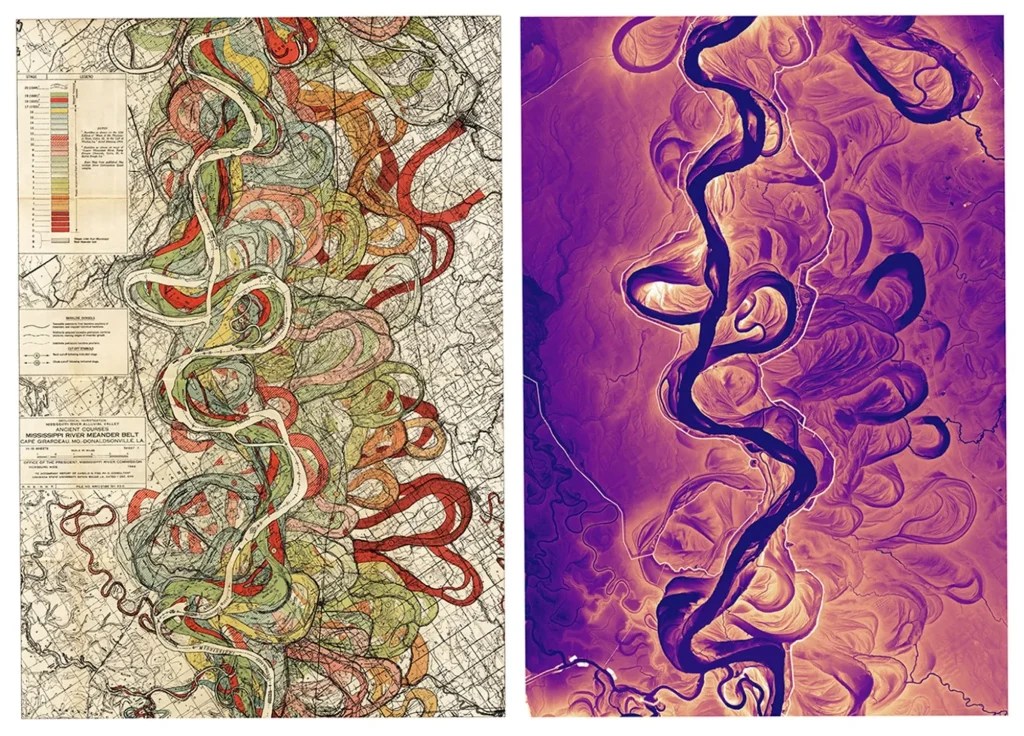
In the 1970s, LIDAR technology—light detection and ranging—becomes public. By 2000, it is used in geology, ecology, and forestry, able to penetrate earth’s soils non-invasively to generate intricate maps. With strong enough computers and LIDAR data, new age cartographers like Daniel Coe create stunning high-resolution images like those Fisk drew by hand, showing ancient riverway signatures in astonishing detail.
By the end of December, I can’t get right. I’m dizzy, lightheaded. My fingers are perpetually cold and…a little bit blue? But it’s the pounding, racing heart all night long while I’m lying still in my bed that finally spooks me: something’s wrong. I type perimenopause racing heart into my phone, which leads me to anemia symptoms: fatigue, weakness, headaches, cold hands and feet. Indications of worsening include: brittle nails, blue-tinted nailbeds, ulcers in the mouth, tongue soreness, dizziness, fast heartbeat, shortness of breath, abnormal menstrual bleeding. “Oh,” I say out loud in the dark. “Shit.”
I spend the next three days in and out of urgent care for iron deficiency anemia and “abnormal uterine bleeding.” There’s that word again, abnormal. I absorb their label into my body, a wrongness coursing through my veins: abnormal where iron should be. The old scorn and frustration I have for my errant body returns. What’s wrong with you now? They schedule me for an ironic blood draw, and my least favorite test: a transvaginal ultrasound. The procedure—which involves inserting a long transducer wand into the vagina to capture sonographic images from the inside—is uncomfortable at best, searing at worst. When the tech presses the wand at a certain angle, I get a familiar, inner cavity aching, deep in a place I can neither touch nor soothe. Her left hand expertly scrolls and clicks the computer while her right guides the wand. From the angle and position, I’m guessing there’s another ovarian cyst, but I know she won’t tell me. I lie quietly, staring at the ceiling, doing my deep-breathing dissociation exercises. I try to leave my body like I have so many times before, but the steady trickle of warm blood dripping down my thighs onto the floor keeps me there.
It has been weeks since I’ve been well enough to see the water or my friend the tree. My head still throbs, my heart still pounds, my fingers and toes still turn purple-blue. All I can manage other than work is sleep.
During my days off for the Christmas holiday, I sit at home, alone, wrapped in blankets, reviewing my various lab results as they come through to my phone. If you experience any new symptoms, the notes say, go straight to the emergency room. This reinforces the doctor’s verbal warning: we can diagnose you, but we cannot help you if you worsen; only a hospital can do that. The size of my ovaries is indicated, as well as each of their cysts. Is 6 cm bad? I wonder, measuring the air with my finger and thumb. I feel grateful that this time at least no rupture or torsion is observed, none of that primal, writhing pain. Fibroids are confirmed, their sizes too. But the source of the endless abnormal bleeding is not. An endometrial biopsy is scheduled.
Fisk’s study of the Mississippi river basin included drilling over 16,000 individual borings into the soil throughout the greater river valley to extract and analyze layers and sediment deposits over time. Before better technology existed, cutting into the earth was the only way to know.
The first biopsy appointment at urgent care is an excruciating failure. The women’s health nurse practitioner tells me what to expect, and suggests an IUD insertion “while we’re in there.” My face scrunches in confusion. “An IUD? I’m forty-five and in perimenopause. Why bother? Can’t I just like…ride off into the sunset?” She lays out her case, pulling up studies on her laptop to show me which IUD brands are safe for ischemic migraines according to the CDC. In a flash she has a model device in her hands, showing me how easy it is to insert. “Shouldn’t we wait to see what the biopsy results are before we add anything new?” I ask. She tells me it’s my choice, but it will only add two to three minutes to our appointment and will regulate my abnormal bleeding. “Think about it while we do the biopsy,” she says. “Here, sign the waiver now so we can just do it if you say yes.”
But nothing goes as planned. She cannot even complete the biopsy, because she cannot get through my cervix — though not for lack of trying. “Well this is a first!” the NP laughs. “You bent my instrument!” She holds up a blue plastic probe with a new curve at the end. I try to laugh along like her now-bent her tool wasn’t just tearing at my flesh: haha that darn cervix, always up to something! I ignore the beads of sweat forming on my forehead and neck, pulling my hair back so I don’t burst into tears on the spot. After months of near-constant bleeding, I now add cervical os stenosis to my collection of diagnoses, that long list of things my body does wrong. I’m told I need a specialist with surgical equipment and possible sedation to force my cervix open and complete the biopsy procedure. I nod numbly, relieved that I avoided the pressure of an IUD.
In 2019, Daniel Coe compiled a digital LIDAR image covering the same section of river as Fisk’s hand-drawn maps. When placed side-by-side, both images show the same primary river channel, the same looping signatures of previous waterways and floodplains. Coe’s recent image, created without a single incision to the land, affirms Fisk’s older one. In 75 years, we’ve developed technology to investigate our earth non-invasively, but not women’s bodies.
The second biopsy appointment is with a new doctor who listens. “No IUD, no problem,” she tells me. “That’s your choice. We have other options.” We talk about hormones, pills, surgeries. Hysterectomy is mentioned, and I tell her honestly: “I begged for a hysterectomy for years and no one would do it. Every doctor told me I was too young, might still want kids, might change my mind.” She sighs, apologizes for her peers, and says the culture is changing now, though not fast enough. “The thing is,” I tell her, “I’ve spent the last fifteen years accepting that no one would help me, learning to accept my body in spite of all of these pains and problems. We’re getting along now, and I don’t want that procedure anymore. Not when we’re this close to the end. Can’t we just wait and see?” She nods, says there’s more we can try, but warns that we might still have to consider the hysterectomy if we can’t get this abnormal bleeding under control.
I lie back, socked feet in stirrups, bracing for the second biopsy attempt. We opt for no sedation since I came alone to my appointment and there’s no one to drive me home. This time, she pushes through the tissue and the procedure is successful, but a bolt of intense, searing heat radiates through my body and I nearly black out from the pain. She stops and withdraws, saying she got enough, no need to push me further. She gives me a moment to recover, her assistant approaching to check my pulse. A few minutes later, I get dressed, wipe tears from my eyes, and drive myself home.
There are no abnormalities, I learn a few days later. No new ones, anyway. After several weeks of labs, tests, appointments, an iron-rich diet and iron supplements, my headaches and dizziness slowly begin to fade. We have no answers. My bleeding, for the moment, subsides.
I stand on the boardwalk beside the old cedar tree, mourning her. Since my last visit, her rapid decay was noticed by the city’s park keepers, her irreversible infection killing her from the inside. Her failing health is a liability risk, and they’ve cut her down. I count seven, no eight large sections of her beautiful red-brown trunk left wherever they’d fallen amongst the ferns. I’m upset, angry, wanting to blame someone for this loss. Is it the city’s fault? The storm’s? The creek’s? I turn to the water, contained now within the usual creek bed a few feet away. I ponder the flood, and how it’s the most natural thing to occur after all that rain, expected even. All of the land surrounding the creek bed is floodplain and wetland because of similar past events over hundreds of years, probably thousands. Why am I angry at the creek for flooding as it’s always done?
I stand between the tree stump and the creek. No one labels the creek waters as abnormal and tries to fix them. We accept this as part of the natural cycle, and we adapt to it with raised boardwalks and footbridges, and the occasional loss of trees. I imagine a map made for the writhing rivers of my body, shifting my language from abnormal to meander. What colors would I use? Where do my layers loop and bend? Could I see the beauty in these changes over time? Maybe I could accept, then, that my body is not a problem to fix, but a process to honor, a ritual to respect.
Image Citations

Stephanie Silenti (she/her) is a language lover, meaning seeker, grief tender, and aspiring cailleach. She believes that sharing our stories can bring healing and build community. Stephanie holds a BA in English from UMass Amherst, an MS in Publishing from NYU, and is finishing an MFA in Creative Nonfiction and Narrative Medicine from Bay Path University. When she’s not busy flirting with fog or romancing the moon, she is working on her memoir. Stephanie currently lives and works on the ancestral lands of the Nipmuc and Pennacook Nations in central New England.


