

In the discipline of humanities, I study topics and ideas that encourage me to question things. I don’t make anything or produce a product. Are my books of poetry and translation products? If so, I don’t make any money from them. Do I produce questions? I question systems that produce work from music and artmaking. How my body remembers a poonal is the title of a performance. Last year I had the privilege of being part of a class called Theories of the Body. While I’m not a dancer, I’m interested in how my artmaking engages my own body, how I use my body to engage with my environment. A lot of the discussions I had in class had to do with notions of mind and body as not being separate categories. Listening to my own heartbeat lowers my anxiety.
In the class we read a few texts from South Asian authors. Some of the South Asian authors talk about classical Indian artforms or about the complexities of doing research in India and other countries vs the USA. How does research feel in spaces that are not white or European-centered? I enjoy readings from people who write with a global perspective about the travel of dance and musical artforms. I feel invited to question some of my closeted feelings about Carnatic music, have fun with an experimental performance, think through many ways my body remembers Carnatic music.
When my son Archanu was born I began to play Indian classical violin again. I had not played for over ten years. My spouse encourages me to play again. I slowly begin the research of remembering compositions. I find YouTube videos with music I had learned to play before and had forgotten. In some ways the digital world makes remembering the compositions and how to play violin more accessible. I don’t need to dig around for old cassette tapes.
My aesthetic dimensions as a Carnatic musician will be crucial to understanding how my body creates meaning in the world. The class discusses the political space of museums, stages, and virtuosic performances (i.e. performances where a body can do things I can’t do with mine). For me, Carnatic music is a virtuosic space because of the repertoire and skill required. To learn and play Indian classical violin requires access to free time and labor. I used to think it was my own labor. Mostly it was the labor of other people. Amma used to drive me to violin class every week after school, for example. The commute would usually be an hour back and forth. Something else comes to mind, what Appa frequently says. Carnatic music is in my genes. “You have a natural talent for Carnatic music because of your ancestors,” says Appa. “If you want to become a basketball player, it might take several generations. Because no one in the family was ever a professional basketball player.”
I want to introduce my performance to the class and invite the students and professor to be a part of my theater group. On this occasion, I ask them not to be the audience. I experiment with the notion of inviting people into my space and giving them permission to act in that space. The poonal for me is something that wraps me up, ties me down. I ask the theater group to intervene somehow in the music. I’ll play for seven minutes or until I’m covered in poonals. I consider this a rehearsal, I ask everyone to participate in their own way. I explain how I am a product of various patriarchal values, one of which is my sacred thread.
The day before the performance N and I make the poonals. We buy the yarn from JOANN Fabrics and Crafts. The store helper asks me what I’m trying to crochet. I’m already out of my element, in a store where I never shop. I buy white yarn and also off-white yarn. When I was young, I would frequently lose my poonal. Inevitably, Appa would find out I lost my poonal because when I replaced it without telling him, the new one would look clean and white. I want to buy some yarn that looks gray and dull. I used to covet slightly aged-looking sacred threads. At home N and I make the poonals. We cut loops and tie yarn. Archanu distrupts our plans and N has other work to do. During our evening routine we watch something on the projector and put Archanu to sleep. Archanu’s favorite thing in the world is to drink his bottle and watch mommy shower at night. The bathroom is so steamy and warm. After everyone goes to sleep, I make about a hundred sacred threads. During this process some questions come to mind. What kind of fabric are poonals? Who makes them for me? Does something about wearing a poonal change the way I move my body?
My uppanayam happened when I was thirteen. I still remember the grueling ceremony. Many relatives attended the ceremony. Recently, we stayed in a hotel in Chennai to visit some relatives and I made a joke to one of my cousins. I asked if he had also booked a special room where I could do sandhyavandanam. Sandhyavandanam is a ritual I’m supposed to do three times a day because I wear a poonal. At first my cousin didn’t understand the question. When he finally understood the joke he felt the need to fire back. Are you even wearing your poonal?
My sacred thread was something the kids in school would make fun of me about. A bully in junior high would constantly pull on it. I was an easy target because he sat behind me in algebra class. My violin teachers were all Brahmin. When I travelled to India to become a professional violinist, not only was my violin playing under scrutiny but also my demeanor. My teachers observed whether I could sit on the floor and eat South Indian food with my hand – sambar rice, rasam rice. Once I went to music class in a pair of shorts. Chennai is glaring hot. I was sent back home to change my clothes. “I’ll make an exception because you grew up in America and let you wear pants. Either you wear a veshti or pants,” said my teacher.
Carnatic music made me feel like a replication and representation of a particular kind of lineage, the caste system in India, male musicians. The three main composers of Carnatic music are male. Yet at the same time, I did not grow up in India. My rejection of poonals and Carnatic music happened gradually through my teens and twenties. When I ask my theater group to participate in my performance, I do not expect them to understand anything about my Brahmin upbringing. Perhaps I want them to question their own baggage when it comes to their own art forms. In making my Carnatic music political, I wonder if my questions might open up a way to bring forward the body as a marker, barrier, agent in creation and sounding.
I consider whether my Brahmin family members might find the performance as reinforcing Brahminism. What would my family members think of this performance? What kind of conflicts, support, or rejection might I face if I ask people I love in India to redo the performance? A poonal is a day-to-day reality for my male family members. I’m the only one, as far as I know, who doesn’t wear one. Several of my cousins have done uppanayams for their children, including my cousins who live in the USA.
“Are you playing violin?” asks Appa.
“Yes, I am . . . Appa.” My voice is husky voice despite myself. Longing to have the same body as my father, to perform that body.
If only Appa and I could perform a music concert together, better yet, in the same body. He sends me a video of the retirement community where he wants to retire in Kumbakonam. The retirement community is modeled after an agraharam, a land granted by kings for religious purposes typically for Brahmins. I have to look up the meaning of Agraharam. When Appa says the word, the connotation creates a sinking feeling for me. Agraharam creates distance I don’t want to bridge.
One of the people interviewed in the video Appa sends me displays his poonal prominently. The advertisements for the retirement community show people with all the accoutrements and clothing of tradition. I bring a screenshot of someone in the video to my class. My performance group. I ask people what they notice. People speak about a lot of things but nobody specifically mentions the sacred thread.
In my academic classes, the students would say he is performing Brahminism. I want to ask all the students in my class something. When they close their eyes, where do they want to retire? Where does nostalgia take them? Nostalgia for something I have destroyed says the professor.
Much of my need for visibility in performance is marked by my feelings of being an outsider. I grew up thinking I would be a professional Indian classical musician. Rebelled. Then I backpacked around India with other young white American and European backpackers. A couple of times the Indian owners of the guesthouses would try to have me thrown out because they thought I was a thief trying to rob the white people. Once on the border of Kashmir, an Indian police officer stopped our car because he thought I was a Kashmiri terrorist among the white people. How do I experiment with freedom while also playing Carnatic music? How do I make a political Indian classical violin composition?
Much of academia in the arts is occupied with narratives of trauma and abuse, unearthing the inequalities and marginalization of various voices. These days I’m occupied in trying to explain to Appa how he’s been affected by trauma and abuse through the patriarchal hierarchies of Indian culture.
His response to my inquiry? “What the f*** am I talking about?”
My performances are scores for how to do grief. Perhaps I’m the first generation in my family to score grief in a way that’s not preordained by Brahmin rituals. My professor and peers would say I carefully curate embodiment in my performances. More than anything I use academia to carefully curate my finances. Find a way to profit off the moneyed complicity. Frequently it doesn’t feel good.
I generally avoid the company of other Indian people. It’s fairly easy in art programs in higher institutions because usually there are only a few people from India or with Indian heritage. Then one day I met Amarnath, a student from India. Amarnath is a dancer and musician, virtuosic in multiplicities. He sings and dances Indian classical art forms with a familiar spirituality. He doesn’t speak to me about his feelings of ambivalence about learning these classical art forms. No good things come from bad things says Amarnath in a sardonic tone. With Amarnath I experience virtuosic dysphoria. I remember pride and beauty in my body I used to feel when I played music. Before his death, he asked me to bring my violin to St. Louis so we could play together.
When I finally bring my violin to St. Louis, Amarnath dies. When I play violin for the students in my class, someone says they closed their eyes. I am surprised. Amarnath’s presence in my life may have been a coincidence, but his death was one of the reasons I felt drawn to play violin again. Renew the idea of someone closing their eyes for beauty.
I tell Appa on our phone conversation that I’m going to be playing violin in my class.
“Make a video and send it to me,” he says.
I don’t think he realizes what I mean by my performance.
How my body remembers a poonal
performance Score
Camera Rolls
Begin playing violin
After a short improvisation begin a composition
When the composition is playing, audience members invited to use poonals to tie me up, weigh me down
Performance disrupted by weight of sacred threads
I wonder how Appa would feel about the video. He probably wouldn’t understand the disruption. His idea of life from his generation: work hard. make money. don’t have any fun.
Appa wants me to at least have the bare minimum of success. My focus is not on playing the composition perfectly, I’m looking for the bare minimum of failure.
Devotion in terms of a plan. I make a plan to create a kind choreography around my violin playing. A (soft) choreography. “It follows that if the political is not a given, if it needs to be (re)discovered and (re)produced, then the political is always a kind of experimentation. It comes into the world through the experience of experimenting. This is why the political needs a kind of pre-established plan, or a program… “ says André Lepecki. My performance deals with programming of my social and corporeal interaction with my environment. How is Carnatic music defined by the programming of my body to become a perfect disciple, a Brahmin musician? In my performance I seek to implicate the audience in engaging with the parts of Carnatic music not visible to most people who do not dig deeper into the roots of Indian nationalism. In my attempts to redo my performance I seek improvisation and collaboration. Yet at the same time I am transmitting techniques I have gained not just in music, but in the other disciplines of live performance from contemporary artists in Romania, India, and the USA.
In Frankfurt we are bussed to our plane. The bus is held up. I’m with Archanu and can’t see what’s happening. Afterwards N tells me the bus was held up because a police car stopped the bus and escorted a couple with a baby onto the plane. “Are they Romanian?” I ask.
“I don’t know. The mother was wearing a headscarf,” says N.
We arrive in Bucharest. I wait on the jet bridge with Archanu for our stroller. N is still in the plane gathering our luggage. “Excuse me, can I see your documents?” asks a police officer.
My body freezes. “Are you Taleb?” he asks. By this time N is out of the plane. “I’m looking for a couple with a baby,” says the police officer. A blue passport in his hand.
“He’s not Taleb,” says N.
“In any case, please show your documents,” says the police.
I’m sluggish to respond. N speaks to the police officer in Romanian. He insists again that I show my documents. “We just got off the plane, what’s this all about?” she says. The police officer lets us go. I wonder how many different ways this encounter could go down. I used to be one of those people who was confident to show their documents.
On the taxi ride from the airport in Bucharest the customary thing to do is to chat up the driver. My brother-in-law is in the car too. “There are so many Nepalese, Sri Lankans, Pakistanis on bikes and driving cars. Delivering food everywhere. The city is overrun with them. I don’t know where they learned to drive because they don’t know how,” says the taxi driver. As we continue into the center of the city he points out hotels owned by Jews.
It’s true. When we live in Bucharest, many times our food is delivered by brown people who speak English. My body moves differently. I speak Romanian. When I received my Romanian residency card the police officer asked if I speak Romanian. To speak a language and move in this world is a specificity. Sensitivity? Is it overt racism, or perhaps a lack of awareness or curiosity? Most people I talk to in Bucharest don’t know anything about Indian classical music. Some people are mildly polite. Bucharest is another venue for my performance. I wonder what legibility a poonal will have and what my music says in how I remember my body.
Link to Performance:
https://www.youtube.com/watch?v=ntGpA9FZJUA&ab_channel=RajChakrapani
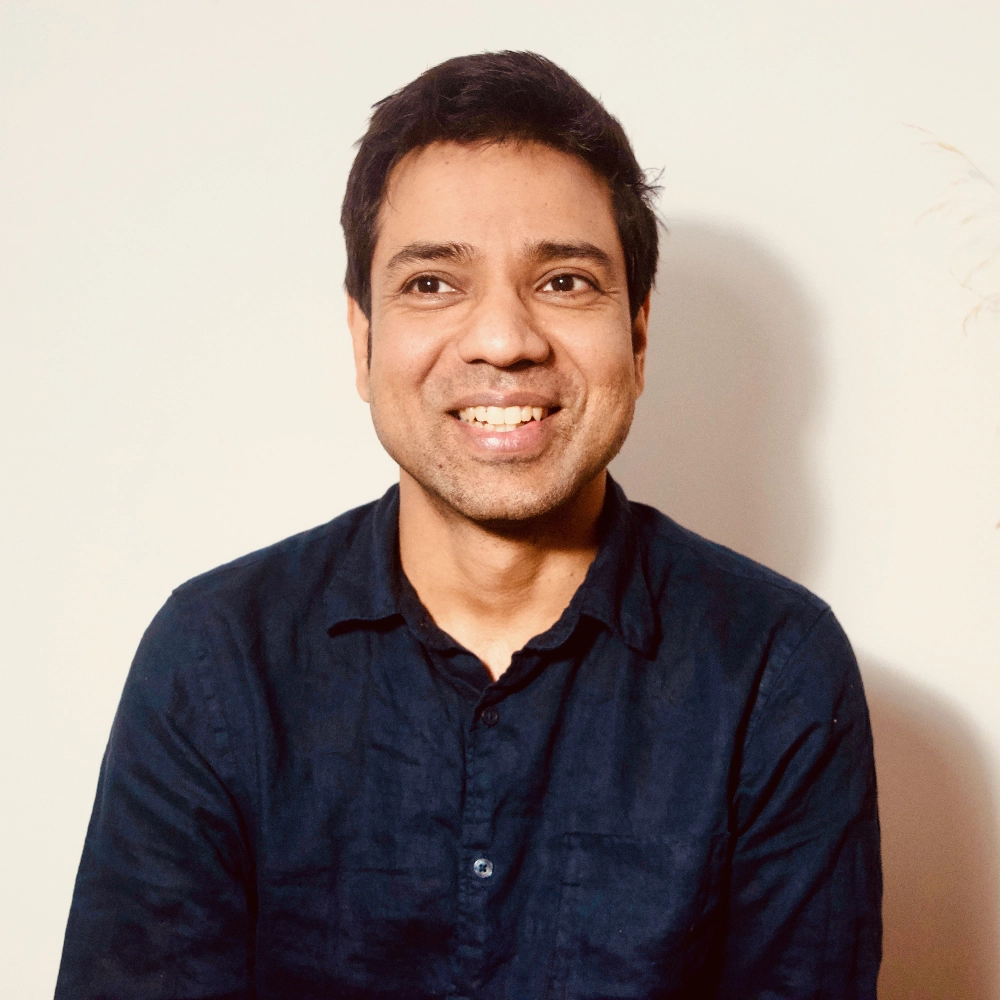
Rajnesh Chakrapani is the author of The Repetition of Exceptional Weeks, and two chapbooks Brown People who Speak English, and Manifesto on Translations of Hospitality. He lives in Bucharest.


