

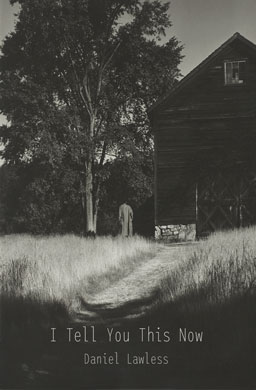
I Tell You This Now
by Daniel Lawless,
Červená Barva Press, 2024,
72 pages
Daniel Lawless’s latest poetry collection, I Tell You This Now, begins and ends with time: the shape of grief over time, and how time shapes us in its wake. In his opening poem, “Family Photographs: My Brother, Solar Eclipse, 1965,” Lawless situates us with the title, only to illustrate time’s cruel and indifferent fluidity,
In a year, Haldol, ECT, the closed gates of a sanitarium.
But for now—how happy you were.
To be eleven and unconcerned . . .
We are at once introduced to a narrator whose voice orients us—“In a year,” “But for now,” “To be eleven”—yet moves from 1965 to an adult’s perspective. Throughout this collection, this voice will remain and guide us within the shadow of an eclipse, within the confines of a photograph, as we feel the heft of loss and wanting. As I read I Tell You This Now, I thought of Marie Howe’s poem, “The Gate,”
I had no idea that the gate I would step through
to finally enter this world
would be the space my brother’s body made.
Lawless’s spectacular writing is a journey to articulation, to palping the size of loss, which is a “shed-sized poem—nails, hoses, / My dad’s cobwebbed bicycle.” Like a maestro who keeps time with their hands, Lawless delivers us to the conclusion, “You wear your life lightly / As the dog you name wears the name you name it.”
Throughout this collection, I learned new words. This is always exciting: a hidden treat, like a bonus track. Lawless uses definitions and etymologies, not only to move the narrative of grief along a timeline, but also, to define the eel-like quality of language. In “5.23.20,”
the speaker places us “In the Memory Care Rec Room,” with his mother, her crayons, and her “beautiful blue present.”
Because despite everything—
which is a lot—wouldn’t it be nice to see things her way
for once—dyschronometrically the head nurse calls it—
a flamboyant kid-simple world
endlessly repeating itself like this?
Having nursed my own mother through late-stage dementia, I immediately understood the word, dyschronometrically, when all of time is happening at once: relatives and events long gone exist in the nursing home’s neutral and final walls. In the poem, “Once,” which traces the etymology of the word “once,” Lawless stops time again, “Once, we begin, our lips puckered, as if for a kiss / but a kiss that never comes, breathless, forever in the past.” Words are a way to trace time, whether ones looks at the OED or studies words in a poem. Lawless employs etymology as a sculptor’s tool. In “Ullage,” the poet tries to remember this “Odd word, for many a complete blank . . . / A feudal tax, a gully, something to do with the throat?” In trying to remember, the speaker defines the emptiness of the word, brings in Catholic school, and again, the size and shape of grief.
All the other kids slack-jawed, staring, a hole opening up
Where our pride and anger leaks out, a sort of ullage,
The empty space left in a vessel measuring what’s lacked.
“Aglet,” too, that “little sheath / at the end of a shoe lace,” traces its roots back to “needle’ / To point or pierce. Colloquially, a small sorrow.” “Dither,” broke my heart, as the word travels through time with “a little feather in it, a little wooden top,” and ends with our more modern usage of the word, as a way to dramatize the baffling horror of his sister’s death.
My father in the next room
Wondering aloud whether he should wear
The black or the dark navy-blue socks to her funeral.
The speaker’s “strange toy-heart” is tested by the vicissitudes of time and of language. In “Home Visit,” the brother, “the year-ago diagnosed schizophrenic,” who, a year before that was “a theology prodigy bound for Princeton,” now
can scythe verbatim great swatches of “Directives for the Interior Life,”
and Conrad Aiken’s Collected Stories, whose short strange tale
“Silent Snow, Secret Snow” about a young boy’s descent into
madness he’ll sing-song
lines from again tonight in his bare room.
Like the rooms in the nursing home and the sanitarium, the poems in this book attempt to enclose grief. In “Rose,” the speaker searches for a way to verbalize it.
Or streichefrieden, the act of gently stoking a dying animal.
A cobwebbed old gardener’s shack like the first stirrings of a trumpet . . .
. . . ghost bike . . . bricked-up stained glass window . . .
the rose which only words far from roses can describe
wrote the great French poet Aragon.
And how else should I speak of you, dearest sister,
on this your death day?
In his sequence, Poems from the Polio Ward [from Photographs and Captions from the Polio War, 1943-47, the Courier-Journal, Louisville, Kentucky], Lawless offers us “snapshots” of children and young adults locked in to “an unwieldy apparatus that fills half the living room.” These claustrophobic “lungs” become vessels of time and grief. Whether the victims are lied to about their condition (“like a cast / on a broken bone”) or, in the case of the “Anonymous Girl, Aged 17, “Cured” Awaits Her Departure from St. Anthony’s Hospital,” we—the observers or readers—are gazing at a “memento mori,” and will “be forgiven /for thinking she’s been newly dead for a century.”
Lawless had me pondering about forgiveness: in time, will we be forgiven our fears and cruelties? The poet does not shy away from the effects of cruelty, for better or for worse. In his brutal poem, “Why Write,” written completely as a hypothetical, the poet dares us to contemplate the horrific killing of a cat, her kittens, and his own abuse at the hands of the father. We are brought back to the “shed-sized” grief,
what if I also explained how a couple of eyeballs had fallen
out of the bag and the drunk father said
they looked like jellybeans,
and smeared with slime and viscera, demanded the boy eat one?
That for days he tasted it, the smell wouldn’t wash off,
while in the shed the mother’s carcass stayed covered in flies,
that if I cold carve a poem out of this
I could do anything?
Daniel Lawless, in this masterful collection, has carved poetry out of time and grief and ghosts. “That hopeful more we heard in morte each time,” he writes in “In Basel,” “The way-worn Go in that woeful Gone.” These poems are “ghost-delivered,” because, “When you’re six you’re a ghost inside of another ghost.” I Tell You This Now is a soulful book that inhabits our “substantial world / Where this and this and this keeps happening.”

Jennifer Martelli (she, her, hers) is the author of The Queen of Queens (Bordighera Press) and My Tarantella (Bordighera Press), awarded an Honorable Mention from the Italian-American Studies Association, selected as a 2019 “Must Read” by the Massachusetts Center for the Book, and named as a finalist for the Housatonic Book Award. She is also the author of the chapbooks In the Year of Ferraro from Nixes Mate Press and After Bird, winner of the Grey Book Press open reading, 2016. Her work has appeared in The Academy of American Poets Poem-a-Day, The Tahoma Literary Review, Solstice Literary Magazine (finalist, summer poetry contest, 2020), Thrush, The Sycamore Review, Cream City Review, Verse Daily, Iron Horse Review (winner of the Photo Finish contest), Poetry, and elsewhere. Jennifer Martelli has twice received grants from the Massachusetts Cultural Council for her poetry. She is co-poetry editor for Mom Egg Review.


