

Monument Valley was the properly mythic place for meeting this mythic event, a solar eclipse. In an eclipse the sky’s usual tones and colors turn strange, and the land too grows strange, then surrealistic, and few landscapes were better able to agree with and amplify this surrealism than the odd spires and buttes and mesas of Monument Valley. Even sunsets were more intense here, deepened by Monument Valley’s red sandstone.
The eclipse surrealism of the sky and land starts out slowly and subtly but grows steadily, a steadiness saying that even strangeness contains a deep order.
A solar eclipse is the face, the Cheshire Cat smile, of the very deep order of the universe. An eclipse reveals the steady motions of the solar system, reliable for billions of years, the orbits of Earth around the sun and of the moon around Earth, the steady revolving of Earth and moon, the extremely precise power of gravity, never fluctuating for a second over billions of years. The solar system is so reliable that astronomers can predict, many years in advance, the beginnings of eclipses right to the second, and their trackways, down to a few feet, across thousands of miles. The star of the show is a sun that has shined steadily for eons, sending out light with an extremely precise speed and energy, generating rains, molding rocks and soil, nurturing life. The sun is the face of atoms with their own deep order, with extremely precise and enduring shapes and orbits and charges and motions and ways of combining and generating light. The night sky proclaims a vast universe with the same deep order everywhere, a universe expanding in unison from the same great ordering, generating galaxies and numerous other patterns. The sandstone spires canvassing the eclipse portray a further, geological order. The humans whose faces show strange eclipse glows, and whose bodies cast strange shadows, hold their own deep order, the merging of atoms and stars, a universe of cells pulsing with patterns.
And yet for most of human history, most humans have seen eclipses as outbreaks of chaos, a violation of the natural or sacred order, a threat to humans, seriously frightening.
This was not just long ago and far away. Monument Valley is a Navajo Tribal Park, with Navajo families living amid the mesas where they have lived for generations. Monument Valley and its surrounding region had long remained more isolated from outside influences, including Christianity and science, than most Navajo lands, and traditional ways have endured there better than in many other places. Navajos there are more likely to live in hogans full of sacred symbolism, tell mythic stories to their children, practice traditional ceremonies, and call upon medicine men to address illness, including with elaborate sand painting ceremonies. Traditional ways say that solar eclipses are dangerous and that Navajos should avoid them.
My Navajo barber in Flagstaff had offered me a warning. She was well rooted in the Navajo earth, holding land at the bottom of another famous Navajo landscape, Canyon de Chelley, where she’d gotten married amidst a flood. She came from a very traditional family and was the first family member to adopt Christianity, while her disapproving siblings belonged to the Native American Church, most noted for its peyote ceremonies. But when decades of cutting hair was giving her carpal tunnel syndrome, she went not to a doctor or to her preacher but to one of the most famous Navajo medicine men, who gave her a mixture of “Navajo chiropractic,” herbal treatments, and spiritual ceremonies. She told me it had worked. My trusting my head to her hands could be interpreted as my granting some credence to Navajo traditions. That same medicine man was brought in to give a blessing to a new wing of the Flagstaff hospital, to reassure traditional Navajos who were wary of the world of scalpels, shots, pills, x-rays, and anesthesia. In other ways, my barber followed Navajo traditions that neither her preacher nor some other Arizona tribes would endorse.
Unlike all the barbers who will yak endlessly to the back of your head while they work, my Navajo barber felt this was improper, so whenever I prompted a conversation, she stopped the haircut and circled to face me to talk. This alone made me hesitate to ask many questions, and when it came to asking about Navajo spiritual practices, there were boundaries and secrets I tried to be careful about. I did learn that Navajos are prohibited from viewing eclipses, that they are supposed to go inside and close the door and, if a hogan has any windows, close the curtains, and refrain from all activities, including eating. Violating this was inviting spiritual danger. She did not approve of people treating eclipses as spectacles or entertainment. In this respect I agreed with her: eclipses open a doorway onto the primordial.
The Navajos had closed Monument Valley for the morning of the eclipse, allowing park employees to stay home and be safe. I was outside the park, at a nearby set of mesas, with a great view of the world-famous monuments.
We should avoid the usual condescension towards pre-scientific peoples as being stupid for seeing eclipses with fear. Most peoples viewed eclipses through cosmologies that had their own logic and ingenuity, that made sense of the world and human life by weaving stories and gods constructed out of the raw materials of natural forces and animals. People fit eclipses into their cosmologies to find meaning in them. Visually, it appeared that something was taking a big bite out of the sun, trying to swallow the sun. Logically, this had to be something with a mouth and a motive. If people lived in forests full of birds eating round, yellow fruits, birds whose flying seemed so magical it had made them into gods, then it was a bird devouring the round, yellow sun. If people lived in northern lands where the main predator was wolves, which had been promoted into mythological demons, it must be a hungry wolf who was devouring the sun. For jungle dwellers who admired the transformations of frogs, a magical frog was a likely suspect. For peoples whose main demon was a dragon, it was a dragon up to his old, devious ways.
The Navajo cosmos holds many of the same constellations humans everywhere have recognized, but they also have their own variations, adding or subtracting some stars. The Navajos did not know and did not need the star-written gods and stories of Babylonian farmers and Greek mariners, so they found their own meanings in the sky. Some constellations announce the changing seasons, and some teach lessons about the stages of human life.
Polaris, or the North Star, represents the fire at the center of a Navajo hogan, providing light and warmth and cooking, around which the family revolves. For the Navajos, Sagittarius is a bear whose nose peeks above the horizon as spring arrives and as bears and other animals are coming out of hibernation. Some stars in the tail of Scorpius look just like the tracks a rabbit leaves in sand, and Rabbit Tracks tells Navajos when it’s the right time in autumn to begin hunting deer. For much of their history, the Navajos were hunters and gatherers. In places where farming was easier, such as along the San Juan River twenty miles from too-dry Monument Valley, Navajos watched the Pleaides, which they called “seed-like sparkles,” to know when spring had advanced far enough to make it safe to plant corn. Canus Major and Cancer, which the Greeks saw as a dog and a crab, are for Navajos a snake and a desert bighorn sheep, telling Navajos when it’s the right time of winter for healing ceremonies and for telling stories about the cosmos.
For the Navajos, the sun is male and the moon female. The sun is a giant turquoise disk carried across the sky by a spirit, an old man. When Navajos build a hogan they carefully align it with the rising sun on the equinox so that sunrise flows into the doorway and, on the back wall, maps out the progress of the seasons. The moon is a giant white shell disk whose phases define Navajo months, which have names like Little Eagles and Cry of Little Eagles, Little Leaves and Large Leaves. Moon phases also set the right times for ceremonies. In numerous ways, Navajos seek to align themselves with the cosmos.
Yet the Navajo cosmos holds plenty of chaos, which was why Monument Valley was closed for the eclipse, so Navajos could hide from the cosmos. Their neighbors, the Hopis, were not noticeably worried about the eclipse, and I knew of some Hopis who were planning to observe and enjoy it. This difference is a reminder, against the stereotypes many Americans are inclined to impose onto Native Americans, that Native American tribes hold a wide spectrum of cosmologies, often shaped by different landscapes and lifeways. The Hopis, as farmers who trust seeds to hold a highly reliable order and to unfold it according to plan, find more order and benevolence in the universe. As hunters and gatherers on a sparse land, the Navajos found the cosmos untrustworthy, full of trickery, evil spirits that need to be fended off. When the Navajos became sheep herders, trickery continued in the form of clever coyotes constantly sneaking up on their sheep.
Still, the Navajos were well short of the usual human response of seeing eclipses as threatening the end of the world. For many peoples, eclipses are a titanic battle between good and evil. Sometimes the sun and moon were perpetual enemies, and now the moon was attacking the sun again. Sometimes the sun was being attacked by animals, gods, monsters, witches, the spirits of the dead, or vampires. Sometimes human sins circle back and cause eclipses. Sometimes it’s mere accidents, as when an Amazonian boy shoots an arrow into the sky and it hits the sun and wounds it, requiring a shaman to remove the arrow. Usually, eclipses triggered more desperate actions. People lit bonfires, banged drums, blew horns, prayed, chanted, sang, shouted, clapped, danced, threw stones, shot arrows into the sky, or offered food to the hungry moon-eating force. All of these methods succeeded at saving the sun, so people remembered them and repeated them for the next eclipse.
At the other extreme, a few peoples have seen eclipses not as warfare but as love. For cultures as different as the Australian Aboriginals and the Tlingits of the Pacific Northwest, the sun and moon are husband and wife, and when they embrace so thoroughly in an eclipse, they are making love. The eclipse-as-embrace seems such an obvious idea, it’s surprising so few cultures embraced it. But eclipses always came as a shock, without warning or logic, clearly threatening the sun, terrifying. It was only when some cultures began systematically recording astronomical events over generations that they realized that eclipses held patterns and were even predictable.
For the Navajos, eclipses fall between the extremes of warfare or lovemaking. Eclipses are the death of the sun and the rebirth of the sun. The sun is a male who protects the earth from evil. The moon is female, in charge of the earth’s fertility. When the sun reaches the end of some sort of cycle and begins to die, it’s a dangerous moment, for the sun’s protection of Earth may lapse. The sun needs the moon’s help to regenerate itself. The Navajo cosmos may hold many monsters ready to pounce, but an eclipse is the cosmos performing a giant healing ceremony.
I was seeing the harmony of the cosmos in another way. Onto the round sun the roundness of the moon was advancing slowly, slowly, steadily, steadily, revealing the rounds of the solar system, the precise clockwork flowing that has been flowing steadily for eons. I was seeing Earth’s motion too, for I was standing beneath a 500-foot-tall mesa with a sheer cliff, and I had positioned myself so that the cliff was blocking half the sun, so that Earth was eclipsing the moon eclipsing the sun. As Earth turned and orbited slowly and steadily, the sun crept away from the cliff and I had to take a step back to keep it eclipsed. Another step. Another step. I was observing the eclipse not just with my eyes but with my body. Earth’s motion was becoming my motion. I was performing a ceremony that confirmed I was part of a vast roundness, vast flowings. I was seeing a massive mesa flying through space, seeing Earth carrying a small human, a geonaut. The moon moved onward, another step into the sun, another step, lining itself up perfectly, its dark roundness filling the bright roundness perfectly, performing an ancient ceremony, honoring order, honoring light, making love to Earth.
In another way, I saw another form of cosmic order. Through my eclipse glasses the mesa cliff was only a dark band, so I took off the glasses to observe the cliff’s glow and color. I saw massive geological powers, which from Earth’s beginning had been creating rock and dissolving rock and processing it and sorting it into new rock, rock that became alive and generated massive new raw materials for creating new kinds of rock. I saw sand and mud and fossils becoming rock and being lifted out of the sea to become tall mesas glowing with sunlight.
The moon held no cliffs like this, nothing this strong, nothing that had felt such sculptor hands. The moon held massive rubble. Yet before the Space Age, when artists like Chesley Bonestell tried to picture the moon or the moons of other planets, they often came up with landscapes that looked southwestern, much like Monument Valley. They were trying to say that the moon was unearthly, very strange, but they were also saying that Earth is very strange.
Yet many people come to Monument Valley not to see something strange, but to see something familiar. They come not for the land, but for the human stories upon the land, and not the Navajo stories. They come because they live almost entirely within the world of human stories, where geological stories are mere scenic backdrops for human stories, where the grandeur of Monument Valley only magnifies the story of one nation.
Until the 1930s, Monument Valley, reachable only by a rough dirt road, remained largely unknown to the outside world. When Hollywood director John Ford saw photos of Monument Valley, he decided it was a suitably mythic landscape for American national mythology. Until Ford, western movies had been melodramas, thin excuses for saloon fistfights, street gunfights, horse chases, train robberies, damsels in distress, and good guys in white hats and bad guys in black hats—or Sioux headdresses. Ford felt that America’s westward expansion was our national mythology and deserved grander stories. When he filmed Stagecoach in Monument Valley in 1939, sending his stage coach around and around in circles but giving moviegoers the impression that the entire West looked like this, he scrambled all the usual stereotypes: the banker is really a thief; the prostitute being driven out of town by the Victorian ladies has a heart of gold; the town drunk is really a skilled and caring doctor; the gambler is really a gentleman; and the escaped convict turns out to be the hero. Ford could never make up his mind about Native Americans. As the son of Irish emigrants, he bore long, bitter Irish memories of a people oppressed and dispossessed, and he applied those sympathies to the Joads in his The Grapes of Wrath. Sometimes he viewed Native Americans as Joads being dispossessed by monstrous forces. Other times, including in Stagecoach, he celebrated Manifest Destiny heroically crushing the Indians.
Many people come to Monument Valley because they’ve had heroic stagecoaches running through their minds for decades and they want to feel that story become more alive within themselves and make them feel more heroic. They perceive the Navajos through some of the stereotypes of western movies. The Navajos have mixed feelings about Hollywood’s Monument Valley. They are pleased that their homeland is admired throughout the world, and they try to tell visitors their real story. But their own shops sell more Wild West souvenirs than Navajo rugs and jewelry, and the most popular stop on the valley roadway is John Ford Point, from which people see the land through his cameras and stories.
Onward, progressing steadily, the moon moved across the sun. The moon became fuller and the sun got hidden, eighty percent, eighty-five percent, ninety percent, finally ninety-five percent of the sun was hidden. This was not a total eclipse but an annular eclipse in which the moon is a bit too far from Earth to completely cover the sun. Yet the moon still fit perfectly in front of the sun, a dark round disk outlined by a ring of light, which seemed to flare as the moon fit fully in front of it. This fullness lasted four minutes, during which the sunlight had about the same intensity as you’d see from Jupiter. The temperature dropped. Birds went silent.
I removed my eclipse glasses to look at the land. The nearby cliffs and the distant buttes glowed dimly and strangely. The shadows of rocks and trees were strange, blurred. Undoubtedly, my own face glowed strangely. I looked for my shadow, and the sun and moon told me I was a strange thing.
The word “monument” comes from a Latin word that means “something that reminds us.” Of what was Monument Valley trying to remind us? Not national mythology that on Monument Valley’s timescale was but stagecoach dirt ruts that would soon be swept away by the wind. Not unrecognition and ingratitude and outright fear of the cosmos that gave us life. The strange sunlight was emphasizing what the strange rocks of Monument Valley had been telling us all along, that we were born from a strange planet that is nourished by a strange, very loyal sun, that the reliable astro-metabolism of the solar system has become a geo-metabolism that creates rocks and raises them high, which has become our own bio-metabolism pulsing with solar energy and reliable molecular orbits. Amid strange spires, humans stand, further monuments glowing with strangeness, sometimes frightened by it, but sometimes inspired.
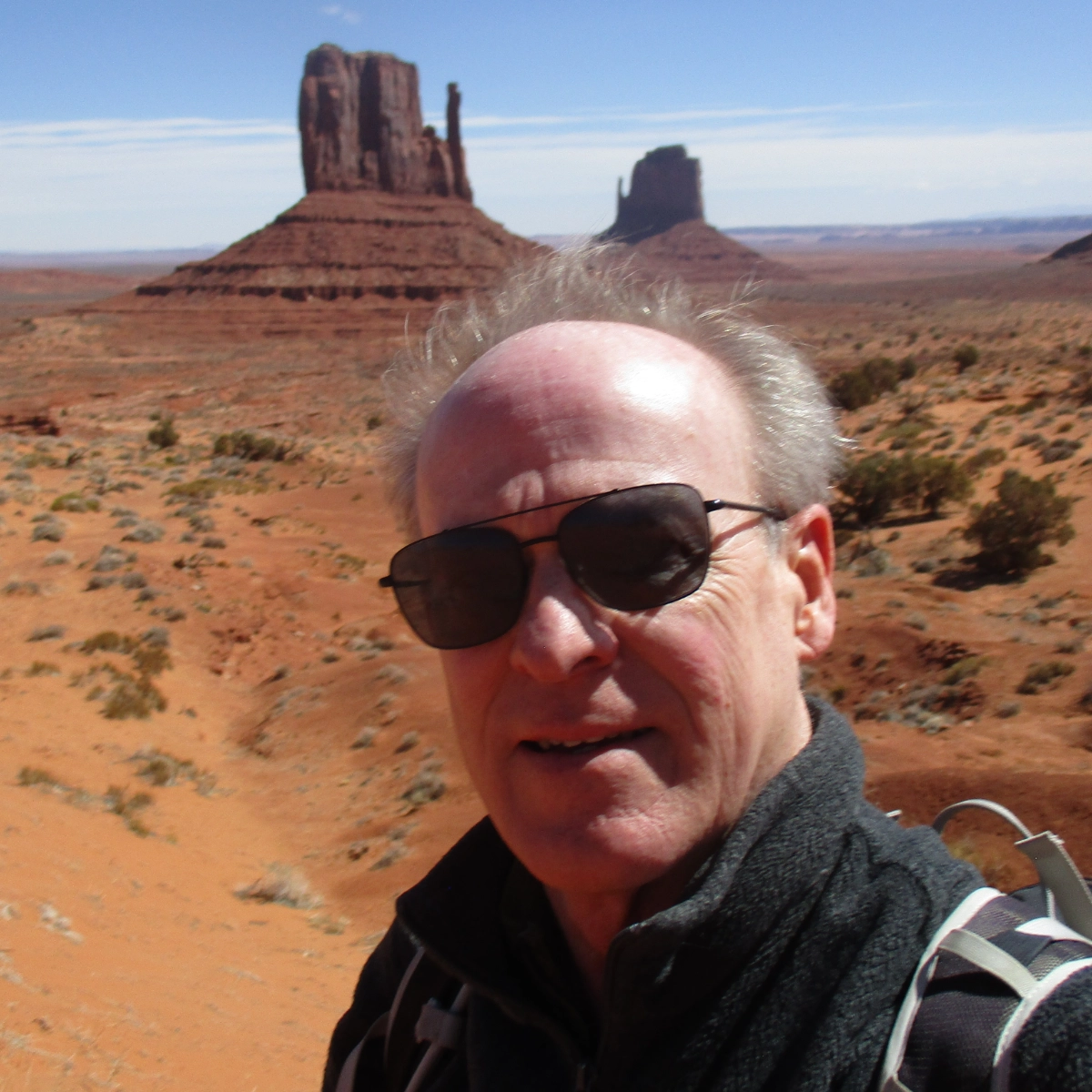
Don Lago is the author of Canyon and Cosmos: Searching for Human Identity in the Grand Canyon (University of Nevada Press, 2025), which uses the Grand Canyon as a Walden Pond for exploring the place of humans in the grand scheme of things. It includes Native American spirituality, as several tribes regard the canyon as their place of origin. He is also the author of other book of literary nature writing, including Where the Sky Touched the Earth: The Cosmological Landscapes of the Southwest, which holds a Monument Valley sunrise on the cover. He lives in a cabin in the forest outside Flagstaff, Arizona.


