

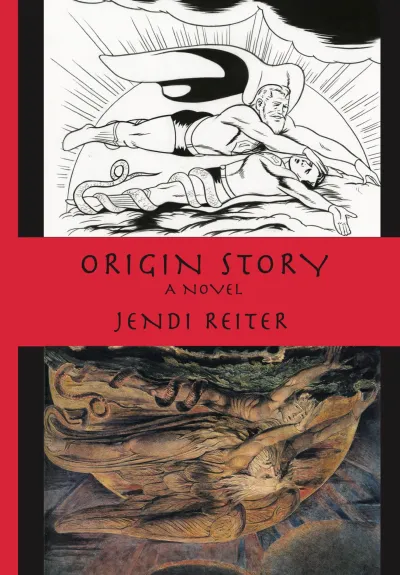
Origin Story
By Jendi Reiter
Saddle Road Press, Ithaca, NY
381 pages
My hands were tied to the bed when the timer went off.
… “Uh-oh, Peter, was that the oven or the smoke alarm?”
What better way to serve up a novel than with sex and food? In what is the most playful, provocative, and disarming opening I’ve read in years, Jendi Reiter wastes no time introducing his characters and setting them in motion with vivacity and panache.
New York City, late-1990s. Peter Edelman, the principal narrator, and Julian Selkirk, his boyfriend, both in their mid-twenties, have been lovers for five months after Julian’s former lover, Phil (and Peter’s best friend), died a year ago of AIDS. But it isn’t the disease that casts a long shadow over this ambitious and courageous novel. Something happened to Peter in his childhood—something so traumatic he fractured into multiple selves.
Someone…did something to me…a long time ago. And I will find out what it was. [ ] And all of us were in danger. I hugged myself tight, trying to keep everyone inside from tumbling out.
Origin Story is Peter’s journey to find the source of the fracture, and heal and become whole again.
Reiter’s investment in Peter and Julian is so deep we cannot help falling in love with them. Peter: yoga coach, gym trainer, and mentor to a homeless teen; Julian: rising star fashion photographer. We are moved by their emotional and physical intimacy. Their erotic sex is scribed with joyful abandon and acrobatic grace. Rough, tender, holy, immediate, and abundant — bed, bathroom, under a boardwalk with the ocean lapping waves, on a tangle of power cords beneath the stage of a Christian men’s revival in full crescendo, (the sex and the salvation).
Their intimate dialogue sparkles with wit and innuendo, spontaneous and improvised, like jazz. Yet something in Peter holds him back from a full, loving commitment. Something compels him to slip off into the night for a session in a BSDM basement: “Keep it safe. Nothing that’ll leave a mark. My boyfriend doesn’t like it.” It is heartbreaking to witness.
As young gay men, we see Peter and Julian through the lens of their respective families; Peter, a Jew from New York City, has a rich history in tradition and scholarship. His maternal grandfather, Rabbi Saul Hauser has died recently and Peter is sorting a cache of letters between his grandfather and another rabbi. They wrestle with the origin of their faith, Adam and Eve, and their expulsion from the garden. The letters appear randomly in the novel and are one of the unconscious triggers in Peter that begin to awaken him to the trauma of his own origin story and the expulsion from the garden of his childhood. The correspondence is one of the many genres Reiter employs to illuminate Origin Story.
Julian’s family is from Georgia. They are evangelical Christians, and his father has political ambitions. His high school friend, Brent Harrison, with whom he had his first sexual experience, has found Jesus and is emailing him with the Good News. Julian’s response: “…—are you still gay and taking cold showers, or did Jesus electroshock you into kissing girls the way you used to kiss me?” But Julian keeps up the email exchange. Is he curious or tempted?
Peter’s mom manages Gateway House, a shelter that takes in kids who are homeless because of family trauma or addiction and prepares them for permanent foster homes or independent living. She asks Peter to join the program as a mentor, and he bonds with Tyler Wick, a genderfluid teen who also goes by Tai, his feminine self who, in this gender, is a graphic artist.
I saw different. … I saw it in the tilt of her head, how she swung one leg over the other, the assured flick of her hand inking figures into action on the page. Tyler was no Method actor performing these tics for an audience. Both halves were real.
Peter’s talent as a writer is sparked, and they decide to make a comic book, The Poison Cure, with a superhero, Pharmakon, who dispenses justice to child abusers. It is Peter’s way of unconsciously processing his own trauma. We witness the creative process of their collaboration. It becomes the subtext of Peter’s subconscious, moving him forward (backward) to uncover the truth of what happened to him in his childhood.
Peter’s family is blended through fracture: his parents are divorced. His father, a civil rights attorney, had an affair with a college student, Ada Porter, a poet, with whom he is now married, and they have a teenage girl, Prue, Peter’s half-sister. They have a tender and sassy big brother/little sister relationship. He confides in Prue: “Don’t tell anyone I said this… But I think I was touched in a bad way, when I was a kid. [ ] If I don’t get my brain unstuck…I am literally going to die.” Throughout the novel Reiter folds foreshadowing blended with foreboding to heighten the narrative suspense.
Everyday events become tripwires setting off anxiety attacks he cannot source. As the story unfolds, the attacks become increasingly severe—dizziness, auditory and visual hallucinations, time displacement, memory loss, and blackouts. In a gay nightclub with Julian, Peter has a psychotic break in the bathroom, hallucinates he’s being molested, and is rescued by Julian who was worried he hadn’t returned.
Now I was really scared. I’d stepped out of my life and back in again, without warning. How would I ever stay nailed down?
I leaned my hand against the entryway wall and it didn’t go through. That was a start. In the red-lit corridor I caught sight of my face, broad and shadowy and strange, in the mirrored panel opposite. I took a step closer, into focus. Someone inside me saw a strong man from the future, a Jedi hologram, statue in a secret cave. Help.
At his next therapy session, Peter asks for anxiety meds. Dr. Katz “(‘call me Sid’)” prescribes tarot cards. Peter is skeptical. Sid explains, “Whatever card you pick, you’re going to see something true, because the meaning comes from something you already know on some level.” Peter’s session with his therapist using the tarot deck is another genre Reiter employs to create his tapestry in the making.
I would like to go behind the scenes of Origin Story and consider its framework, for it is a work of art in and of itself. It is analogous to a loom and the craft of weaving which is created by vertical (warp) and horizontal (weft) threads. The warp threads hold the tension — the dramatic arc of the story — and the weft threads are drawn through — over, and under the warp threads (character, plot, dialogue, setting, point of view) — creating the fabric that becomes the story. The expressions to spin a yarn and weave a tale are deeply embedded in our and many cultures.
Reiter’s warp threads are the chapter headings that he uses as the structure upon which to weave his story. The novel is presented in four parts, the name of each chapter heading gleaned from a week in the yearly reading of the Torah.1 The weft threads are the genres Reiter weaves through the narrative: Comic Book, Medical Intake Reports, Journals, Essays, Letters, Emails, Interviews, Diary, Poetry, Lyrical Prose, Tarot, Therapy Sessions, Mix Tapes, and Psalm. As such, Origin Story is situated at the crossroads of our historical moment:
In our current vernacular, this can be considered as intersectionality. This process of converging and conflating experiences can be considered the weft in the lives we continue to weave for ourselves as human beings and society. Within our current pulse, our societal fabric is being unpicked and unraveled through processes of cultural reckonings and unlearning. The established warp threads of inequality, restrictive codes, and divisive conducts are now being brought forth in our daily narratives. Currently, there is an aggressive fervour to reconstruct our societal tapestry with two district approaches. On one side, there is a call for revision and reform, all to instill and install a new warp and weft, where the prospects of inclusivity and cooperation are being broached with a complicated yet considered establishment. On another side, there is also a backlash to reconstruct the status quo – where the weft of an unequal, privileged narrative is being hastily shuttled in.2
Reiter concludes Part III (Bereishis — “In the beginning”) with a seventeen-page tour-de-force climax. Peter can no longer bear not knowing what trauma happened to him in his beginning. He hides himself in his grandfather’s apartment with a notebook to finish The Poison Cure, a deck of Tarot, a razor blade. He is creator, seer, destroyer.
“No one knew where I was. Or when. In my suspended state, could I think myself back into the past that physicists said still existed in some dimension of this room, to find the place where I’ve been broken.”
He puts on the mix tape, draws The World (Reversed) from the tarot deck, and begins to write. The inter-play heightens his inner dialogue, opens the door of his subconscious, and allows the traumatic events to surface.
Quickly now. Wipe this out. Release myself. Every conflicted surrender a training for this. Because I’d always known the truth would end it all.
Or will it?
With some measure, is this not why we read—to discover intimations of our own origin story? This is one of the sublime purposes of art: to give us back to ourselves. I am thinking of Gaugin’s mural, Where Do We Come From? What Are We? Where Are We Going? Reiter extends the mural to our present time. Origin Story is both a map and a manual. By the skill of his craft and the beauty of his art, we find our own path. We draw from his wellspring of courage. We are living epistles. What is the story we tell?
NOTES
I Vayeira: “And he appeared.” Genesis 18:1 – 22:24. Tells the story of Abraham: his great but failed intercession to save Sodom and Gomorrah from destruction, the birth of Isaac, and Abraham’s test to kill Isaac and offer him as a sacrifice to God.
II Beshalach: “When he let go.” Exodus 13:17 – 17:16. After the ten plagues, Pharaoh lets the children of Israel go; crossing the Red Sea; wandering in the wilderness; the miracle of the manna from heaven.
III Bereishis—“In the beginning.” Genesis 1:1 – 6:8, the creation story, Adam and Eve expelled from the garden; Cain, the first murderer kills his brother Abel out of jealousy; the story of Noah and the flood, and the promise of the rainbow.
IV Vayeishev: “And he lived or And he dwelt.” (Genesis 37:1 – 40:23) The story of Joseph the Seer, and his coat of many colors; the jealousy of his brothers who fake his death and sell him as a slave in Egypt.
For an interview (Alternator Chat) with Everett Wong. Among many topics he also connects weaving with colonialism and genderfluidity. https://youtu.be/pHeXZUk0UMQ?si=qAH43foC4on8rFdP

Richard Cambridge’s poetry and theater productions address controversial themes on the American political landscape. From 1998 to 2000, he travelled to Cuba four times as co-founding member (with Patiño Vázquez) of Singing with the Enemy, a troupe of poets, musicians and performance artists. The show, ¡EMBARGO!, a dramatic mural of poetry, music, and dance, portrayed the four decade economic blockade on the people of Cuba. By special invitation, the troupe performed in Havana, Cuba in July 1998 at the historic First U.S.—Cuba Friendship Conference.
Richard was also commissioned by the National Lawyers Guild of Cuba to write and perform a poem for their yearly conference, “From the Belly of the Beast” (1998) and “Letter from Cuba,” (1999). In November 2000 he performed at the World Solidarity with Cuba Conference, in Havana, Cuba.
In 2001, he co-founded ¡PRESENTE! with former African American political prisoner Kazi Touré. In collaboration with local artists and imprisoned activists, PRESENTE! is a dramatic tapestry of poetry, music, dance, mask, mime and ritual that brings awareness to political prisoners and prisoners of war in the U.S.
A longtime resident of Cambridge, MA, he received the Cambridge Peace and Justice Award for his art and activism. He has published poetry, PULSA—A Book of Books (Hanover Press), and a spoken word CD One Shot News—Poetry of Conscience (Earthshine Productions). His awards include The Allen Ginsberg Poetry Prize; a finalist for a residency at the Fine Arts Work Center in Provincetown, MA.
He is a Fellow Emeritus at the Black Earth Institute, a progressive think tank based in Wisconsin. He guest edited Volume II Issue IV of About Place, the institute’s online journal, whose theme was 1963-2013: A Civil Rights Retrospective. http://archive.aboutplacejournal.org/civil-rights/
His poetry, essays, and reviews have appeared in Solstice Literary Magazine, About Place, the Asheville Poetry Journal, and other publications. He curates the Poets’ Theater at Somerville’s Arts at the Armory, and is the poetry editor for The Lunar Calendar. He is working on his second novel, 1970, an alternate history of that year in which a band of activists led by Black Panthers spark revolution in the U.S.


