

This issue of poetry in translation features four contemporary Italian poets: Silvia Rosa, Mariadonata Villa, Edoardo Olmi, and Loris Ferri, as well as one Malagasy poet, Jean Pierre.
In July 2024, I met Jean Pierre in his native village of Ambodipaiso Sud, in the rural Vatovavy region of Madagascar where he serves as a teacher, leader, and a visionary. His poem was originally written in French, the language of the colonizers. It addresses a vacationer from the Global North, who seemingly moves through the bucolic landscape of the Malagasy countryside, yet not without a disquieting twist. The hardworking peasants in the rice fields are toiling under the watchful gaze of visitors from another world, amazed at a lifestyle sometimes still described with the derogatory ethnocentric term ‘exotic.’ The air is thick with echoes of postcolonialism, as the guests are fed with what they expect: traditional music and dance, glimpses inside the huts, and a taste of local liquor. The ‘tourist village’ offers a performance that both sides have silently accepted, despite being aware of its inauthenticity. Jean Pierre bids farewell to a guest he will likely never see again, but through his poem he reaches out to us, extending an invitation for intercultural kinship across boundaries.
Loris Ferri’s poetry addresses two specific topics: the margins and nature. The margins have a double meaning: refugee routes and the borders of existence. Nature, interpreted in a symbolic way, holds the signs of something that transcends matter. Tower of Castellaccio originated as part of a collaboration with visual artist Alessandro Giampaoli. Even though the only remaining part of this ancient watchtower in Lamoli, Borgo Pace, Italy is its very base, its soul is still palpable here. The second poem, Ionian, is a cosmogony of the Mediterranean. The final verses symbolically overturn a dramatic image of drowning that represents the recent migration crises, by focusing solely on nature itself. It’s no longer the migrants who drown, but the horizon that drowns in Africa, before our eyes.
Edoardo Olmi’s poems are often influenced by the Beat poets, as well as Italian and American neo-avant-garde. For example, in “Love Epilexia (Elban Songs)”, Olmi experiments through certain metrical and stylistic elements while meditating on Elba (an island in the Tyrrhenian Sea off the coast of Tuscany, Italy) across time. The poem alludes to Etruscans and ancient Romans, as well as Spain and the Republic of Pisa, only to transition to the themes of the resistance against the invasions by the Barbary pirates, as well as the mining economy between the two world wars and the more recent era of mass tourism. In his poetics, Olmi masterfully oscillates between the lyricism, tradition and innovation.
For Mariadonata Villa, poetry is not only an act of resistance, but it also has a salvific function. In her poetic statement, she writes: “I believe there is a karstic river in contemporary Western poetry that is trying to restore an original, archetypical relationship with wonder and to eschew the Cartesian axes that limit our vision. Poetry holds a space for epiphanies, and for all that is unspeakable to exist.”
Silvia Rosa’s two poems revolve around the theme of thresholds and transitions. The lyrical speakers stagger on the border between life and death. What happens at the moment when one loses their body and steps into another dimension? What do deceased people whisper from the place of loss? For Rosa, poetry is a place for healing, where one can redefine pain. Poetry does not just capture a feeling, but liberates it, because here every expression takes on an autonomous, mysterious existence.
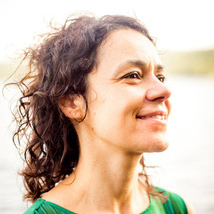
Ewa Chrusciel is a poet, translator, and educator. She has four books of poems in English with Omnidawn Press: Yours, Purple Gallinule (2022), Strata, Of Annunciations, Contraband of Hoopoe, as well as three books in Polish: Tobołek, Sopiłki, and Furkot. Her book Contraband of Hoopoe was translated into Italian by Anna Aresi and came out in Italy with Edizioni Ensemble in May 2019. Her poems have been included in curricula at institutions such as Harvard University, University of Wisconsin, Dartmouth College, Salem State University.
She also translated various authors into Polish, including books by Jack London, Joseph Conrad, and I.B. Singer, as well as book of selected poems by Jorie Graham (2013), and aforthcoming book of selected poems by Vievee Francis (2027), and selected poems of Kazim Ali, Lyn Hejinian, Cole Swensen, Mathew Olzmann and other American poets.
She is a Professor of Creative and Professional Writing and M. Roy London Endowed Chair at Colby-Sawyer College.


