

This issue gathers three poets writing from Eastern Europe: Roman Honet and Tadeusz Dąbrowski from Poland, and Yury Zawadski from Ukraine, each working the same fault line between the personal and the historical. What follows are three very different answers to a shared inheritance: how does a poet from this part of Europe write a private life when history keeps insisting on being the subject?
Roman Honet is a legendary figure in Polish poetry. He belongs to what a famous Polish literary critic, Marian Stala, named the “current of emboldened imagination” and he’s been called one of the “new existentialists,” though neither label quite pins him down. His debut, alicja, announced the generation born in the 1970s, poets who came a decade after bruLion and had no patience left for the old fight between classicism and barbarism. Karol Maliszewski, a renowned critic of Polish poetry and a poet himself, even spoke of a “Honet line,” crediting him with breaking the hold that Marcin Świetlicki (who was also featured in one of Solstice’s issues) and the bruLion style still had on Polish poetry at the time.
His poems are oneiric, hermetic, and bewildering. They revolve around a theme of memory and loss that’s intuited rather than named outright. The dreamlike images keep colliding with the turpistic, and existential undertow running beneath both. Take a poem “I opened a dream which was not mine”: wreckage disguised as landscape, a crashed space probe, old car seats abandoned in grass stands in for a province, a childhood, a grief Honet won’t name directly. The syntax destabilizes its own authority. The mourning keeps getting interrupted by something closer to fable: bees imagined as feeding on clapping and music, the dead disguised as children eating songs.
If Honet’s poems dissolve the world into private myth, Zawadski’s move in the direction toward a poetry that insists the personal was never really private to begin with.
Yury (Jurij) Zawadski / Юрій Завадський (born in Ternopil in 1981) holds a doctorate in comparative literature and is known in Ukraine chiefly as an “extreme” poet, oscillating between conventional free verse and sound/phonetic poetry (zaum-adjacent “poetry without words,” built from syllable and sound rather than sense). His 2006 piece “ЦИГАРКИ” (Cigarettes) is considered one of the first hypertextual poems published in Ukraine, and his collection ТАКСИСТ (Taxi Driver) — a free verse fused with sound poetry — was shortlisted for the Ukrainian Book of the Year in 2015.
The poems presented here belong to a different register: rather than the sound-poetry he’s known for, they draw on the Eastern European Romantic tradition. They originate from a series of portraits in his Polish-language book Jak poczuć się samotnym w zatłoczonym pociągu (Zawadsky writes in both Polish and Ukrainian). These portraits evade closure; they are indeterminate and elusive. This current in Ukrainian literature — retreating from war into privacy or aestheticism — is the opposite of Zhadan’s poetics. Yet these aren’t ultimately private poems; they revolve around the themes of time, identity, memory. For a poet from this part of Europe, personal life is always only a pretext for philosophy, and Zawadsky genuinely has the mind of a theorist. In the Eastern European tradition, the poet is never solitary but always a poet among others, shaped powerfully by community and place of origin. This is also, covertly, an erudite poetry: its topography is historical as much as personal. The Dnieper isn’t simply a river but a symbol of Ukraine, so almost involuntarily, everything becomes myth. An American reader should notice that the movement here runs in the opposite direction: an attempt to reclaim an intimacy that the universal has swallowed, to recover biography from its captivity within fate.
Tadeusz Dąbrowski closes the issue just with one poem but working from yet a different trajectory. Not as much as myth-making but its refusal, a plainness that turns out to hide as much as Honet’s or Zawadski’s density does.
Tadeusz Dąbrowski writes with a deceptive plainness; the kind of clear, unadorned language that, as Billy Collins has noted, can smuggle in mysteries no straightforward prose could carry. There’s something of the reporter in him, as Adam Zagajewski once observed: a realist’s temperament pressed into service not for accusation but for revelation, compressing the absurdity of the contemporary world into lines of remarkable density. That density rarely feels heavy, though his poems have a way of teaching the reader how to be bewildered and astonished all over again, as Ilya Kaminsky put it, finding the surreal already embedded in ordinary life rather than imported from elsewhere. In the poem “Uisge beatha,” presented in this issue, a lapsed churchgoer’s wry, half-ironic return to Mass via a homily that compares Pentecost to a whisky-tasting with old friends dissolves, almost without warning, into a moment of unguarded grief. The poem’s real subject turns out to be underfoot the whole time: the oakwood parquet beneath his feet, identical to the floor of his childhood home, undoing all his irony in a single, quiet image.
Three poets, three different types of soil underfoot but in each case, fertile – feeding on syllables and songs.
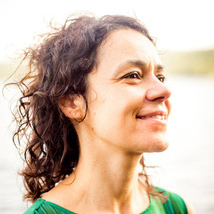
Ewa Chrusciel is a poet, translator, and educator. She has four books of poems in English with Omnidawn Press: Yours, Purple Gallinule (2022), Strata, Of Annunciations, Contraband of Hoopoe, as well as three books in Polish: Tobołek, Sopiłki, and Furkot. Her book Contraband of Hoopoe was translated into Italian by Anna Aresi and came out in Italy with Edizioni Ensemble in May 2019. Her poems have been included in curricula at institutions such as Harvard University, University of Wisconsin, Dartmouth College, Salem State University.
She also translated various authors into Polish, including books by Jack London, Joseph Conrad, and I.B. Singer, as well as book of selected poems by Jorie Graham (2013), and aforthcoming book of selected poems by Vievee Francis (2027), and selected poems of Kazim Ali, Lyn Hejinian, Cole Swensen, Mathew Olzmann and other American poets.
She is a Professor of Creative and Professional Writing and M. Roy London Endowed Chair at Colby-Sawyer College.


