

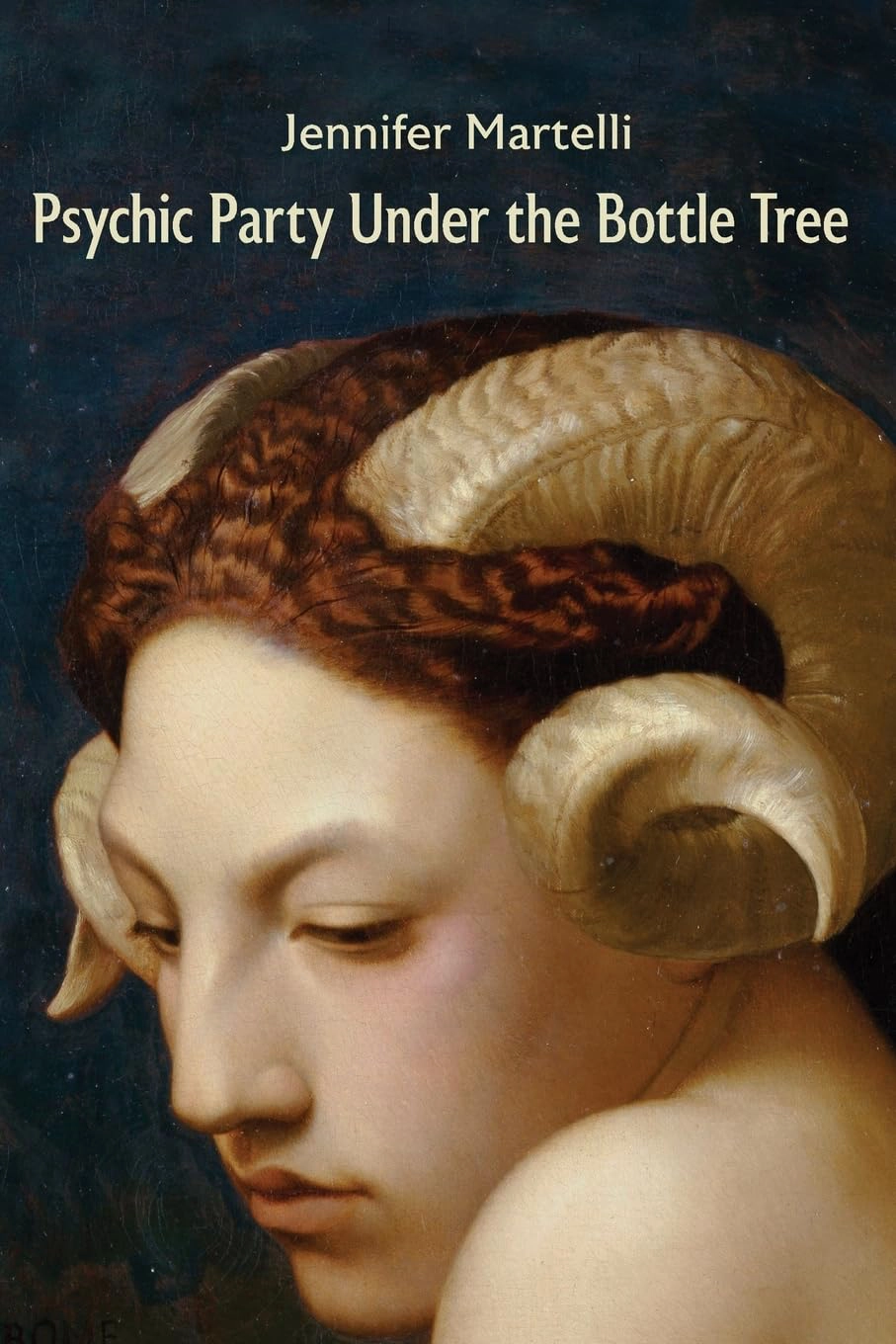
Psychic Party Under the Bottle Tree by Jennifer Martelli
Lily Poetry Review Books, 2024
82 pages
ISBN: 978-1-957755-42-7
$18
Those fortunate enough to be familiar with Jennifer Martelli’s previous collections of poetry will recognize in Psychic Party Under the Bottle Tree her signature use of recurring motifs and unexpected juxtapositions. Fear of snakes, suffocation, images of dead plants fill these poems which are also haunted by her past struggles to achieve sobriety as well as to maintain it. This is her most personal collection yet, one that lays bare the speaker’s terrors and insecurities while that very act of revelation also showcases her boldness for these poems are not just about one’s fears but a primer for how to survive them.
The title poem itself is both an invitation and a warning, for who wouldn’t want to witness experience a psychic party under a bottle tree? Yet the guests are enclosed in glass bottles hanging from a tree, and the psychic with the pendulum gives ambivalent answers: Yes, they will leave the tree but no, not soon. The pendulum with its yes/ no vacillation captures the mood of the collection. We can escape our metaphorical bottles and the fears that limit us, but not quickly or easily. Maybe not even permanently, for generalized fears such as “Someone out there is angry with me” are difficult to banish permanently.
Like most mothers, this speaker worries her own frailties will infect her children. “Even when I stopped believing in God,// I prayed my kids would never feel as I do.” Again, in the poem “Sobriety,” she writes, “…I fear/snakes and I fear my children//being lonely, as I am lonely.” That artful line and stanza break after “I fear my children” enacts the conflation between fearing for one’s children and fearing them for the ways in which they make you confront your frailties.
The world Martelli gives us may be full of danger and treachery but also resistance, for isn’t the very willingness to expose oneself a possible form of resistance? Although the poet fears suffocation, hers is a voice that will not be suffocated or silenced. For example, in the opening poem “Is There Anything under that Layer?” Martelli writes “The father betrayed his daughter because he adhered//to his own mythology, like most fathers,” and that brief aside, “like most fathers,” shifts the poem for one crucial moment from the fear of being the victim to a sardonic comment on the victimizer. In “Meat,” a food stuff that generally repulses the speaker, she cooks it in red sauce “to make amends to my husband/for my mean words I said and meant.” This line brings us back to that party under the bottle tree where the psychic’s pendulum swings both yes and no. Although the speaker makes amends, her intention stands.
To create this complicated emotional landscape, Martelli makes every part of a poem carry weight. “Ghostwriter” showcases this skill. This poem, like so many others, is infused with a sense of danger. The streets are flooded and filled with sewage. The description of wreckage after a storm is grotesquely human: maple trees have “spilled their innards” and those snakes reappear as downed wires “some live// like snakes still dangerous though dead.” We could be in the midst of one of those horror movies the poet repeatedly references. And yet the poem concludes with an image of innocence and hope: “My daughter breathed on the window to make/even more fog: drew things with her finger: hearts, stars, her name.” So perhaps this mother has not passed on her own fears to her daughter after all. The daughter not only traces symbols of hope but claims them by writing her name. Even the title of the poem, “Ghostwriter,” intrigues. Is the daughter the ghostwriter helping her mother compose a kinder narrative? Or is the mother the ghostwriter narrating the world she wants her daughter to inhabit? One in which her daughter turns away from her gossiping friends in a way the mother cannot turn away from her own hurts? Such provocative questions these poems raise!
Although the poet may tell us she spies “on the people I believe/rejected me/which means I spy on the whole world,” throughout the collection the way she inhabits this fear of rejection is an act of generosity and valor. Phobias of snakes and meat may be specific to this speaker, but her generalized anxiety and loneliness are something I daresay we have all felt. She lays open our wounds along with her own allowing them momentarily to breathe. “I’m balancing at last, well past/my own apogee,” she tells us because ultimately this collection is as about managing our inevitable vulnerabilities as it is about suffering from them. In the opening poem, Martelli writes “mostly I don’t want to be disregarded. That’s the fear.” Jennifer Martelli, let me reassure you, no one who reads this brilliant collection will ever disregard you.

Kathleen Aguero’s most recent book of poetry is World Happiness Index from Tiger Bark Books. Her other poetry collections include After That, Investigations: The Mystery of the Girl Sleuth, Daughter Of, The Real Weather, and Thirsty Day. She has co-edited three volumes of multi-cultural literature for the University of Georgia Press (A Gift of Tongues, An Ear to the Ground, and Daily Fare). She teaches in the Solstice low-residency M.F.A. program at Lasell University and in Changing Lives through Literature, an alternative sentencing program. Kathleen has received grants from the Massachusetts Council on the Arts and the Elgin Cox foundation.


