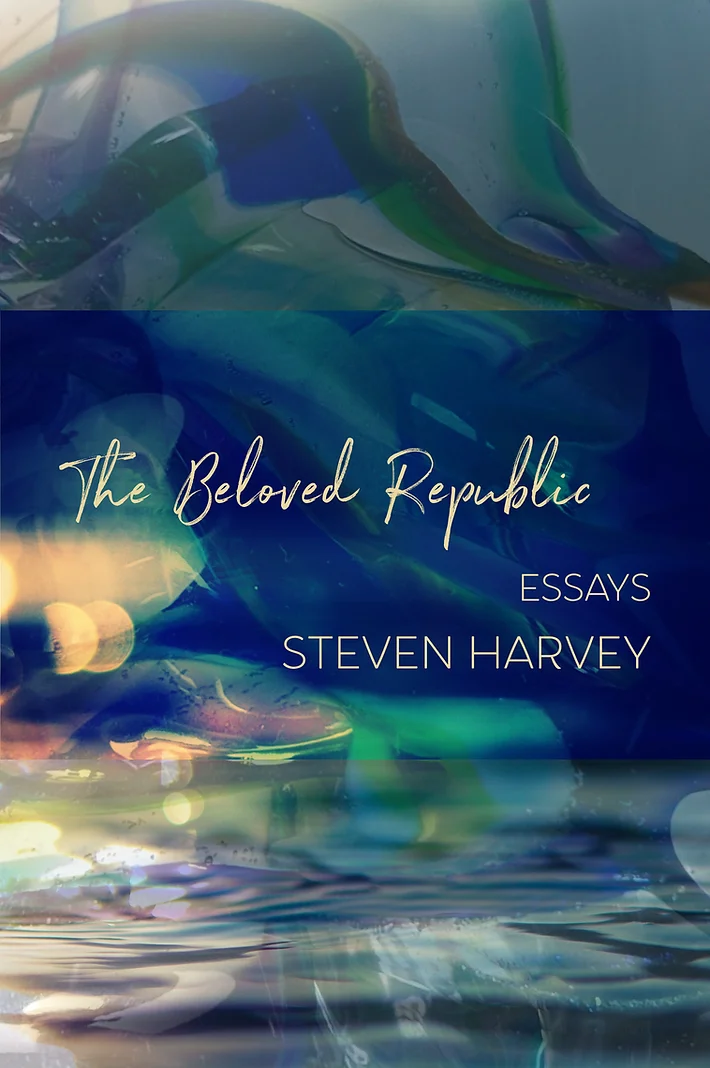
Steven Harvey
Wandering Aengus Press, 2023
“The beech tree rising in our bow window finds its own shape without any help from me.” So begins “A Whole Life” Steven Harvey’s preface that, like the taproot of the tree, anchors the collection of essays in The Beloved Republic. Written over a quarter of a century the beech tree inspires Harvey as his essays “reveal who they are, and, perhaps, why they are here. Like the beech, they grow into themselves over time.” He notes that the word for “book” and “beech” is the same in German (buch/buche). As the beech branches and grows its leaves so does Harvey the pages that become the essays of the book. What a wonder, art following after nature.
Harvey discovers a unifying principle, “the old idea that creativity is valuable in itself….that art generates meaning and offers beauty to a troubled planet, and in its very freshness is profoundly spiritual and political. Those who do this work form the ‘Beloved Republic,’ a phrase E. M. Forster coined,” (and which gives Harvey the title of his book and its signature essay)…”for the peaceful and fragile confederacy of kind, benevolent, and creative people in a world of tyrants, thugs, and loud-mouthed bullies.”
The opening essay, “The Beloved Republic” chronicles a sixteen-hundred-year period of creative artists and their works of beauty only to be followed by political and religious movements of murder, destruction, and terror. “During the intervals between these periodic bouts with brutality, the Beloved Republic comes out of hiding, staggers blinking into the light, and begins to create again.” I think of Yeats’s poem, “Lapis Lazuli,” a meditation on the necessity of art in the face of tragedy: “All things fall and are built again / And those that build them again are gay.”
The centerpiece of the collection is “The Political Personal Essay.” Harvey has honed his craft as an essayist but admits he was reluctant to write about overtly political subjects early in his career. After the election of Donald Trump, his thinking began to evolve. In February 2017 he attended a writer’s conference in Washington, D.C. Though brilliant wordsmiths, the speakers resort to clichés. “What was missing in their oratory was their skill with written language…I knew I had to find a way to address public subjects in prose that clearly took a stand but remained subtle and, above all personal.” He turns to James Baldwin who had opened his eyes to racism when he was young. He rereads “Notes of a Native Son,” and follows its author to his father’s gravesite where in a moment of lyrical introspection Baldwin receives an epiphany that will forever change him: he must accept the reality of racism “totally without rancor” while resisting those evils “with all one’s strength.” Accept and resist. “Without acceptance, there is no hope for love, and without resistance there is no hope for justice.”
Harvey’s struggle may be different, but the method and the path is the same:
What we need is the essay, artfully constructed, which allows us to watch the idea in all its complexity unfold in the writer as he responds to events. It is not pure mind at work — this is not analytical philosophy — but the mind in context, in flux amid apparently irreconcilable conflicts where the self is forged. It is that self in the process of forming that we as readers insist the personal essayist be true to when writing on a political evil like racism.
Harvey has now forged a new tool that will serve the dual function of personal transformation: excavating the residual evils within as a member of the dominant culture — racism, homophobia, white privilege — and inviting the reader into the intimacy of his heart to witness the struggle.
Once we live through the conditions under which the thinking happened…we are more apt to see the idea anew and modify our own position and even change our minds or, if we agreed with the idea from the start, feel less lonely in our convictions.
It is this process of intimate reflection that Harvey applies to the essays. In “The Other Steve Harvey” he reveals he is often asked, only on the telephone, if he is the black television star. After a lighthearted exchange, “No, he’s the rich one,…I’m the other Steve Harvey,” he reflects on how white supremacy “others” people of color. When his wife gives him a hoodie for a Christmas present and he tries it on, “I love this!” is his response. But he also reflects Trayvon Martin loved his hoodie too, and it got him murdered. He excavates the subtleties of racism, how, unbidden, the first thought that arises when he sees a person of color is the color, not the person. When he enters downtown Atlanta, he clicks the lock on his car door. When he gets out of his car he moves his wallet to his front pocket. He observes this. He tells us. We (if we are white) register the measure in ourselves. Where are we along this spectrum?
“Where do we take this?” President Obama asked, reflecting on the death of Trayvon Martin. Harvey knows: “When I see a black man, I must teach myself to see a father, husband, or son. When I see a black woman, I must teach myself to see a sister and a potential friend.”
In “Madre Luz,” Harvey considers the paper-mâché statue artist Pablo Machioli installed in Baltimore’s Wyman Park in front of the statue of Stonewall Jackson and Robert E. Lee. He reflects how, when he and his wife lived near the park when he was in graduate school, he “hardly gave [the statue] a thought.” Madre Luz, which means “mother light,’ was designed to “create a conversation” about race. But she has been beaten toppled, and thrown to the ground — only to rise again.
Harvey executes a powerful reversal. Instead of focusing on the beauty of Madre Luz, he shines her light and illuminates the darkness around her: the racists, neo-Nazis, white nationalists, David Duke and the KKK, the riot in Charlottesville. He hands them the mic, so to speak, and records their rage, spiteful dialogue, and verbal gunshots, nearly two-thirds of the essay. When a reporter interviews one of the leaders in his motel room, he unpacks all the firepower he’s wearing, “a lethal-weapon striptease….The bed looks like a crime scene.” This takes a great deal of courage, even faith. I wonder why he is doing this. And then it comes to me: it’s an exorcism.
“An enormous crane lifts the double statue of Lee and Jackson from its pedestal in the pre-dawn dark….Mother Luz stood triumphant, representing the only way to fight hatred: allowing vulnerability to penetrate the consciousness and prick the conscience.”
Harvey doesn’t gloat in the spectacle of justice. Rather he brings it home to personal witness and reveals another layer of subtle racism now brought into the light. “I think back on the many times Barbara and I walked past the Lee-Jackson monument oblivious to the burden it placed on the city. Now we know. Peaceful protesters force us to confront truths beyond ourselves and see past our blindness.”
I conclude this review with “The Book of Knowledge,” Harvey’s origin story. It begins, “In 1952 when I was three, my parents bought me a set of The Book of Knowledge, ten hefty volumes bound in maroon leather, each filled with questions from ‘The Department of Wonder.’” Harvey reminisces of the joy of thumbing through the volumes “taking in the strange and glorious pictures.” For his mother, who had dropped out of nursing school at nineteen to marry his father, the encyclopedia was a self-help book on culture that filled in “the gaps in her education [which] were becoming an embarrassment.” The books also helped fend off depression that swept over her during these years, when his father traveled on business. A few paragraphs praising the volumes that “will never fail for children…the best of all stories told in the simplest words, to the greatest of all ends.” Followed by an abrupt section break.
“And what is the end? On April 6, 1961, when I was eleven, my mother drove into a park near Deerfield, Illinois, where we lived at the time, and killed herself with a gun…. I remembered almost nothing of my life or her life before the suicide except a few vivid flashes, images, really, with the rest blown away by her death.”
When he turned sixty he came across the cache of letters — 406 of them — that his grandmother had given him in his thirties — letters between her and his mother, letters that he never read. He buys a used set of The Book of Knowledge. “Armed with letters and a children’s encyclopedia, I was determined to know who this woman was, and, with luck claim a legacy of beauty and wonder from a devastating event.”
We follow Harvey as he meanders back and forth in time stitching the past with the present until a patchwork quilt of innocence and wonder, horror and tragedy emerges, and he (and we) are made whole. From a letter he almost didn’t read he discovers that his parents awakened him to see Sputnik 2 although he has no memory of it. So he recreates it in his imagination with loving, exquisite detail:
…when my parents and I, somewhere in Illinois, stood in a darkened field together and looked into the heavens. I picture the tableau now like some illustration out of The Book of Knowledge, with me standing in my coat and flanked by my parents, my dad pointing, and my mother with an arm around me, while the three of us gaze into the night sky with wonder.
“This is,” my mother wrote, “a fabulous age.”
The essay transcends its genre, and in the process transforms into something else. Dare I say we enter the realm of the sacred and what I now hold in my hands is not a collection of essays but books of wisdom and redemption, a turning away (the true meaning of repentance) from the dominant culture Harvey was born into, and toward, as Harry Belafonte put it, “freedom and justice [the] universal concerns of import to responsible people of all colors.” I am not reading The Beloved Republic; I am in the Beloved Republic reading The Book of Steven which is chronicling for me this mystic landscape. Harvey as culture scout and guide tracking us forward in our own journeys as peaceful warriors, creating art, making music, writing poems, or simply raising a family, our children being the most precious living and breathing works of art.
All the essays folded into the pages of this book are worthy, instructive, and a delight. I can’t help but think that Harvey’s ultimate gift to us is the humble trade of a surveyor. He maps for us the shape and contour of the Beloved Republic, marking the borders and the boundaries so we get our bearings — what is right and what is true, what is beautiful and what is just.

Richard Cambridge’s poetry and theater productions address controversial themes on the American political landscape. From 1998 to 2000, he travelled to Cuba four times as co-founding member (with Patiño Vázquez) of Singing with the Enemy, a troupe of poets, musicians and performance artists. The show, ¡EMBARGO!, a dramatic mural of poetry, music, and dance, portrayed the four decade economic blockade on the people of Cuba. By special invitation, the troupe performed in Havana, Cuba in July 1998 at the historic First U.S.—Cuba Friendship Conference.
Richard was also commissioned by the National Lawyers Guild of Cuba to write and perform a poem for their yearly conference, “From the Belly of the Beast” (1998) and “Letter from Cuba,” (1999). In November 2000 he performed at the World Solidarity with Cuba Conference, in Havana, Cuba.
In 2001, he co-founded ¡PRESENTE! with former African American political prisoner Kazi Touré. In collaboration with local artists and imprisoned activists, PRESENTE! is a dramatic tapestry of poetry, music, dance, mask, mime and ritual that brings awareness to political prisoners and prisoners of war in the U.S.
A longtime resident of Cambridge, MA, he received the Cambridge Peace and Justice Award for his art and activism. He has published poetry, PULSA—A Book of Books (Hanover Press), and a spoken word CD One Shot News—Poetry of Conscience (Earthshine Productions). His awards include The Allen Ginsberg Poetry Prize; a finalist for a residency at the Fine Arts Work Center in Provincetown, MA.
He is a Fellow Emeritus at the Black Earth Institute, a progressive think tank based in Wisconsin. He guest edited Volume II Issue IV of About Place, the institute’s online journal, whose theme was 1963-2013: A Civil Rights Retrospective. http://archive.aboutplacejournal.org/civil-rights/
His poetry, essays, and reviews have appeared in Solstice Literary Magazine, About Place, the Asheville Poetry Journal, and other publications. He curates the Poets’ Theater at Somerville’s Arts at the Armory, and is the poetry editor for The Lunar Calendar. He is working on his second novel, 1970, an alternate history of that year in which a band of activists led by Black Panthers spark revolution in the U.S.