

Thinking of William Carlos Williams’s famous quote “It is difficult to get the news from poems yet [people] die miserably every day for lack of what is found there” and Stanley Kunitz’s view that poetry makes revelation possible, we bring you features from the French, Russian and Polish that cultivate their inner vision by seeking an adequate language to articulate that vision. In doing so, they unify us, as all art does, acting as a force for good in a world that so desperately needs it.
Susanne Petermann brings us lucid translations by Rainer Maria Rilke (1875-1926) from the French, the language Rilke wrote in only toward the end of his life. The poems are noticeably more childlike than the vast body of his work, drawing attention to their irony. One poem captures the emotional intensity of a child waiting for a parent; the other the plight of the refugee whose child needs comfort more than the truth that “there is no song/can stop the rising sea,” though the song may be just “a lovely ship in a bottle.”
With vigor and passion, Ilya Kutlik engages us in a metaphysical confrontation with time through a fusillade of imagery where Time is a shapeshifter from ghost horseman to cannon-ball till all that’s left is God. Kutlik writes in his biography that he is one of the founders of the Metarealist Russian school of poets, a group that “with audacity and wit and allusiveness have explored a variety of metaphor that defies reality.” His ending of “Hell & Paradise” surely speaks to the strange and contradictory blend of human and divine that we are. We are truly delighted to bring you these poems eloquently translated from the Russian by Reginald Gibbons.
Jadwiga Malina’s poems come from her recent collection “Czarna załoga” [Black Crew].
These poems are haunting. They revolve around the themes of eco-poetry, freedom, human violence and empathy. They are Cassandra-like divinations, foreseeing the ecological and historical catastrophes. They are situated (they tiptoe, in fact) on the quivering line of the historical force encountering a single human life. They continually pose a question: Unde Malum?
–Barbara Siegel Carlson and Ewa Chrusciel

Barbara Siegel Carlson is the author of What Drifted Here (Cherry Grove, 2023), Once in Every Language (Kelsay, 2017) and Fire Road (Dream Horse, 2013). She is the co-translator (with Ana Jelnikar) of Look Back, Look Ahead, Selected Poems of Srečko Kosovel and co-editor (with Richard Jackson) of A Bridge of Voices: Contemporary Slovene Poetry and Perspectives. Her poetry, translations and essays have appeared in Verse Daily, Cortland Review, Mid-American Review, Salamander, Slovene Studies and elsewhere. Her poems have been nominated for Best of the Net and Pushcart prizes. A fourth book of poems The Current is forthcoming in 2026.
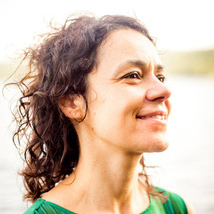
Ewa Chrusciel is a poet, translator, and educator. She has four books of poems in English with Omnidawn Press: Yours, Purple Gallinule (2022), Strata, Of Annunciations, Contraband of Hoopoe, as well as three books in Polish: Tobołek, Sopiłki, and Furkot. Her book Contraband of Hoopoe was translated into Italian by Anna Aresi and came out in Italy with Edizioni Ensemble in May 2019. Her poems have been included in curricula at institutions such as Harvard University, University of Wisconsin, Dartmouth College, Salem State University.
She also translated various authors into Polish, including books by Jack London, Joseph Conrad, and I.B. Singer, as well as book of selected poems by Jorie Graham (2013), and aforthcoming book of selected poems by Vievee Francis (2027), and selected poems of Kazim Ali, Lyn Hejinian, Cole Swensen, Mathew Olzmann and other American poets.
She is a Professor of Creative and Professional Writing and M. Roy London Endowed Chair at Colby-Sawyer College.


