There has been no hour which I do not wish to remember.
Margaret Gatty, The Book of Sun-Dials
“The only real objection,” said Sir Arthur Conan Doyle on the 19th of April 1909, while debating the Daylight Saving or Early Rising Bill, “is that it would set all the sundials wrong.”
In October, the tilt of the Earth positions Scotland at its farthest point away from the Sun. The days shorten and darken; sunrise is late, sunset early, and, as if overseeing the end of the day, the splendid orange-gold globe of the solar star squats large and low on the horizon, larger—and lower—than at any other time in the calendar year. At this point, the UK turns its back on British Summer Time in favour of the lighter mornings endowed by Greenwich Meantime.
Sunday. 1.50 a.m., 29th of October 2023. Outside my front door, the only illumination is the arc of light cast by the security lamps, which flick on as the dog steps over the threshold heading for a soggy mishmash of fallen leaves to void her bladder. Leaf after leaf, red, tawny and yellowing, have been falling from the sycamores since late September, following an earlier descent of samaras, the double-winged seedpods, which catch the breeze and whirl to the ground to ensure a sycamore future. Chilled by the drizzle, I raise the collar of what was once my husband’s blue worsted dressing gown. A dressing gown I adopted after his death two years, eight months and ten days ago. The rough surface of the gown tickles the nape of my neck. I run my hand under the collar, lifting it away a little from my skin. Nearby, low down in the bushes, something scurries among the shadows. The dog lifts her head to reveal her spaniel profile and sniffs the air.
Sundials rely on shadows. The gnomon, “the shadow caster,” projects a dark line on the plate of the dial when struck by the sun. And as the sun appears to move across the sky from east to west, the shadow line keeps pace, creeping clockwise round the dial and marking the hourly intervals engraved on its face; a steady tempo, an unstoppable movement, an inevitable progression of time from sunup to sundown.
After dark, when the sun gives way to the moon and the stars, the sundial’s expression of time is absent. “Time,” observed Margaret Gatty in 1872, “is blank if we cannot mark the stages of its progress.”
Time, like the thrill of an unstoppable southwesterly wind, that lifts the red-gold autumn leaves in a swirl of excitement, presses against the sinews of my body, snatches my breath, streaks my hair grey; time drives across the open fields we once walked together, flattens the grasses, bows the grizzled trunks of the Scots pine and silver birch trees in our woodland garden, loosens their limbs and weakens their will to stay upright. And as it passes, as the leaves float calmly to the ground to wither on the yellow quartz gravel at my feet, time, like the wind, is gone.
Time. Does it then simply give shape and form to the past when remembering who, what and when? Mechanical time does fix the pattern of our daily activities: a time to rise, a time to eat, to clock in and clock off, to catch the train, the bus, the ferry; the ticking clock marshals the moments of our day.
Yet mechanical time, as recorded now in the twenty-first century, is less than one hundred and fifty years old. Local apparent time—dependant on the position of the sun and the cast of a sundial’s shadow—prevailed across the globe until the mid-nineteenth century, when the clatter of machines, the quiver of letters along copper wires in telegraphic communication and the rigidity of railway timetables exacted an internationally agreed mean time.
The UK linked national time to the Greenwich meridian in 1880. Four years later, The International Meridian Conference, held in Washington and attended by twenty-six nations, recognised Greenwich as the “single prime meridian”, thus linking world time zones to Greenwich Mean Time. Greenwich held as the international standard until superseded in 1972 by Universal Coordinated Time, which—based on four hundred and fifty atomic clocks held in eighty-five national laboratories—also accounts for the Earth’s irregular rotation, adding and removing seconds gained and lost as the planet loops the sun.
When measured in hours, minutes, seconds, and milliseconds, when displayed on clocks and watches, computer screens and tablets, when collated on calendars in days and months and years, the perception of time as a single linear thread seems unquestionable; time past trails behind, time future looms ahead. However, “doesn’t time also unfold, -buckle, -braid?” asks Lia Purpura when considering the act of remembering. The question niggles.
1.52 a.m. The security lamps snap off. I stand isolated in the enfolding darkness. It is a moment before I hear the clink of the dog’s pink heart-shaped name tag as it taps against her collar, as she rummages in the leaf litter, unearthing as she goes a fusty odour of decay; it is a moment before my eyes accustom sufficiently to register the stars, the moon and the curve of leaf and branch illuminated in the lunar light to silver-grey. It is but a moment. But within that moment, before I step back within range of the sensors and reactivate the lamps, it is as if there is a temporal pause—the briefest suspension of time—yet enough to muster my thoughts. The lights click on. I regain my focus. And I realise I’ve been holding my breath.
Step with me now through the open doors of a theatre; nestle in the comfort of a blue velvet-clad seat, shoulder to shoulder with fellow theatre goers; feel the warmth of their bodies, the swirl of muted conversation; linger over the smooth pages of the programme; and when the lights dip, when hush descends, when the black fire-screen lifts and the heavy gold-fringed drapes draw back to reveal the light and the dark of the stage, engage (via the magic of the imagination, the dramatist’s words and the actors’ skills) with the virtual world of a stage play—and time splits. “There are,” notes Ayckbourn, “two ‘time streams’ running simultaneously: stage time and real (theatre foyer) time.”
Step into the pages of a book, let’s say Anthony Doer’s Cloud Cuckoo Land—a fictional tale within a fictional story written through the eyes of multiple characters in out-of-sequence time fragments, and plotted as a puzzle for the reader to mentally reassemble—and time splinters further. There is at first real time—the days and hours it takes to read the book— then calendar time—the date, the month and year of reading—and then there is book time, the span or spans of time—past, present, and future—that the author’s characters inhabit the story. Doer crafts strings of words to form images and embody characters, build worlds and tell stories that resound across aeons: the past mingles in the mind with the present and the future.
Time becomes fluid. It feels less like a forward projection of events and experiences, with the occasional backward glance, and more like the elliptical orbit of the earth around the sun. And like the planet, time speeds up and slows down; it spins in daily revolutions as shadows lap and overlap the face of the sundial, creating a form of déjà vu.
1.55 a.m. I have carried my copy of Cloud Cuckoo Land outside with me. Its five hundred and fifty-seven pages are heavy in my hand. I watch the dog snuffle in the dark undergrowth and tiptoe over the angular, sharp-edged gravel, the shape of her body merging with the bushes. I wonder: Is she content to live in the moment, her inflated nostrils filled with the track and scent of what has scuttled through the leaf bed sometime before and which might return? I cup Doer’s closed book between my hands and strive to make sense of my world; to give shape to moments lived and an order to memories, as recollection of the past and imagination of possible futures collide in the present. And I ask myself what string of words and stories, forgotten histories and characters, also brought me here to this point, to this stage.
Just visible inside the arc of light is a silver birch, its arched branches overhanging the drive. The continuous drop of triangular, once mid-green now yellow-brown, serrated leaves—each no bigger than a ten pence coin—add to the decaying leafy vegetation that covers the tarmac and catches in the lush leathery evergreen branches of an established rhododendron, which in spring, when the clocks accelerate forward an hour, will produce a short-lived display of red funnel-shaped flowers, where the first bees of the season will hover, gathering pollen on the fine hairs of their legs.
The night is timeless. The sky is dark. The waning gibbous moon has disappeared behind dense clouds. I am bound in the present. The gentle rustle of a breeze as it ripples through the birch tree is all that disturbs the quiet. Out with the embrace of the electric light; all is black and grey. Stark shadows thrown on the white front of the distant garage door suggest a cityscape, New York perhaps. Berlin. Tokyo. I could be anywhere, in any time, at any time or nowhere at all.
British Summer Time ends tonight. Behind me, in the house, the old pendulum wall clock strikes two sombre notes. Two a.m. The last chime hangs momentarily in the air, overtaken by the new-fangled wireless clock, which whistles into action and reverses time by one hour. It is 1 a.m. again.
A scatter of silver birch leaves blown in through the open door lay forlorn at my slippered feet. The dog slips past me, the silky hair of her coat brushing the exposed skin of my leg below my pyjamas. And in the ring of artificial light, in the artificial construct of time, I’m aware of an hour waiting to be relived. And I wish I could experience again the days, the nights, the hours of a more previous time, a time before the blue dressing gown became mine.
Note
With thanks to Capel Tenison at Border Sundials, Abergavenny, for setting me straight on how sundials work and permission to use the phrase “the shadow caster.”
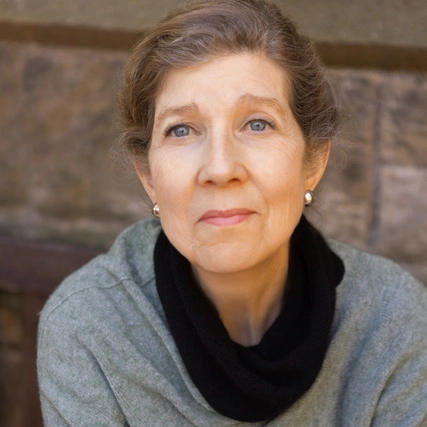
Frances Hider won the Women on Writing (Q4) creative nonfiction essay competition in 2021 with her essay “Safe Haven.” Her writing has also appeared in the Los Angeles Review, Cumberland River Review and Does It Have Pockets. She lives and writes in Scotland.