

When the master would be sick, the house Negro identified himself somuch with his master he’d say, “What’s the matter boss, we sick?” …the field Negroes were the masses… When the master got sick, they prayed that he’d die. If his house caught on fire, they’d pray for a wind to come along and fan the breeze.
• Malcolm X, from “Message to the Grassroots”
The recent inferno at Louisiana’s Nottoway Plantation has unleashed a firestorm (no pun intended) of controversy. Memes abound on social media where Harriet Tubman, Frederick Douglass, and ghosts of the formerly enslaved watch the fire burn in vindicated satisfaction. Some excerpt Malcolm X’s famous speeches about the House Negro and the Field Negro (see above). In several tongue-in-cheek posts, Black celebrants roast marshmallows, do the “Boots on the Ground” line dance, and throw Juneteenth picnics before the flaming Big House. Yet others who lament the loss of the South’s largest antebellum mansion fail to understand why such destruction should be so gleefully celebrated.
Whether one loves or loathes them, slaveholding plantations hold a powerful place in the American imagination—even for African Americans who left the Southlands a century ago. In a cycle of Great Migrations, six million souls sought respite from the vestiges of slavery and its legacy of violence and racial injustice.
My mother was one of those people. The love child of two unwed young people, she left the Mississippi Delta to attend high school in Memphis, then moved to Chicago, where her mother had come some years before.
Mama hadn’t seen her birth father since leaving Leland at the age of 12. At 57 she got the urge to hear his voice, looked up his phone number, and spoke to him. After decades of separation, finding Nathaniel Griffin had been as simple as a Directory Assistance phone call.
Mere months afterward, my sister, Sheryl, and I loaded my mother, my 18-month-old son, and my friend Angela into a cramped Toyota for the 700-mile road trip down South. Mama would see her father, and we’d meet our grandfather for the first time. Angela would also visit her own father, who’d recently left Chicago in reverse migration, moving back home to Mississippi.
Having grown up with horror stories about Emmett Till, lynching, and Jim Crow segregation, we were pleasantly surprised at the open friendliness of Mississippians from all races and walks of life. My sister and I became eager to sample the food, music, and lush landscapes. We frolicked at the Greenville Cypress Preserve, pretending to throw each other to the alligators. We even drove to a cotton field and yanked up a plant to take home as a souvenir. We were so charmed by Southern culture and hospitality that it came as a shock when the tattered remnants of Southern racism slapped us full in the face.
A brochure in our Greenville hotel advertised that a historic cotton plantation, The Aldridge, was open to the visiting public. Neither of us had been to a plantation, though we’d read about them in books and seen them depicted on television shows like Roots. Thinking it might make for an interesting educational experience, I called to arrange a tour. The next day, I set out with Sheryl for a drive to the outskirts of Leland.
I’d expected a sweeping drive leading up to a grand Greek Revival-style mansion with a white-washed façade, shady verandahs, and towering colonnades—somewhat how Nottoway looked before it burned down. Instead, we pulled off Plantation Drive onto a gravel driveway that fronted a modest two-story home of unpainted brick. Were we even at the right place? Squinting in the brilliant sunshine, I consulted a paper map to double-check our destination, GPS guidance not being available at the time.
The Yankee inflections of my telephone voice must have misled someone into thinking I was White. A plump, balding man came out on the portico, shading his eyes with an upraised hand. Upon seeing our black faces, he shook his head and waved us away.
I lowered the window and called out to him. “But we made an appointment.”
“We’re closed,” he said shortly.
“Are you open tomorrow?”
The man turned his back, went inside, and slammed the door.
When we returned to Leland, I told Miss Griffin, my grandfather’s wife what happened at The Aldridge. She gazed at me, hand over heart. “Y’all went out there? Oh, we don’t go there.”
We must have seemed quite the naïve pair of city slickers blundering in where angels fear to tread. Being turned away from a plantation tour might well have been the least of our worries. We were less than an hour from Money, Mississippi, where a 13-year-old Chicago boy named Emmett Till had been lynched 30 years earlier for allegedly whistling at a White woman.
To some, a plantation may seem innocuously anachronistic, like an insect trapped in the amber of history. Yet most Blacks harbor no fantasies of mint juleps in the magnolia-scented moonlight. Plantations may be shrouded in the cobwebs of memory, but like those lauded old times of “Dixie”—that anthem to the antebellum nostalgia—they are neither gone nor forgotten.
That man at The Aldridge and Miss Griffin both seemed to know something we didn’t. Those manor houses were never intended to accommodate people like us. Those of my step-grandmother’s generation may have sharecropped there or remembered friends and family being exploited at such places. They might even have known someone who’d been enslaved at the Aldridge, perhaps a grandparent or a great-grandparent.
There were unwritten rules about who was allowed into “The Big House.” These weren’t just domiciles for enslavers and their families, but seats of power meant to showcase the owner’s affluence and stature. The wealthier the planter, the grander the manor house.
Those of unfavorable social status were not welcome, whether Scots-Irish overseers, the peasant class derisively referred to as “poor White trash,” and most certainly not any Black field hands. One notable exception was the obligatory presence of “House Negroes.” Enslavers and their families didn’t do their own domestic work, not with an unpaid labor force to do it for them.
There were social divisions even within the confines of captivity. Field workers were at the bottom, and skilled artisans stood midway in the pecking order. House Negroes, perched at the top of this hierarchy were sometimes met with sour grape resentment. They were often scorned as collaborators, informers, and “Uncle Tom” lackeys who identified more with the slaveholders’ interests than their own, hence Malcolm X’s lampoon of an imaginary House Negro fretting over Ole Massa’s failing health.
House Negroes’ work often spared them from the burning heat, the bitter cold, and the driving rain. They ate White folk’s leftovers and wore their castoff clothing. Yet enslaved domestics also lived under the careful attention and strict control of their enslavers. Instead of toiling in the fields from “can’t see to can’t see”— daybreak to dusk—they might labor up to 20 hours daily at demanding, demeaning, and sometimes dangerous tasks.
On hot summer days, enslaved children were given bulky, laced-together palm fronds. They’d be made to stand for hours fanning as White planters and their guests gathered to dine and socialize. Children also served as human foot warmers on wintery evenings. I ask you to pause and imagine grown folks warming their crusty feet on the naked backs of children.
Males in the Big House worked as butlers, valets, waitstaff, and coachmen. Women cooked, cleaned, ironed, dusted, stoked fires, emptied chamber pots, breastfed, and raised the Mistus’s children. We heated the water, bathed our enslavers, styled their hair, cared for them when they were sick, helped them in and out of their clothing, and tucked them in at night. Yet our work still might not be done. After having likely risen before day, some were made to work deep into the night as “belly warmers” and “bed wenches.”
In this atmosphere of strained intimacy, any Black man, woman, or child was subject to arbitrary punishment for real or imagined offenses. Any of them might be raped, otherwise sexually abused, or physically assaulted up to, and including death. Indeed, those in the fields, the stables, or artisan shops weren’t exempt from such maltreatment either. Yet people in the Big House were inherently more likely to fall prey to these forms of intimate violence. Small wonder that many of their descendants feel a visceral sense of revulsion to sites where such abuses transpired.
Singer and actor Jill Scott published a 2020 Instagram post she called “Pissed.” In the downtime on a film shoot, she was taken on a tour of a restored plantation. Yet Scott found herself unable to unwind at a place where her ancestors may have been tortured and terrorized. “I felt all those emotions. Raw anger, frustration, hurt, sadness, grief, astonishment, baffled.”
The trauma response was so severe that in protest, an unnamed “someone” in her party urinated on the dining room carpet. Scott didn’t identify herself as the culprit, though she didn’t deny it either. In a quote that quickly went viral, she likened her plantation experience to “a bed and breakfast in Auschwitz.”
Like those Nazi death camps, plantations are haunted spaces, though not always by spectral visitation. Plagued by the traumas of history, they also become time travel devices, offering journeys into experiences some are loath to revisit. Yet others must relish the “bed and breakfast in Auschwitz,” or these sites wouldn’t be so lovingly preserved, with new structures built to resemble the old.
Scholars and activists who advance the study of “reparative semantics” encourage us to reconsider the ways we speak about slavery. You may notice I only use the word “slave” in the context of nonhuman experience, e.g., slave narratives. I recognize enslavement as a condition rather than an identity and acknowledge the fact that those who held us captive never truly owned us. As such, I’m careful to refer to the people as enslaved or captive, and to identify their captors as slaveholders or enslavers, versus owners or masters. And what about the places where all this happened? Would plantations seem quite so charming if we call them what they actually were—slave labor camps or even death camps?
On the reality television series, The Bachelor, single women join a pool of contestants to compete for the attention of one eligible, attractive man. The first Black man on the show was North Carolina native Matt James. He gradually winnowed down the competition to Rachael Kirkconnell, a White woman of part-Latine descent born and raised in Georgia.
A firestorm of controversy erupted when stories emerged from her past. Kirkconnell had liked friends’ social media posts with images of Confederate flags. She even dressed in antebellum costume for a plantation-themed party. James quickly ended the relationship, though eventually they “worked things out” and got back together, only to break up again several years later.
Some felt the criticism of Kirkconnell was overblown. They didn’t think the young woman had done anything wrong, and even if she had, it wasn’t that serious. Tone-deaf and puffed up with self-righteousness, Chris Harrison, the longtime host of The Bachelor franchise, rushed to Kirkconnell’s defense in a contentious debate with the first Black Bachelorette, Rachel Lindsay. He soon found himself out of a job.
Why was this situation so controversial? What was so bad about a college girl dressing up as a Southern belle for a sorority party? Was this a case of cancel culture gone wild?
Critics insist that nostalgia for plantation life cannot be separated from nostalgia for slavery, the “peculiar institution” it was built upon. Many people of color, including The Bachelor himself, were disturbed by Kirkconnell’s past behavior.
A man of biracial White and Nigerian descent, James has no enslaved family ancestry but was raised in the South and claims a Black American identity. He took his intended’s cluelessness as a sign she might not be ready for an interracial relationship. Perhaps some wise elder had also whispered in his ear, “Baby, we don’t go there.”
Ever mindful of my step-grandmother’s counsel, I will admit to having “gone there” on occasion. I visited Port Antonio, Jamaica with an old flame, not realizing the resort we were booked into had been a plantation manor. Though the proprietors appeared to be Creole White Jamaicans, I wasn’t sure if the property was still in the hands of the original enslavers’ descendants.
We checked into a room whose tropical planter décor we found charmingly old-fashioned, if a bit rundown and dated. As we lounged in bed, a mouse went skittering across the floor. Later, a small, furry flying thing fell from the ceiling. Upon closer inspection, I realized it wasn’t an insect. I screamed and brushed the bat off my companion’s back, more freaked out over the nocturnal visitor than he seemed to be.
We compared notes with our guide the next morning over breakfast. He hadn’t encountered any bats the previous night, though he too had been visited by a mouse.
“I guess every room gets one,” my partner shrugged.
Maybe “Ole Massa” (or Bakra, as Jamaicans would have called him) was so scandalized at Blacks sleeping in the Big House, that he unleashed a plague of rodents to drive us out.
The establishment of European plantation culture in the Caribbean, Brazil, and coastal West Africa predated its introduction to the United States. The nature of tropical crop cultivation encouraged slaveholders to employ the labor-intensive gang system. Enslaved people were worked brutally, sometimes to death, to be quickly replaced with newly trafficked Africans.
The international slave trade was outlawed at the turn of the 19th century, though US slavery would endure for nearly another 60 years. North American slave traders began finding it challenging, though not impossible, to smuggle in captives from the African continent.
The concept of breeding farms whose main function was forced mating and selective reproduction may be more myth than reality. Yet slaveholders did become invested—often obsessively so—in Black fertility. They appraised human virility and nubility with terms like “stud,” “buck,” and “mare,” expressions generally used for breeding livestock. Enslavers also noticed that fertility increased when Blacks could supplement their meager diets with independent farming, fishing, and hunting. In time, the market in Black bodies transitioned from imported commerce to an internal trade of Creolized, i.e., American-born population of African descent.
Sites of enslavement weren’t limited to plantations where dozens, sometimes hundreds were held. Many Blacks worked small farms with fewer than ten captives. Others lived in Southern cities, where the enslaved might count for up to 20% of the general population.
Despite this reality, the plantation looms large in the American imagination, both inventive and fact-based. Literature and popular culture examine very different aspects of the experience, depending on who tells the story.
There’s the plantation nostalgia of works like Gone With the Wind. Tara is a prosperous Atlanta-area property until the “War of Northern Aggression” forces Scarlett O’Hara and her genteel sisters to pick cotton with their lily-white hands. On the other hand, Martin Scorsese’s Django Unchained treats the plantation as a site of farcical excess and debauchery.
Black writers have taken a unique perspective on the subject. Crime novelist and television writer, Attika Locke attended a relative’s wedding at a Louisiana plantation. The experience so haunted her that it evolved into The Cutting Season. This thriller set on a Southern plantation links the historic disappearance of an enslaved person with a modern murder mystery.
Novels like Colson Whitehead’s Underground Railroad, Margaret Walker’s Jubilee, and Octavia Butler’s Kindred are partially set on plantations, along with such nonfiction slave narratives as Frederick Douglass’ My Bondage and My Freedom, Harriet Jacobs’ Incidents in the Life of a Slave Girl, and Solomon Northrup’s Twelve Years a Slave. In many works of Black literature, including Alex Haley’s Roots, plantations are not only places where unspeakable violence is enacted upon Black bodies and psyches but also powerful sites of resistance.
Breaking or hiding tools, work slowdowns, practices of religious faith, a form of cultural satire called “puttin’ on Ole Massa,” and the creation of community in the face of terrorism were covert forms of resistance. Overt resistance included escape from bondage, physical attacks on slaveholders (sometimes to the death), and armed revolts.
Bussa’s Rebellion in Barbados, the Palmares Kingdom of Brazil, Tacky’s Revolt in Jamaica, Gabriel Prosser’s and Nat Turner’s uprisings in Virginia, and the armed rebellions that would converge in the Haitian Revolution were all staged from plantations. In contrast to Malcolm X’s famous “House Negro and Field Negro” analysis, enslaved domestics often figured prominently in these acts of resistance.
In the US context, plantations are identified with the South, where cash crops like cotton, sugar, rice, and tobacco were cultivated. Slavery did exist in Northern states and Canadian territories, though the populations were considerably smaller than in the South. While plantations were established in places like Sussex County, Delaware, and Brooklyn, New York, enslaved northerners were more widely dispersed across farms, dockyards, mines, factories, artisan shops, and households in rural and urban areas. Freedom also came to various parts of the Northlands some six to eight decades before Southern emancipation.
Some plantations never recovered from being abandoned en masse by formerly enslaved workforces or raided and destroyed by Union troops in the Civil War. Others endured up to a century past emancipation by converting to sharecropping, a system in which agricultural workers—often the formerly enslaved—paid landowners—generally the former enslavers—a portion of the yield from crops they raised and harvested. In theory, Blacks could now benefit from the fruits of their labor. In practice, sharecropping re-enslaved them to generations of debt.
Some Blacks were held captive as convict laborers. Rounded up on pretexts like loitering, they would be leased by the state to private planters, or incarcerated at prison plantations like Mississippi’s infamous Parchman Farm, the Old Atlanta Honor Farm, and the Louisiana Prison at Angola—once an actual plantation. Populations of predominantly–though not exclusively–Black men were forced into the same backbreaking labor once performed by their enslaved ancestors before the Civil War.
By the mid-20th century, mechanization rendered agricultural labor all but obsolete. Thus, the era of the working Southern plantation abruptly came to a halt, and many were demolished or deteriorated into ruins. Those still standing now serve as interpretive centers, event venues, inns and hotels, and private residences.
Plantations may seem more acceptable when repurposed for educational and historical pursuits. Living history museums and interpretative sites include Thomas Jefferson’s homestead at Monticello, Colonial Williamsburg (formerly the Middle Plantation), and Caw Caw Interpretive Center, a Charleston area wildlife preserve and demonstration rice farm. The Edwin Epps House once stood on a plantation where free Black Northerner, Solomon Northrup was enslaved after being kidnapped in 1841. It has been relocated to the campus of Louisiana State University at Alexandria to serve as a museum helping to tell the story of plantation life.
Then there are the kind of venues that Jill Scott referred in her “bed and breakfast at Auschwitz” analogy. In her undergraduate thesis, Gone with the Wedding: The Historical Evolution of Southern Plantation Weddings and Subsequent Cultural Implications, Louisiana State University student Madeline May Holmes explores how Southern plantations became intimately “entwined with the wedding industry.”
According to Kelly McWilliams, author of the novel, Your Plantation Prom is Not Okay, celebrities like Blakely Lively, Reese Witherspoon, Jennifer Lopez, and Justin Bieber have all celebrated their weddings at former plantations. Lively later issued a public apology for doing so. Restored plantations continue to market themselves as “decadent” venues for romantic, nostalgic nuptials at grand mansions like Oak Alley Plantation in Vacherie, Louisiana, Southern Oaks in New Orleans, Boone Hall in South Carolina, and, until recently, Nottoway Plantation.
Yet some have distanced themselves from a politically fraught past with sites that began as plantations but no longer advertise their founding stories. Others with “plantation” in the title never actually were. They offer the ambiance without the historical baggage. Plantation Hall in southern Indiana was only established in 1999. The main building of the Sanctuary, a resort built in 2004 on Kiawah Island, South Carolina, is modeled after the Southern vernacular manor house but carefully avoids calling itself a plantation.
Some of these properties have even passed into Black ownership, a reality at once affirming and bittersweet. From antebellum times, landowning Blacks in places like South Carolina and Louisiana established plantations where they worked the captives just as hard as any White enslaver. After emancipation, some enterprising freed Blacks managed to acquire the lands where they were enslaved or had sharecropped. This phenomenon reaches into the present.
In the OWN Network-HGTV series Breaking New Ground, Broadway performer, entrepreneur, and self-described “free, gay, Black man,” Robert Hartwell documents his renovation of an abandoned 1822 Great Barrington, Massachusetts, “plantation-style manor.”
The place he now calls Hartwell House was never an actual plantation. While Massachusetts plantations like The Royall House were once active, by the time a wealthy textile industrialist moved into the mansion on Castle Street, Massachusetts had abolished slavery half a century before, becoming the first US state to do so.
Yet Robert Hartwell, who was raised between North Carolina and East Hampton, NY, sees his project as one of cultural reclamation. His research uncovered the presence of an unsung workforce that helped construct and staff the estate, a people who weren’t enslaved at the time but might have been born in captivity. Their movements throughout the mansion were relegated to a shadowy enclosed servant staircase. One of the first actions Hartwell made in renovations was taking up a crowbar and demolishing the servants’ stairs, determined that no Black feet would ever have to mount them again.
Like its southern counterparts, Hartwell’s manor house had been a showpiece for White affluence and power. Indeed, Northern industry was inextricably connected to the Southern economy, as most of the cotton for the New England textile mills was produced with enslaved labor.
Sharswood Manor Estate had a long history as a Virginia tobacco plantation. Built in 1800 as a middling holding with up to 35 enslaved people, its transition into sharecropping lasted well into the 20th century. In 2020, Black military veteran Frederick Miller purchased the property as a private residence, not realizing his great-great-grandparents were once enslaved there.
After researching its history and learning this astonishing family connection, Miller founded the nonprofit Sharswood Foundation to support the plantation’s upkeep and historical preservation. In June 2022, he hosted a Juneteenth celebration with over 1,000 friends and family in attendance. For Miller and others, acquiring the place where their ancestors toiled and transferring sites of trauma into black hands becomes a powerful statement of resistance.
Thanks to the efforts of two Black women, artifacts of plantation culture have been transplanted into new places and contexts. Tsitsi Wakhisi, an associate professor in the School of Communications at the University of Miami, owns a grand 1850 Greek Revival and pine log plantation home. She spent years combing through the real estate listings before settling on the present property.
“I always wanted to buy a home on a formerly working plantation. It was an odyssey of sorts. I must have looked at 20-25 properties in North Carolina, Tennessee, South Carolina, and Virginia.”
Wakhisi obtained her present home in 2016. The Potts Plantation once occupied 17 acres in Westport, Georgia. When the city acquired the property and the surrounding area to build a dam sixty years ago, the home was loaded on a flatbed and transported some 2-3 miles away.
Ongoing maintenance projects seem to go hand in hand with historic properties, house fires being one of them. When tenants accidentally started a fire with extensive damage, progress on her home was set back significantly. It took two years to get things back in shape, but for Wakhisi, it’s all been worth it.
She is well aware of how some Black people feel about plantations. I don’t want to have anything to do with it. Yet Wakhisi maintains that many live this reality, even without even knowing it. “If you don’t want to live on a plantation, then don’t live in the South. They (enslavers) owned hundreds and hundreds of acres of land. You may not be buying the home, but people are always building on former plantations.”
For Wakhisi, this quest represents more than just the charm of a historic property. “I wanted to use it for something that would be uplifting. Let’s take it and tell our story. Otherwise, somebody else is going to take it and tell it.”
She plans to relocate to Georgia after retirement and dreams of founding a writer’s retreat in the space. She also wants to research the property’s history and write a novel about the Black people who labored there.
“Who were these people and what did they go through? You look at the staircase, the kitchen—even though the original kitchen was outside. This is where we were forced into subhuman existence. This is where people were sweating, maybe over there they were planning to escape.”
Wakhisi traces her interest in these properties to a plantation tour in South Carolina. Before arriving at the Big House, she came upon a small church, the original wooden structure built by enslaved people. The sight moved her to tears, and eventually to action.
In a 1926 essay about the role of the Black artist, writer Langston Hughes invokes the memorable phrase “free within ourselves.” In the case of praise houses, enslaved people practiced forms of resistance that proclaimed—as in the immortal words of Atlanta Civil Rights activist, Mother Pollard—“my feets is weary but my soul is rested.”
That notion of living “free within ourselves” is one that Atlanta visual artist Charmaine Minniefield’s Praise House Project has made into a mission. She rescued and restored such a structure, not just to memorialize it, but to preserve its sacred purpose.
Minniefield saved a local praise house from demolition by twice moving it to a protected location. She also curates arts programming there. African belief systems maintain that the power of masks and charms can only be released when they are danced in ritual performance.
Minniefield, who is partially descended from the Gullah-Geechee community of the Carolina and Georgia coastal areas, acknowledges musical and movement traditions called “ring shouts” as part of the “moving meditations” that emerged during our period of captivity. She animates these sacred spaces with song, sight, and movement in performance and art installations.
“We don’t meditate in stillness,” Minniefield maintains. “We meditate in motion. And our memories are medicine.”
Maya Angelou’s oft-recited poem “And Still I Rise” contains the memorable coda: Bringing the gifts that my ancestors gave/I am the dream and the hope of the slave.
In the early stages of the COVID-19 pandemic, a group of fifteen Black Tulane University medical students toured New Orleans’ Whitney Plantation. In an image since gone viral, they posed in white medical coats on the porch of the former slave quarters to illustrate how the past inspires the future.
“Our ancestors learned to crawl so the next generation could walk, so the next could run,” said Sydney Lebat, a co-founder of 15 White Coats, an organization that reinforces positive imagery in global learning spaces. “And now our generation can fly.”
The expression “I am my ancestors’ wildest dream” is a statement of homage to our forebears, acknowledging what author Ta-Nehisi Coates calls “the beautiful struggle.”
This attitude may have prompted my mother’s phone call to Mississippi some 40 years ago. Or maybe it was a premonition. Her father, Nathaniel Griffin, died in 1988, two years after our visit. My mother passed away in 2017, a few months shy of her 88th birthday. If Mama was her ancestor’s wildest dream, I am now hers, as my children will one day be mine.
I haven’t forgotten Miss Griffin’s wisdom of the ages. “Oh, we don’t go there.”
Is there ever a right time to “go there”? For Robert Hartwell, Frederick Miller, Tsitsi Wakhisi, Charmaine Minniefield, the 15 White Coats, and other Blacks who’ve made a difficult peace with plantations, this just might be one of those times. Still others invoke the old chant composed in common and popularized by Rock Master Scott.
The roof, the roof,
The roof is on fire.
We don’t need to water
Let the mutha-fucka burn.
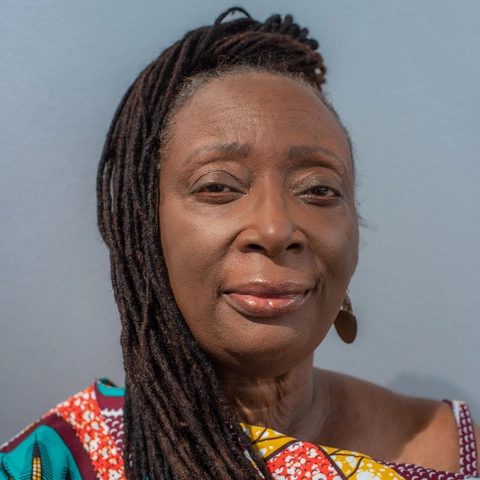
Sandra Jackson-Opoku is the author of the award-winning novel, The River Where Blood is Born and Hot Johnny and the Women Who Loved Him, an Essence Magazine Bestseller in Hardcover Fiction. She also coedited the anthology Revise the Psalm: Work Celebrating the Writing of Gwendolyn Brooks. Her debut mystery novel, Savvy Summers and the Sweet Potato Crimes was published in July 2025. Jackson-Opoku’s fiction, nonfiction, and dramatic works are widely published and produced, appearing in Adi Magazine, Midnight & Indigo, Aunt Chloe, Africa Risen: A New Era of Speculative Fiction, New Daughters of Africa, Obsidian, Another Chicago Magazine, storySouth, Lifeline Theatre, the Chicago Humanities Festival, and others. Professional recognition includes the Malice Minotaur Award for First Mystery Novel, a Plentitudes Journal Fiction Prize, the Hearst Foundation James Baldwin Fellowship at MacDowell Arts, a US National Endowment for the Arts Fiction Fellowship, an American Library Association Black Caucus Award, a City of Chicago Esteemed Artist Award, the Iceland Writers Retreat Alumni Award, a Globe Soup Story Award, and a Pushcart Prize nomination.


