

You are not allowed to speak once the lights go out, and the doors are locked. No one wants to hear your songs once it’s dark, and you’ve been shut away, but you keep singing anyway. Your name is Evangeline, and you will never let it be forgotten.
The other girls tell you the walls in this place are white. You can’t confirm that because your eyes don’t work, but it feels like a white place, stripped of all emotion and meaning. You touch the rough sheetrock and imagine it is bright purple like the walls in your old bedroom where everything was a piece of your story. You had dolls in that room, soft things with button eyes and yarn hair that your mother and sister made for you. Dolls aren’t allowed here because they encourage too much mental stimulation. You trace your name onto the wall with your finger, first in print, then in braille dots. Your nails are kept too short to carve into the paint, but you try anyway. Your name is Evangeline, and some day, you will find a way to make a mark.
You don’t sleep well in the white place where time is a fluid thing. You’re awake when the breakfast bell sounds its clattering call. You trade your insubstantial nightgown for an equally insubstantial shirt, pants, and socks with grippy soles. You don’t know what color they are, but you imagine they are white, ghostly garments for girls who are closer to the dead than the living. You tie your hair in a knot because you’re not allowed to have hair elastics and wait for a nurse to fetch you. You memorized the route to the cafeteria on your first day here, but they don’t like it when you go places on your own, so you don’t. You sit on your bed and wait to be collected by a nurse who does not know that your name is Evangeline.
The nurse’s name is Petra. She’s the one with the nasally voice and hands so slender and fragile they feel like they’re made of bird bones. She tips a pill from a paper cup into your right hand and presses a paper cup of water into your left. “Drink up, sweetheart,” she tells you.
“Evangeline,” you tell her. “My name is Evangeline.”
You tuck the pill beneath your tongue and swallow the mouthful of water in one smooth gulp. Petra takes the cup, then takes your hand to lead you down the hall. You don’t tell her she’s guiding you wrong; you’ve tried asking to hold elbows instead of hands before, and it made no difference. They took your cane when you arrived because of its weapon potential and consigned you to a fate of trailing walls and clinging to the hands of others. They want you to be just another girl with her ghosts, but your name is Evangeline, and you can still think for yourself.
Petra stops at the bathroom, pushes you into a stall, and pulls a curtain closed to give you the closest thing to privacy you’re allowed to have in this place. You pluck the pill from beneath your tongue and drop it into the toilet. The pills make the ghosts go quiet, and you don’t want to live without the ghosts. They are the only ones who remember that your name is Evangeline. You pee, flush, and push through the curtain to where Petra is waiting. You let her squirt soap into your hand and turn on the water for you. Mechanically, you rub your hands together in the cold stream of water. You roll the paper towel she gives you into a ball and hold it out for her to take, then allow yourself to be tugged down a set of stairs and into the cafeteria.
Petra sits you at a table full of other girls who are either drugged into docility or pretending to be. She puts a tray in front of you and presses a spoon into your hand. You probe the contents of your bowl with your spoon: Cheerios. You count out twenty-five Cheerios and use them to spell your name in braille along the top edge of your tray before upending your milk carton over the bowl. You do this every time you are given food that can be used to make braille dots because your name is Evangeline, and you are not as docile as they think.
After breakfast comes the group meeting where all the girls talk about their ghosts. Some have bad ghosts—the kind that spend every waking second whispering wicked wishes and devilish dares into the girls’ ears. Your ghosts are the good kind—the kind that stroke your hair in a ghostly breeze and remind you that your name is Evangeline when you forget to remind yourself. The nurses here think all ghosts are a bad thing; they say it’s unnatural to hear, and see, and speak to things that should not exist. Some of the other girls agree; they happily swallow the pills that make the ghosts go silent, the world go soft around the edges, and the future seem irrelevant. You tell the group your ghosts are quiet because you know that’s what the nurses want to hear, but truthfully the ghosts are singing—always singing, always whispering, always calling your name: “Evangeline! Evangeline!”
You have made a single friend in this place. Her name is Bianca. You taught her braille using Skittles in the lounge while the nurses were away smoking cigarettes, and she used the candies to spell out her plan. Bianca survived on wits and thievery before she came here. She’s got the eyes of a pickpocket and the mind of a fugitive, and those are assets in a place that is designed to negate escape. “Keys,” she spelled in the Skittles once she knew all the letters, “I know where they keep the keys.”
Bianca does not disappoint. She knocks the jar of Skittles onto the floor in the lounge after the group meeting and slips something into each of your grippy-soled socks and into the knot in your hair while cleaning them up. You spell, “What?” with the Skittles on the table. Bianca rearranges them to say, “Nurse Nancy’s keys to my room, your room, and the roof door. Your room is in the left, mine in the right, and the roof in your hair.”
You and Bianca eat the candy evidence of your forbidden communication. You resist the urge to smile because Bianca has told you that the drugged girls never smile. Tonight, when the lights go out, and the doors are locked, you will not be held captive within those four white walls.
You wait until it’s completely silent before you use Nurse Nancy’s key to open your door. You slide the ridged piece of metal back into your sock before you exit just in case you’re caught. You’re not afraid of being caught; no one will ever suspect the blind girl of making and executing an escape plan. You’ll just tell them you’re lost, that the nurses forgot to take you back to your room before lights out, and they will swallow the lies without question as long as they don’t find the keys.
You trail your hand along the wall and count three doors down to the right. This is Bianca’s room. You pull the key to her room from your other sock and flinch at the sound of it scraping as you fumble to insert it into the lock. The door opens with a soft snick. Bianca doesn’t say anything, just links her arm through yours and starts moving silently along the hallway. She leads you up the stairs instead of down, up, and up, and up into a part of this place you’ve never been before, until you reach another door. You slide the key from your hair into the lock, and the door swings open.
A blast of cold, damp air hits your face as you follow Bianca onto the roof. Your clothing isn’t substantial enough for this, but you don’t care. It has been a very long time since you’ve felt rain pouring down upon you and breathed air that isn’t climate controlled, and you’ve forgotten how good it feels. You let Bianca lead you across the roof and put your hands on the top rung of the fire escape ladder. She goes down first, and you climb after her, clinging tight to the slippery metal. For the first time ever, you are grateful for your grippy socks.
Your feet hit the first window platform, and you pause to find your balance. You reach out to touch the bars on the window; the outside world would’ve been so close if the windows weren’t welded shut behind iron bars. You climb downward again. You don’t stop until your feet hit the ground. Then, your hand is in Bianca’s, and you are running. Your name is Evangeline, and you are running away with your ghosts.
The End
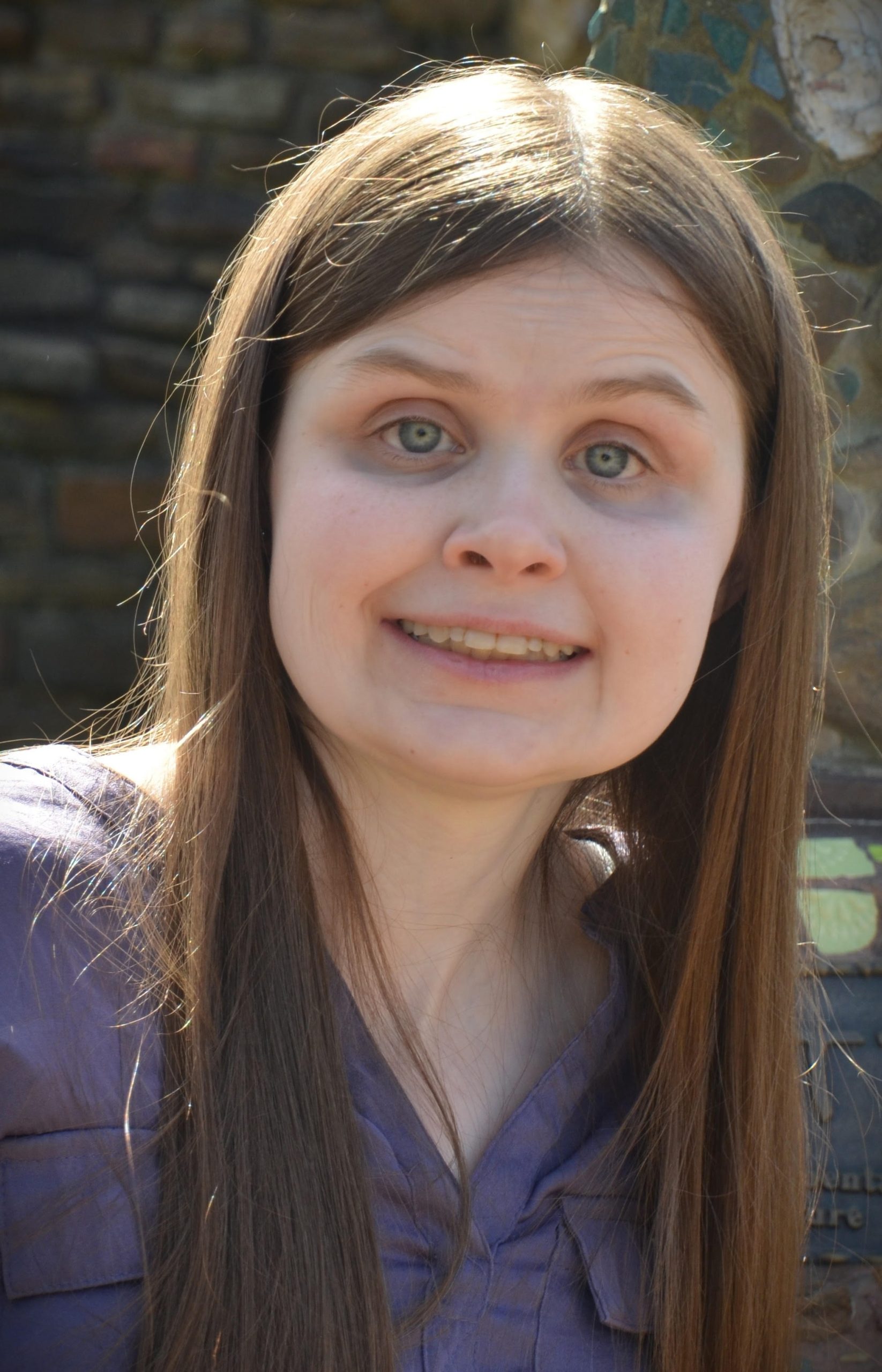
Cheyenne Raine, also known as Caitlyn Laster, is an MFA candidate in fiction living in the American South with her guide dog and two cats. She writes about haunted places, haunted people, and the eerie beauty of small towns. Her work often explores the thin line between the ordinary and the uncanny. Cheyenne is blind and strives to amplify disabled and otherwise marginalized voices through her writing.


