

The first time I saw the Saguenay River it was nighttime. I was driving along the north shore of the St. Lawrence River and stopped at Tadoussac where the road is connected by a car ferry. I stayed the night in a hotel decorated with cartoon posters of baleines, and brochures for whale watching tours on display. I did not have whales on my mind. I did not even know I was travelling alongside a whale corridor, where blues, fins, minkes, humpbacks, belugas and various species of dolphin come in summer to feed in the nutrient-rich waters of the Gulf of St. Lawrence. When I crossed the fjord in the morning on the ferry I heard the whale watching boats blasting their speakers across the wide resonant fjord but I did not see any signs of whales.
Another time while crossing over on the ferry I did see them: belugas. I saw their snow-white forms rise to the surface one at a time like the voices in a chorus, coast on the surface for a while and then dive down and disappear – and then they rose into view again, further out toward the mouth of the fjord. When the ferry docked we rushed to the nearest lookout and climbed up, and from a great height we could look down on the wide estuary opening up toward the Gulf, the tall shoulders of the cliffs rising up on both sides of the broad river, and we saw them again– their white forms moving through the dark water, brightening as they rose, undulating like the movement of mountains rising and descending into a valley, then rising again. The mountains themselves seemed to be breathing with them. In synchronous movements they slipped towards the horizon and out of visibility, vanishing like the last thumbprints of frost on a window. I crossed the Saguenay many times after that but never again did I see belugas.
A long time would pass before I did go on a whale watch. My husband and I were staying at a friend’s cottage on the Bay of Fundy, in Nova Scotia, which as it turns out is one of the best places to see whales. Humpbacks, and the still-endangered right whales, as well as a variety of smaller cetaceans, spend their summers feeding on the abundant herring, mackerel, and small crustaceans in these plankton-rich waters, their prey concentrated by the pull of the tides, the most powerful in the world. I had come to terms with whale watching after learning that whales choose to engage with the friendly humans who come to see them. Those humpbacks breaching and spy hopping and twisting their bodies in the air do seem to be putting on a show for us. The grey whales, who were infamous for their ferocity toward whaling boats, and who a century ago were massacred by human hunters in their birthing lagoons almost to the last one—today they will swim beneath your little boat and lift you up, then gently lower you down again. There is no more fascinating story to me of our evolving relationship with other species than this whiplashing narrative of our relations with the cetaceans.
Species who were ruthlessly hunted only a short time ago for the most pedestrian and undignified uses—for margarine and pet food—who were used for target practice by bomber planes, who were killed simply because they eat too many fish – became in only a decade or two venerated protected beings. (In the year 2024, Norway and Japan are the last to persist in a commercial hunt.) This turnabout in the western world’s attitude towards whales and dolphins in so short a time, may be the most significant shift in the human relationship to non-human animals since the children of Genesis– somewhere along the long road from paradise to the industrial slaughterhouses– walked away from the community of animals to which they had always belonged.
I am not the only one who has looked at this story as an allegory of hope. And yet whales are still dying from a thousand and one causes other than harpoons.
•••
Jonah’s whale is the oldest celebrity whale, as far as I know, although he never even had a name, and this would result in the common confusion between Jonah, the man inside the whale, and the whale who is mistakenly called Jonah. Another confusion is that the whale in the story is so often referred to as Leviathan, when the Hebrew word used in the story is dag which means fish, not לִוְיָתָן (Leviathan). Leviathan was not a whale but a mythical monster. Melville was the one who identified the whale with Leviathan, although Milton before him had sometimes conflated the two. Joan McIntyre, founder of the whale conservation organization Project Jonah, and the editor of an anthology of writings about whales, includes the passage on Leviathan from the Book of Job in her collection, but this monster with scales and fire leaping out of his nostrils, who is “kin over the children of pride,” is not a whale and never was. And this monster is clearly not the creature called up by God to save Jonah from drowning at sea, who is altogether a passive actor in the tale.
It’s hard to know how to read the story. Mostly we remember the first part– where Jonah ends up inside the fish – but not the second, where God sends Jonah a giant gourd to shield him from the desert sun, but then sends a worm to devour it. While the first part of the story serves as a metaphor that can carry so many meanings – the passage through dark night of the soul, the hero’s journey, the resurrection – the second is just odd. After Jonah delivers his prophecy to the Ninevehs, who repent of their wicked ways, fast and wear sackcloth and sit in ashes, even the cattle – God spares them, but Jonah is “very angry.” He begs God to let him end his life. “It is better for me to die than to live,” he says. God then prepares a “gourd” to shield him from his grief, then he prepares a worm to devour the gourd.
Some commentators see humor in this story – the man in the belly of the fish, the cartoon-sized gourd and the worm, the cattle sitting in ashes. Perhaps it was written as a satire of magical beliefs, the kind that the new monotheism had rejected. Jonah was angry that God saved the Ninevehs, who in his mind, were wicked and should have been punished. But the cattle too? says God. Jonah in the end is not a very likable character, an unlikely choice for so grave a role. It is unclear whether Jonah’s confinement for three days inside the fish is meant to be a punishment, or was it an act of mercy? Jonah himself called his entrapment in the fish’s belly a “hell.” But then, he was always a whiner.
Perhaps the ambiguity of the story contains the double meanings the whale will come to have for us – the whale as monster, the whale as a sublime, conscious being.
•••
I came of age in the time of an emerging “save the whale” movement, which I associate in my memory with those images of the earth from space that appeared around the same time. That blue green orb, drifting in a cold dark infinity, sheathed in diaphanous whorls of watery life. Those images showed us that the earth was mostly ocean, and the oceans belonged to the whales.
A passion for whales arose where the space age came full circle to meet the arcadian, where the most advanced technologies would unveil the secrets of supremely intelligent beings who were admired for living without the need for technology at all. Where astronomers in search of intelligent life found signals coming from the deep oceans, and would send those signals back into space on the Voyager Spacecraft, for if any creature on this earth was going to make contact with other intelligent life out there it would surely be the whales. No photo had ever been taken of a living whale at sea before we had images of the earth from space, but now we could see a whale from the sky, her perfectly streamlined body, diving and parting the waters and we almost felt the same awe as we did at seeing the planets and the moon in their celestial orbits. How uncanny that the songs of the humpback whale resembled the ambient synthesized sounds coming from the avant garde composers; that it was the US Navy who first picked up the sounds of whales singing through their deep-ocean listening devices; that it was NASA who gave us those images of the earth through which we would learn to see ourselves as part of one earth, one consciousness, one interconnected web of life.
Above all it was the song of the humpback whale that changed our way of valuing the whale – those haunting, tragic, beautiful songs that could be heard across half a hemisphere of longing, and to which we responded as we did to our own music, to Mozart or Verdi under the subtle influence of Coltrane and Philip Glass. Their songs were unique to their creators, were improvised upon, were taught, were repeated note for note, were heard on the other side of the world. A single song could last up to half an hour, containing, says Carl Sagan, as many bits of information as the Odyssey of Homer or Moby Dick. “Is it possible,” he asks, “that the intelligence of Cetaceans is channeled into the equivalent of epic poetry, history, and elaborate codes of social interaction?”
Who were these extraordinary singers? They were surely not fish. They were not even quite animal, but something else. They were artists, performers, culture bearers, knowledge carriers. Using a language we had reserved for the exceptional human species became unavoidable when speaking about them. Here was a message from the greater universe coming to us not from deep space but from the deep oceans. How strange that of all the animals, the ones who would turn out to be most like us, were the ones who were the least like us.
•••
That the movement to save the whales grew out of a campaign to end nuclear testing was not an accident. These were the activists who belonged to a generation born in the afterglow of the nuclear annihilation of two Japanese cities, who saw their peers dragged off to yet another war, who came back without their legs or the better half of their souls, or who didn’t come back at all. They watched whole atolls vanish under mushroom clouds, and in the action that would launch their movement, they bore witness to the detonation of a five-megaton underground nuclear blast (equal to 200 Hiroshima’s) that measured the heat of the sun, that sucked a giant crater out of the center of Amchitka Island, shattered cliffs and blasted the legs of falcons through their bodies, that split the ears of sea otters who washed up dead on the shores for weeks. On the way home from the Aleutians, having failed to stop the blast, they would pass through an old whaling station and would walk around the piles of bones and the rusted trypots, and in the words of Greenpeace co-founder Robert Hunter, those “who had been so intent on stopping a holocaust” were reminded that “for this other race of giant creatures the holocaust already came.” Warships, in need of new targets for killing, were repurposed into whalers, and these peace activists saw that wars were now directed at the earth itself and that all of life was in the crosshairs. These were the ones who rose up to stop an animal slaughter, unprecedented in scale in human history.
And if the humpback’s songs sounded tragic, if they sounded like the music of grief, maybe that is because they were.
•••
There was a time in my life when I listened to whale song in the dark. It was my Jonah period, when I feared my own choices, when I did not know what voices to trust, when I was altogether without trust in the world. I slept in the day and read books through the night and I listened to records. Whale songs.
For George Orwell, in his essay on the novelist Henry Miller, “Inside the Whale,” the story of a man inside a fish is a fitting metaphor to describe a writer who is indifferent to what is occurring in the broader world around him, one who floats through history, insulated from any responsibility, living inside the whale. Though some find the idea of living inside a “visceral prison” to be a horror, Miller himself found the idea of living in such a place “attractive.”
In the eighties I was no longer reading all night and listening to records, afraid to step out into the world, but I was still trapped inside the whale. So large was my anxiety that I would lose the apartment it took me so long to find, that I would lose my job, that this would be my life. Somewhere the seventies passed into the eighties while I barely noticed the change, when we lost our copies of Small is Beautiful and Black Elk Speaks, when Baba Ram Dass put on a suit and so did I, when we forgot about whale songs. If someone out there was speaking up for the whales (they were), who were still being slaughtered (it’s true), I did not hear them. I did not know how to be in touch with my own grief. The cry of the whale was far away as the radioactive cloud that drifted toward us from Chernobyl.
In the years after I left the city I spent a good deal of my time outdoors. I lead a troop of goats one summer through weedy pastures and idled away the afternoons with them. I lived in a houseboat where I was rocked at night by the wakes of passing boats and washed with neon lights passing though the portholes. In the years that followed when I lived by Lake Champlain even when I was home I kept a sleeping bag and tent and cooking pots at the ready beside my door. For weeks at a time I slept on fir bough carpets where I listened to the loons at night, the aurora swooning and sashaying overhead. I walked for hours along the lake shore and watched the snow geese in their enormous congregations make their wakes in the sky. I trekked through logging slash and saw rivers dammed up and listened to the grief of those who lost their ancestral homes, and who mourned the animals and the forests churned up into phone books and toilet paper. I stood in protest for First Nations whose lands were under assault, for the women of the Narmada and for Mumia Abu Jamal and for Leonard Peltier and for Palestine. I did not need to believe I could change the world only to believe in those who gave their time, who showed their bravery, the ones who stood up on the backs of dying whales and lived in trees and who put their bodies in front of bulldozers in the olive groves of Palestine. And in the ones who knocked on doors and stuffed envelopes and did not ask for much in return. On the cold Labrador Sea I saw lone minke whales, pilot whales who swam beside us, puffins diving in the fog, icebergs licked by sunlight into merengue peaks and troughs. I saw a pod of belugas cross the Saguenay.
I learned that they, too, were dying.
•••
It is odd that although I can remember the calls to “save the whales,” the bumper stickers and newsreels of Greenpeace activists in tiny inflatable boats coming between the whales and the harpoons, I still imagined spermaceti candles and baleen corsets when I thought of whaling. Starbuck and wind-powered clipper ships. In my own lifetime, nations who never had a culture of eating whales were eating them without knowing they were eating whales in the form of margarine, which would be a far more important driver of extinction than candles ever were. To compare the much larger number of whales killed in the modern industrial era to those taken in the nineteenth century is only part of the story, because it was the largest of the whales who were taken in the modern period, meaning that the sheer biomass removed from the ocean gives us a more important measure of the ecological impact of whaling. (One blue is twice the size of a fin, four times the size of a humpback, and the equivalent of twenty-five large elephants.) The scale of defaunation in the post-war years was unparalleled in human history, greater than the slaughter of fifty million bison on the Great Plains. Of the blues, who had numbered 300,000 in the Southern Ocean at the beginning of the century, by the time the Soviets quit whaling in the late nineteen seventies, there were only a few thousand left.
•••
But why does Jonah wish to die after he saves the Ninevehs? The Talmud says that Jonah initially fled God’s command because he feared being ridiculed as a false prophet. If he warns the Ninevehs, they will change their ways, repent, and God will spare them. Then the prophecy will not come to pass. This is exactly what happens, and poor Jonah is a laughing stock, and so, he runs away again and wishes he were dead. This is the dilemma of the prophet, any prophet, because as soon as he delivers his warning, he has intervened in the course of history.
Perhaps the story is a reflection of what must surely have been a vexing problem for the new monotheism, which is, how do you tell a false prophet from a true one?
How shall we know the word which the LORD has not spoken? Where a Prophet speaketh in the name of the LORD, if the thing follow not, nor come to pass, that is the thing which the LORD hath not spoken. (Duet. 18: 21-220)
Hence Jonah’s dilemma.
•••
It was ecologist Dr. Paul Spong, a member of the original Don’t Make a Wave crew, who introduced the group to the whales, who would become, forever after, “total whale freaks,” in Robert Hunter’s words, after their encounter with a pod of greys off the Mendocino coast. The greys lifted their heads out of the water to listen to their flutes and saxophones (Paul Winter among them). One lifted a zodiac in the air and gently brought it down.
Their next encounter with whales would be of a different sort. Cries from a pod of sperms with killer boats in their pursuit. A stricken whale thrashing in a crimson sea. Lifeless bodies – juveniles among them –dragged up the spillways to be flensed and rendered. And over the next few years, crew members would face innumerable dangers. Their floorboards bulged and their engines failed; their radios sputtered into silence; they got lost in a heavy fog, the invisible killer boats and whales all around them, thousands of miles from any point of land. They steered in inflatable dinghies through waters infested with white pointer sharks, among the biggest and deadliest of their kind, attracted by the blood of dead whales. Lashed by cables as harpoons flew over them, they came between the whales and the harpoons, with a thrashing whale at one end and a killing boat on the other. They did indeed get run over by the massive ships who refused to stop for them.
Is this the thing that the Lord hath spoken? Dolphins came to protect them. The whales swam to them; the fog lifted just in time. They were carried home in a following wind through a storm. One sperm whale under attack, hurls his body toward his attackers, but seems to know that the one pinned between the gunners and the whale was not one of them, and spares his life.
Or this: A pod of sperms under attack by Russian whalers swims directly toward the Greenpeace ship, which does in the end save them. A few days later the same pod, who had survived the Russian attack, in the same place where it took place, comes right up to the Greenpeace boat, breathing and blowing and circling them, and then “as if on signal,” they lift their heads out of the water to stare at them. “It was as if the whales were saluting us,” Hunter wrote. “They were saluting us.”
“And who but a megalomaniac can dream of actually changing the consciousness of humanity?” Robert Hunter asked, with an optimism that feels as distant as crystals and incense, maybe even baleen corsets and spermaceti candles. “The answer is simply the existence of a planet-wide mass communication system, something that had never existed before. Its development was the most radical change to have happened since the planet was created, for at its ultimate point it gives access to the collective mind of the species that now controls the planet’s fate…..”
And in the brief widow of opportunity presented by the birth of this planet-wide communication system, when a harpoon shot could be heard around the world, it was that easy– before the collective mind was shattered by digital media into a thousand and one epistemologies, for we could no longer tell them apart, and even if the glaciers do melt and the sea levels do rise, how do we know that the thing hath happened let alone that the word that was spoken was true?
Of course, they could not have foreseen how the media universe would break up into so many galaxies, with all their conflicting narratives, and so we might forgive them their innocence, the mysticism of a time when we looked out there across the universe and imagined we might make contact with intelligent life. A planet-wide consciousness would sound a lot like hegemony to a later generation, who would admit in their media universe all the cranks and conspiracy theorists rather than accept a single (read: imperial) consciousness.
But what if we did, for a brief historical moment, make contact, and then we let it slip away? Sometime ago, lost in the all-consuming work of colonizing nature, humanity lost its place in the community of beings. Indigenous People remembered, and the poets mourned the loss. But what if, for a moment, we might have come close to remembering what it was like to belong?
For the next generation of Greenpeace-style campaigns – and I participated in many – almost all of them would fail. Those early success – the end of nuclear testing, Rachel Carson, the Clean Water Act, Brown vs Board of Education, Maya Angelou reading On the Pulse of Morning – I now wonder, was any of it real? The progress? The empathy? The dream of the rainbow?
And the whales? The whales were our proof. Singing and diving and coming up for air.
•••
The Bay of Fundy has the highest tides in the world. At low tide, you can walk among sandstone monoliths carved into flowerpot shapes, then paddle around them hours later as if you were wandering on the other side of the moon. It’s like you’re walking inside a hidden cave or temple to see a world that hours before was forbidden to you. And in a few hours it will be closed to you again. You have only a short time to stay and look.
Seagrasses, dulses and algae feathers draped over rocks, combed back by the outgoing tide. Piles of boulders pushed up by waves, huddled like sleeping, flocculent beasts. A mosaic of periwinkles, barnacles, dogwhelks, and sea urchin shells. Soft flat rocks lay open like the pages of lost scripts, a cuneiform carved by slender fingers of water over time. Bouquets of squid larvae, fat opalescent fingers in bundles the size of baby seals and as naked, left behind on the sand.
By the millions the shorebirds will come, having waited for the outgoing tide, to descend in wave after wave, to feed on tiny shrimp-like animals buried in the tidal sand. Sanderlings, then yellowlegs, then semi-palmated plovers. They form silvery banners overhead, flashing and undulant, fooling their would-be predators into thinking they are reflected light, they are water – no, they are light. A shattered light. A liquid light. Another wave will follow, wait for the outgoing tide, alight, then rise like a mirroring light, like a thunderclap without a sound. Ruddy turnstones. Dowitchers. This is their last stopover before riding the thermals all the way to Surinam.
The intertidal is a body undressed. A wand will pass over this world and drown it, take it away, and hours later, will wish it back to you again.
Ocean. Land. Ocean. That is also the story of the whales.
In the constant churn and pull and swirl, enter the deep diving, crashing and sifting of whales – prey concentrated in the centrifuge, an opulence of plankton– food to the krill which is food to the herring and mackerel and seabirds, seeded by sediments scoured from sea cliffs –who gulp down baleen basket-loads of herring, water pouring through colander plates and into the swirl and pulse of the tide pull. Add to the fecundity, their orange-pink plumes, nutrients pumped from the seafloor to enrich the plankton gardens. Captured carbon dioxide drifts down in marine snowfall to the seafloor fathoms below.
A cycle that could go on forever, as long as the moon pulls on the tides and the world pushes back. The whales sing the song of the moon, and the tides sing it back to them.
Fifty years ago, there were no humpbacks in these waters. Today, by the thousands they return in summer. One hot sunny day in late August, I climbed into a zodiac with a half a dozen other passengers to go see them—a biker couple in black leather, draped with fancy camaras, a family from Central America, a couple who just happened to be passing by when our boat was about to leave. We headed out across the bay, saw puffins and sanderlings bulleting past us or riding on the waves. And then we were joined by a pod of Atlantic white-sided dolphins, who dove under us and circled around us and performed their aquabatics over our bow waves, while their human admirers swooned and cried with joy as if they had witnessed the birth of a child, or a star, or a butterfly emerging from its cocoon. I could look down into the water and see their white-banded aquamarine bodies rippling like banners. I wanted to reach down and touch them they were so close. After a while our guide said Let’s go see some whales and he revved the engine and the dolphins chased after us for a while until they let go of us and we reluctantly let go of them.
And then our guide spotted the whale’s plume in the distance.
All that we see of her is the tip of the iceberg, the top of a submerged wheel turning, first revealing her blow hole, then her arched back with its dorsal fin, then her thick serpentine tail ending in a pair of flukes, symmetrical as wings, a fringe of water trickling down from their scalloped edges. Then she tucks her flukes under the surface like a letter into an envelope, leaving behind a faint fluke-print. When she reappears, she lolls about near the surface, blowing now and then, making a snotty lip-blubbing noise, spraying herself with mist. Her calf muzzles beside her, rolling on his side and raising a huge paddle-shaped flipper, flashing its white underside and then slapping the water as if he’s just made a good joke. The calf is more playful, and seems to be aware of us, like he wants to engage, but this mother is just trying to take a nap. She doesn’t spy hop. She doesn’t put on a show for us, she doesn’t breach or open her enormous baleen basket to feed. She just sighs as if in ennui at our presence, which she seems to tolerate but no more. She is beginning to make me feel sleepy, her back rising in a slow swelling. She is like the dream we try to remember in the morning, emerging and then slipping under the surface of conscious memory, a part of the dream appearing and then eluding us. She floats on the border between seen and unseen, sea and sky, light and dark, between the monstrous and the divine. Before her final dive, she raises her flukes straight out of the water and waves, her tail as solid as a tree trunk, and then she’s gone.
What was it all about? I am as interested in the creatures in the zodiac, their expression of ecstatic joy at the sight of dolphins, as I am by the cetaceans and their forgiveness towards us. Why was it we all had come so far to see them? Was it a need to apologize? To correct for our historic violence toward them, as inheritors of the wealth extracted from their bodies, the wealth that helped to build the industrial age? Perhaps it was just their own display of joyfulness that rubbed off on us. Iris Murdoch has a name for what happens to us when we experience beauty: she calls it unselfing. “I am looking out of my window in an anxious and resentful state of mind… Then suddenly I observe a hovering kestrel. In a moment everything is altered,” she writes in The Sovereignty of Good. If we can experience this release from the confines of the self at the sight of a bird in our window, how much more are we unselfed by travelling this far, by an encounter with an elusive creature who slips in and out of visibility, only allowing us glimpses of its otherness? Perhaps it is the expectation of feeling a connection to a species who shares a consciousness with us, as if we had at last made that extra-terrestrial contact, to discover that we are not alone. But did any of us feel it? That connection? “A self-directed experience of nature seems to me to be something forced,” writes Murdoch. “More naturally…we take a self-forgetful pleasure in the sheer alien pointless independent existence of animals, birds, stones, and trees. ‘Not how the world is, but that it is, is the mystical’.” Maybe, we were demanding too much from her, she who was just trying to take an afternoon nap.
Afterwards, I wanted to apologize. We had intruded upon this tender domestic scene, turning up uninvited in a noisy, diesel-powered boat to violate her privacy, when she should have the right to be left alone. It’s possible to live in kinship with animals without needing anything from them in return, as the Lunni people live with the orcas who share the Salish Sea with them. “They are our relations,” says Lunni Elder Raynell Morris about the pod, otherwise named the Southern Resident Killer Whales, who, decades later, still live with the trauma of having had their young ones abducted for the aquarium trade. “What happens to them, happens to us.” Both the Lunni and the whales are defined by the Salish Sea, both depend upon the salmon, and both share ideas about family and kinship. They too, had their children stolen from them.
The Lunni know how to love the whales without fetishizing them. It is possible to recognize your kinship and likeness with other highly social and intelligent animals, without demanding they learn your customs, without needing them to cure us of our loneliness.
•••
But how not to be Orwell’s Jonah, living inside the whale – passive, compliant, going about our lives inside a whale who is swimming in a sea of plastic waste and dying reefs and mountains of discarded fishing net and the ongoing holocaust of ocean life? Even those of us who’ve heard the warnings, even while we grieve. “For the ordinary man [sic] is also passive. Within a narrow circle (home life, and perhaps the trade union or local politics) he feels himself master of his fate, but against major events he is helpless as against the elements.” In other words, Jonah inside the whale is the modern individual trapped by his individualism, and outside our walls of insulating blubber we are surrounded by the “environment.”
“There you are, in the dark, cushioned space that exactly fits you, with yards of blubber between yourself and reality…. able to keep up an attitude of indifference, a storm that would sink all the battleships in the world would hard reach you as an echo….”
And yet, Jonah himself said that he was tangled up in weeds, and buffeted about, thrown to the bottom of the mountains. He could not have been comfortable, having to share his space with enormous piles of squid beaks, or half-digested herring and copepods. In today’s oceans, he would be crowded by miles and miles of fishing nets, Styrofoam coolers, buckets and car doors. Maybe even an entire greenhouse and its contents. The world today is inside the whale (this is the meaning of the subtitle of Rebecca’s Giggs book Fathoms: The World in the Whale), whose flesh is poisoned with mercury and PCBs, whose milk is laced with toxins. No one can escape into a domestic space, insulated by yards of blubber, no one can be protected from the coming storm. If the whale is the world, then she is dying.
•••
Farley Mowat’s book A Whale for the Killing, is the story of one trapped fin whale in a Newfoundland fjord—of the mob who came to spray her with bullets and torment her, of the efforts of the outside world to come to her rescue.
They shot at her until they ran out of bullets. A crowd of boats chased her for days. She swam erratically, barely taking a breath before diving. They cornered her until she grounded in the shallows. The crowd went wild.
She thrashed about and then managed to lift herself back into the water. One boat ran over her, slicing a deep gash in her back with its propeller. She stranded herself again. Men and boys threw rocks at her.
Her wounds seemed superficial but they had begun to fester. Mowat put out a call for help. The Bronx Zoo offered to send some supersized syringes. A drug company in Montreal offers to send massive doses of antibiotics by charter flight. A veterinarian would fly in at his own expense. Where a day before, the crowd was determined to torture and kill her, now the whole world was determined to save her life.
But it was too late. The whale had died and sunk to the bottom of the Pond. Or, she decided not to rise up again. “All of North America will hear the news with regret.”
Then her carcass rose, choking the town in its stench. And she was, it was confirmed, pregnant.
Who are we? This was the question of Mowat’s book, A Whale for the Killing. And how did we turn, and so quickly, from the beings who sprayed her with bullets, into the ones who wept at the news of her death?
If the whale is the world and the world is inside the whale, then she is the whole suffering world and the epitome of pain, and we are inside of it. Jonah, whose lungs would have been crushed by the pressure, in truth, could never have survived such grief.
•••
I used to think that belugas were called “sea canaries” not because they are such great singers, but because they are the first to suffer and die from industrial pollutants that also endanger us. In the late eighties, the St Lawrence belugas were considered the most polluted mammals on earth. Levels of PCBs in belugas were high enough to qualify their bodies as toxic waste. Pollutants flushed into the St Lawrence from all the industries lining the Great Lakes, including PCBs, DDT, and PAH, a known carcinogen likely coming from the aluminum smelters along the Saguenay. Research found pollutants had damaged the belugas’ reproductive cells. “The St Lawrence beluga,” scientists declared, “is absolutely doomed.”
The belugas I saw swimming across the Saguenay fjord were sea ghosts: they were the last belugas, phantoms of a species millions of years old, vanishing in plain sight.
But then in 1996 the worst flood in twentieth-century Canadian history buried the contaminated river bottom with up to twenty inches of new sediment. The belugas could root around in the river bottom—which is how they like to feed—without being exposed to pollutants. Protections were put in place. A nation that dropped bombs on them for target practice was now taking half-measures to save them.
God once sent a whale to save a man, so he could save a city, and now, a flood to save a whale, giving us a second chance, a chance to prevent our losing them forever.
•••
For thousands of years people lived inside the bones of whales. Apart from the cave, the whale skeleton may have been the origin of the architectural idea among humans. It is possible to live in kinship with animals – whales—and also to kill and to eat them. The whales gave to the Peoples of the Bering Strait the architecture, and sustenance, of survival. To both revere and kill an animal for food, John Berger thought, may have been the first existential dualism: the vestiges of this idea “remain among those who live intimately with animals.” Maybe it is this intimacy we seek when we climb aboard a zodiac to get close to the whales. But this can never be the intimacy of those whose bodies are made of whale, of those who have lived inside the heads of whales. Here is yet another meaning to wrest from the Jonah metaphor, that the whale can shelter us, can buoy us and give us breath, can carry us into life.
The New Englanders who came to Beringia and slaughtered the whales the Yupik and Chukchi depended upon thought the People lacked industry, lacked all badges of civilization because they killed so few whales. Because they ate them. The New Englander’s ecocide was also a genocide, because whales and people were bound in an intimacy that can only be known by those who have lived inside the whale.
•••
Born a whale but raised by humans. Once upon a time, humans changed places with nonhuman animals, women and men married bears or seals or were ravaged by swans, and hybrid beings haunted not just our dreams.
A human/whale who can straddle the gap between us—who might teach us to speak or understand whale, who might instruct us on how to live without discord within our own families, even between nations.
No one knows where he was born, or to whom be belongs. He turned up in a Norwegian harbor, liked to give high fives, retrieve shiny metal objects from the water to please his human friends. He had learned to wrap ropes around boat propellers from someone. He wore a harness on which it was written “Property of St. Petersburg” identifying him, most probably, as an escaped conscript from the Russian Navy. But Russia refuses to claim him.
It had been almost two decades since the last celebrity whale, who’d been rescued from captivity, Keiko, captured the world’s attention, and who, after ten years and 20 million dollars were spent on his rehabilitation, turned up dead in a Norwegian harbor, where out of loneliness he’d gone in search of human companionship. People will fall in love, as they did with Keiko, with this orphaned beluga, who they will name Hvaldimir. One marine biology graduate student would devote his life to looking after him. An American filmmaker set up a foundation for him. His picture even appeared on the cover of the New York Times Sunday Magazine. But no one knows what to do with him. He will disappear for a while and then turn up, now in Sweden, now in Norway. He leaves his human friends and heads out alone, swimming south, then north again. He knows he belongs somewhere else, that the two-legged animals who pet him and clap for him and follow him – he does not belong with them, but he also misses them when they are gone. They do not even speak his language. Why he doesn’t know but he feels lonely and unsatisfied, even a little humiliated.
And then he turns back to swim in the boat traffic and to feed around the salmon pens where so many fish come to scavenge the pellets that fall through the nets. He is in danger here – of collision, of being slashed by a propeller, of being recaptured for service in the aquarium trade or yet another navy. The longer he remains in the company of humans, the farther he is from ever returning to his origin as a wild whale.
The last I heard of Hvaldimir, until news of his death in August 2024, he had struck out on his own again, this time headed north. Unloaded of so much meaning, he is not the world, he is not the herald of a new consciousness: he is just a whale, swimming out to sea, alone, not quite knowing where he is headed, trying to make sense of the dim signals he hears, a language, he has a sense, he once knew, their meaning hovering just over his conscious mind, like a dream slipping away. Like Keiko, like Mowat’s whale, he will die from a common infection, without a villain or a hero to shape a good narrative arc in the end, disappointing our magical belief that we can achieve anything so long as we wish hard enough, that we can swoop down and save the world, after all we’ve done, when, after all, it will be the whale who will save us. Hvaldimir will be forgotten, for all but a few, a distraction for a day, or two, from our oceanic loneliness, from the crushing depths of our grief.
•••
The Jonah story may be the only Bible story with a genuine appeal to children, and there are countless retellings written for young readers. I am sure the story would have appealed to me, had I been raised on Bible stories. My favorite book, if I had to name one, as a child was James and the Giant Peach, a Roald Dahl story about an orphaned boy who finds refuge from his cruel guardian aunts inside a giant peach. There was something about that interior, its feeling of safety and secrecy, that had an immense pull on my imagination, a child who was excessively introverted and shy, and afraid, whose deepest desire was to find a place to hide where she could be invisible. Inside the peach James finds his community, and from there he is taken on a wild series of adventures, Jonah-like, through the greater world, just as I was free to travel inside my own head through the world of books. No one I knew was eaten by a raging rhinoceros but terrible things did happen to those I knew and loved in New York City in 1968 and in the years following, and even in a household without a television the images of napalmed children and grieving, walking wounded were everywhere in the air. The adult world, the story confirmed, is a menacing place and if your home is not a place of refuge, if one of your parents is cruel and abusive to you and the walls do not feel secure, if while you read your favorite book you are wearing a black armband for Martin Luther King, Jr., the one everyone around you is weeping for, their grief swelling to become a sea around you – then you will need to find a place of sanctuary of your own. Your refuge can also be a portal through which you will find your way out into the world again.
•••
Rachel Carson’s best-selling book on the oceans, The Sea Around Us almost came into the world with a very different title. Had it held on to its working title, Return to the Sea, it may never have become, in 1951, one of the most widely read books of its day. Hard to imagine, because it is a work of science writing, and because it is a work of poetry. Much was made of her single voyage on the research vessel the Albatross III, as well as her few minutes underwater eight feet deep in a dive helmet. She descended on a ladder, to which she clung for the few minutes she viewed her beloved underwater world through a faceplate. In truth the author of three stunning seminal books on the oceans was someone with little experience of the sea, who could barely swim, who floated through the night only in a sea of scientific papers. Her singular genius was her ability to transform the language of science into poetry, while never compromising her scientific precision. Her reader became an “undersea traveler” who could see before her a vision of oceanic life in cinematic prose. This was a time before the oceans became choked with plastic, when the industrial scale slaughter of the largest creatures on earth was just getting underway, as was the Great Extermination by fleets of factory trawlers and longliners with their thirty thousand hooks. The war had ended, the seas were open for peaceful exploration once again, scientific discovery was at its crest, and there was still a boundless unknown to discover. Nothing was taken for granted. The sea around us was still an exquisite tapestry of life, an eternity in perpetual change, the image still a comfort – to know that we are buoyed by life sustaining waters, that “great mother of life.”
David Quammen wrote a book about man-eating animals, Monsters of God, because, he wrote, as long as there are still animals out there who can eat us, we are still not the absolute masters of this earth. “For as long as Homo sapiens have been sapient … our alpha predators have kept us acutely aware of our membership in the natural world.” But what of animals who keep us aware of our proper portion among creatures with far more capacious minds, with a far greater capacity for peaceful coexistence? What if we need, not only animals out there who can eat us, but animals who can save us? Animals large enough that we can live inside of them? What if we need animals who can forgive? What if, where there is nowhere safe to run to, we need to be braver than we’ve ever been before?
•••
When I saw those belugas so many years ago swim the Saguenay, I considered myself blessed to have glimpsed those ephemeral forms, one after the other in their choreographed ballet, to have watched them fade back into the dark waters, dissolving as if they were made of salt, as if they were immaterial. But then they rose up again, their bodies moving in the ululations of snowdrifts, sounding and resurfacing, as if I was witnessing a metamorphosis, day fading into night and rising again as dawn. And when I deboarded the ferry and rushed to the top of the lookout, and looked down over the broad dark mouth of the river where it opens to embrace the sea, hoping– just when you thought you couldn’t hold your breath any longer, when you thought you could no longer bear your grief– what you never expected to see or thought you deserved– they rose up again, flashing their glacial light, rippling on the surface of the dark in bodies made of snow that will never melt, and then slowly, slipping away like dreams in the deep sleep of the dying, their vapor plumes hovering over the horizon at the end of time, a shimmering forever in a sea of change.
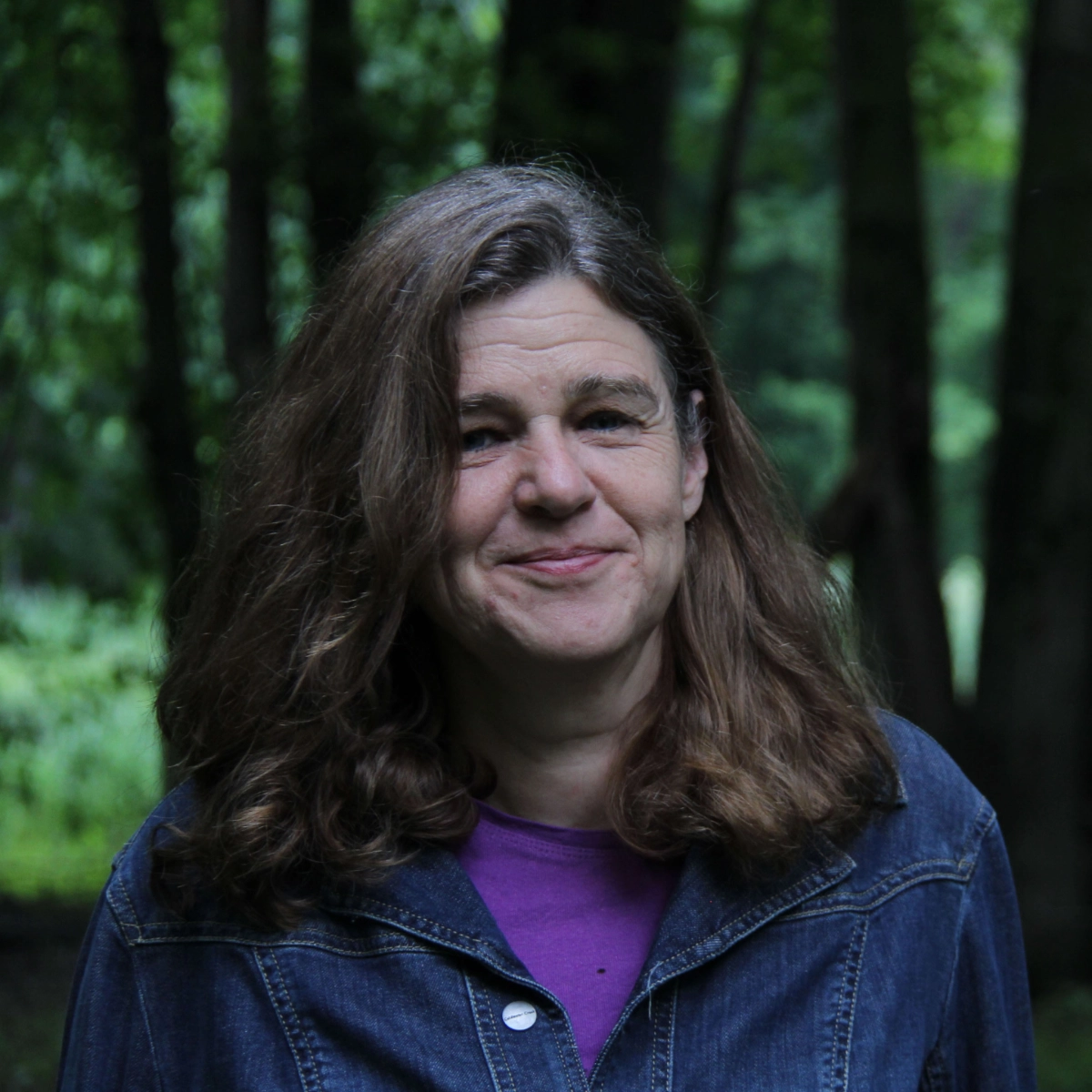
Alexis Lathem is the author of Lambs in Winter: Sketches of a Vermont Life Through Seasons of Change (University of Massachusetts Press) and the poetry collection Alphabet of Bones (Wind Ridge). Her work has been supported by the National Endowment for the Arts, the Black Earth Institute, the Bread Loaf Writers conference, the Marble House Project, the Vermont Arts Council, the Chelsea Award for Poetry, and elsewhere. Her poems and essays have appeared in About Place Journal, AWP Writer’s Chronicle, Beloit Poetry Journal, Chelsea Review, Gettysburg Review, The Hopper, Hunger Mountain, Saranac Review, Solstice, Spoon River, Stonecoast, Tikkun, West Branch, and other journals. She received an MFA in Writing from Vermont College, and lives on Abenaki land in the Winooski River Valley in Vermont.


