

You wake up one morning alone at 70, your wife of 30 years newly dead from lung cancer, having promised at the start of your relationship to stop smoking and then deceived you all those years. How was it that you didn’t smell it on her? Didn’t find the cigarettes? It’s true you often smelled smoke in the condo, but you thought it was the asshole neighbors across the way coming into the alley for a late-night cig. Not your wife. Not your lovely wife who’d pledged to always tell the truth. What else had she been hiding? Was she at the massage school teaching when she said she was teaching, or was she a secret assassin like in some of the movies they watched? Who was she always texting when they watched TV?
“My students,” she said. “Another crisis they want me to know about.”
“Oh.”
“Yes, oh.”
He came home from work to find a scooter at the bottom of the stairs to his building, a scooter blocking the stairs, blocking the sidewalk. Its wheels were locked and it did not roll and it was heavy. With some effort, Jeffrey picked it up by the handlebars and moved it onto the grassy strip between the street and the sidewalk.
Sidewalk cleared, he went up the steps and got his mail, then on into his condo. The condo he’d lived in for 27 years, sharing with his wife and a series of cats. Except the last of the cats had died, and so had his wife.
You wake up one morning alone at 70 and as the work day rolls along, the boss — 20 years of working for him — tells you it’s time for him to sign off.
“I’m tired of the bullshit,” the boss said. “Do I want my tombstone to read: He wrote good contracts? Is that what you want for yours? There must be something more.”
What more? There it was. This was someone with whom Jeffrey had had long conversations about the future of the planet and how AI might destroy it, about raising children even though Jeffrey had none, about politics, culture, music, baseball, lifting weights. They’d both been club DJs in the 70s, finally finding a reasonable, secure career path later on.
Now he was leaving, and the word was the company was promoting someone who’d never seemed to like Jeffrey, never seemed to understand what he did or why the company needed him to do it. Surprising because the new man had been in plenty of meetings where people from other departments talked about Jeffrey and his reports on credits as if he were a magician, a wizard, the only thing standing between them and total chaos.
“Absolutely indispensable,” more than one person said. “You can never retire.”
The new man made a sour face at this. Apparently, he was going to work to make Jeffrey retire.
He couldn’t sit still in the condo, so he went out for a walk, and there were two scooters now on the verge. Something was wrong with them, and both had red tail lights flashing.
Walking used to be contemplative, but now, too much time to think and rethink and hash and rehash.
You wake up one morning alone at 70 with your wife dead, a new boss, and a job hanging by, well, a thread, supposedly a solid thread because you are in a “protected category,” but it doesn’t seem to matter, doesn’t matter how good your work, someone younger always thinks they’re the smartest person in the room. They can do it better, smarter, cheaper. They’ll do things with AI.
“We need these sooner,” the new boss said, “and I think we should change the format.”
There it was, the hand that had to mess with everything just to show they were doing something.
When he came back from his walk, the scooters were no longer flashing, but now there were six lined up on their kickstands, evenly spaced, ready to be ridden. The scooter companies advertised freedom. No car. No parking. Ride where you needed to go. Pick up another for the ride home.
Jeffrey couldn’t say he wasn’t a little intrigued. All those double negatives, a way to put some distance between him and the scooter and the decision to ride. He’d seen riders zipping around. More often, he’d seen them on the sidewalks, though that was illegal. Seen them with two people aboard, often a young man with a young girl behind him, arms wrapped around his waist. That was illegal, too. Not the hug, the double riders. He’d seen scooters go racing past a line of stopped cars, pulling blocks ahead with ease.
Something held him back. He hadn’t been on a bike in years, never a scooter. At 70, he had some balance issues. His late wife always said: “I love you, but graceful? You won’t be on ‘So You Think You Can Dance’ anytime soon.”
Was it just like riding the proverbial bike, something you never forgot? You put one foot forward on the platform. You pushed off with the other and twisted the accelerator. There were hand brakes on both sides. How hard could it be?
Maybe harder than it seemed as he watched a man half his age come flying down the hill in front of his condo building and wipe out spectacularly a few apartments down. He might have hit a rock or a depression in the road, but one minute he was buzzing along at probably the scooter’s maximum speed of 20 miles an hour, the next, he was sliding along the pavement, and that was going to lead to a serious road rash.
Three other people were on the street when it happened. Three other people pulled out their phones — to call for help Jeffrey wanted to believe, hoping they weren’t the kind of monsters who filmed a man at his worst and did nothing to assist. Maybe there was still some good in the world as those three other people rushed over to see if the fallen scooter man was all right.
Jeffrey decided they had it covered and went back to his condo, all the while thinking, What now? What now?
Travel? He’d been down to Mexico once to see a pal who’d moved there as an economic refugee from the United States, and now, with the felon destroying the economy, creating havoc and uncertainty, he was stuck, not even sure if his Social Security payments would continue or if someone in some office somewhere might declare him dead and then he’d have to get back to the States to prove he was not a ghost.
“I don’t think I want to come back,” his friend said. “The country doesn’t seem safe.”
And Mexico did? His friend’s part of it, maybe, San Miguel de Allende, where even in that expatriate haven, the cartels started moving in. Was that safe? People were found dead on the street, though they were locals who may have run afoul of the criminal organizations. So far, they’d left the Norte Americanos and the Europeans alone.
So, not travel.
How about something spiritual like guided meditation or yoga? He and his late wife tried yoga one time. “Even though you’re inflexible,” she said. “I’m not inflexible, I just lack flexibility,” he told her. “Is there a difference?” In the class he turned tree pose into leaning tree, sun salutation into setting sun salute, and child’s pose, with his knees that hardly bent, left him on all fours. Afterward, they laughed and laughed. “You tried,” she said. “I guess I am inflexible,” he told her. Yoga now, would only have him think of how much he missed her, that rapier wit.
So, not yoga.
It would be nice to get another cat, to have a small living presence in the condo that might climb onto his lap and fall asleep. Even though he was allergic, even though you couldn’t count on a cat for such affection, it still was a nice idea. But the thought of it brought up the last moments of Stanley T, their cat of so many years. Stanley T, named, like all their previous cats, after jazz greats. Stanley T who loved being brushed. Stanley T who loved being held. Who slept every night at the foot of their bed, waking them at dawn to be fed. When the vet said it was time, as the technician administered the fatal shot, Stanley T reached out and covered Jeffrey’s wrist with his paw. Then, looking straight into Jeffrey’s face, the life went out of his eyes.
What now?
The question kept him up at night as he tossed around ideas and scenarios for exactly what came next. He kept thinking about the scooter, how riding it might be that small step, and so he bought a helmet and gloves, but besides trying them on for fit, that was as far as he had gotten.
His wife had been such an integral part of everything, he didn’t know how he might go on without her. She had a vicious wit, and yet he managed to make her laugh most of the time. She’d instilled a love of cats in him and they’d both cried when their most recent one had to go at age 21. He felt that she was always looking out for him.
After the latest round of Covid vaccinations, before his wife passed, something happened to his system. First, he developed mouth sores that looked like herpes but were painless.
“Dermatitis,” the skin doctor said, waving off any connection to the vaccine.
It took 15 weeks for that to go away with the thrice daily application of some stinky cream, and then the non-stop outbreaks of genital herpes started. Of these, there was no question. Jeffrey had experienced enough of them over the years to know what they were. He took round after round of Valtrex, and the outbreaks waxed and waned and waxed again, faster than the phases of the moon.
His wife was sympathetic, though she couldn’t resist a jab or two: “Leftovers from your wastrel youth,” she said. And she was always helpful, finding 10 studies on line about the link to Covid and/or — “and/or,” she said, the vaccine as a trigger to HSV. His primary care guy waved that off, too. “No one really knows,” that doctor said.
The outbreaks were painful and lasting, and his wife was sympathetic, but what could she do? What could anyone do? You took the medication and you waited. He found some piece of medical equipment online that used red light to hasten the healing. The thing cost $400, and though he used it exactly as instructed, it didn’t seem to do anything except make his penis look like a creature in a horror movie with all the flaming light around it.
Or three: “That’s what you get for swinging your dick around,” his wife said, referring to his time some 45 years before ‑‑ long before they’d ever met — as a disco DJ in the clubs of Boston and San Francisco and LA.
He never thought of himself as a dick swinger. As a DJ, he’d never had to try much. Girls just came by the booth and offered themselves. Who wouldn’t have gone home with them, though they mostly saw him as a trophy, and once the sex was done, asked him to leave. Early mornings for work, don’t you know.
Jeffrey might not be a wizard with his smartphone, but he was good enough. He went so far as to download and install apps for two scooter companies, linking his credit card, but still, he did not ride.
He was not immune to influences. Who was? A reel came up suggesting intermittent walking to improve fitness and maintain weight. This actually sounded like a great idea because his knees were shot (Oh, why, Jeffrey, did you wrestle when you were 14?). A mix of fast and slow, and medium walking ‑‑ he could manage that.
Unable to sleep, he found himself pacing in front of his condo building at 3 AM. Not quite the intervals suggested by the video, but he was moving, right? Things hadn’t been like this since the days of Ativan withdrawal, another dreary episode that his wife had to help him through. She hid his gun, the one he’d purchased after the riots, and said she was “monitoring” him closely.
The number of scooters in front of the building had changed again, and now it was down to three. Some kind of soft blue night light was on, illuminating the kickstand and the ground beside them.
Jeffrey went on pacing, walking past the scooters and a couple of driveways away, then back to his condo building, back to the scooters. Was this a form of meditation? There were no answers to be found in the flower beds or the cracked sidewalks or the lights in front of his building, and he went back inside.
In one more attempt at the spiritual, he tried a guided meditation app. The woman with the soothing voice told him to observe his thoughts without attachment. Most of his thoughts were about his wife. The app called this a success. Jeffrey didn’t think so, and deleted it before the free trial period was up.
One Saturday, he walked down to the Palisades overlooking the Pacific when a protest march came by. Part of him wanted to join. Part of him thought, what was the use? Nothing changed.
The marchers, a crowd of gray-haired men and women, streamed by, holding placards and signs decrying the reign of the Emperor, and stating firmly President Elon was not elected and had to go.
“We’re on our way to the Federal Building,” someone shouted. “Come along.”
The Federal Building? It was 5 miles away.
“C’mon,” someone else said.
“Let’s go,” from another.
Even if he wanted to, he didn’t think he could make it that far. The knees. While he thought about it, he remembered something from home in Massachusetts. The route of the Boston Marathon ran along a main street where his own intersected. He and his parents and his brothers used to come out to watch. Volunteer water stations had been set up, and the crowd applauded each runner running by.
It seemed like that now with the marchers. He was watching the marchers and he was applauding — well, inside. He was applauding inside. They were brave and committed, and it was useless and nothing was going to change, and before they knew it, America would be like Hungary, and that felon that had somehow been elected would be president for life, what life remained. And yet they were out there marching, a crowd that grew bigger and bigger as they moved along, taking over all four lanes of San Vicente and the green median in the center, up on the sidewalks, marching along. In front of them, holding flags like an honor guard, were five young women on scooters, leading them along.
He wished he were brave enough to march with them, but the thought of getting arrested and losing his job, tenuous as that job was at that moment, made him pause.
What now? What now? What now? Jesus, he was a broken record — vinyl was making a comeback — his thoughts stuck in the groove, unable to move on.
Walking up to the stores and restaurants a few blocks away, he came across an old girlfriend, someone he’d gone out with before he met his wife and had had only sporadic contact with over the years. Was she a possibility to rekindle whatever they once had?
“Sara,” he said, “hello.”
Before she said anything, a gust of wind came up and her bangs blew back, exposing half of a bald head. Alopecia. The word came to him in a flash. How horrible for her.
She must have seen something in his eyes because she reached up to push the hair back down and said: “I have to get going.” She was gone down the sidewalk without saying another word. Nope, no possibility of rekindling anything, not with her.
Running into her put the idea in him that maybe he should try one of those dating apps for “mature” singles. He downloaded the Silver Singles app and created a profile. The first picture was no good, showing him with all his glorious jowls. He could use Photoshop and make some fixes, but then, when the women saw him in the flesh, they’d know he cheated. When the women saw him. That was positive thinking that he might actually meet someone if he could get past picking the picture and posting it.
Should he try a picture of himself at the gym? Reading? An old one with his cat? But there was no cat anymore, so how to explain that? In front of a store?
It took him forever to figure out the right one. In the end, he put the camera on a tripod that had been hanging around in a closet, set it on the patio deck, and took a picture in front of the Brazilian hardwood fence that his late wife had so liked.
The picture was recent, truthful and accurate, and yet the background of the beautiful brown fence made him think of his late wife and miss her even more. He wasn’t at all sure that it was the best choice, but unless he moved to somewhere for a fresh start, pretty much every picture was going to remind him of her. He uploaded and pressed Save.
Not much happened for the first week or two, though he checked the app a couple of times a day. Okay, more than that. Ten times a day and nothing. He looked through some pictures and profiles of other women, but no one seemed to interest him.
Then he suddenly had an invitation for what he thought of as an exploratory get-together. Coffee after lunch. A safe meeting time in a public place while it was light out.
She was definitely his age with silver hair and an attractive face that probably had been beautiful when she was young. She was slender, and she was interested.
Okay, he wrote back.
He hadn’t been on a date in over 30 years. Did anyone even call it dating? They were meeting for coffee on a Saturday afternoon. She had wanted to do something during the week, but he told her he was still working. Full time.
Working, her message read. Interesting.
Coffee it was on a Saturday afternoon with plenty of time to bail if they didn’t click. He could buy an espresso and be done with it in ten minutes. If necessary.
There was going to be the obligatory exchange of biographies. He assumed. How much to tell? What to leave out? You didn’t lead with your failures, how you wanted to be a screenwriter and ended up doing screen credits in a Legal Department; your past addictions the ones way past and those more recent; your psychological problems stemming from your feelings of mortality and loss of your wife. You had to put your best face forward. Or was it foot?
That was another problem at 70: he was starting to forget things. Small things, maybe, but things. He pictured actors’ faces and couldn’t remember their names. Sometimes a word he should have known swam just out of reach. Foot or face, you had to put your best self forward.
All of this he thought about in the days leading up to the date or assignation or rendezvous or meeting. Jesus, he couldn’t even decide what to call it.
They were meeting at one of the coffee places on Montana, a big commercial street in Santa Monica with plenty of stores and restaurants, easily walked. It was the kind of street that, if things went well, they could walk and window shop and continue talking. If.
A few minutes before the appointed hour, he locked his condo door and headed out to the street. There were no scooters anywhere, not even at the top of the street where the City had a designated scooter area.
It was a pleasant walk with a gentle breeze. He went past a bank that had just closed and was now for lease, past the mailbox store that had also closed and had a rental sign in the window, past the mattress store where someone was lying down on one of the mattresses, past the yogurt shop filled with families.
She was sitting at a table outside and had already bought herself something to drink. She was not like her picture: heavier, hair thinner, face more lined. The picture on the app was probably 15 years old.
He introduced himself and she said, “I got here early.”
“I’m a little nervous, too,” Jeffrey said.
“I’m not nervous. I just like to be on time.” She looked at her watch as if it were he who was late and keeping her waiting.
“I’ll go get myself something. Did you want anything else? A pastry? Some merchandise?”
He was trying to be funny or cute or charming, but she narrowed her eyes.
“I try to avoid refined sugar,” she said.
Oh, this was going great.
Inside the coffee place, it was crowded with a long line, and after he ordered, he had to wait. He watched her from one of the windows. She sipped from her drink and looked at her watch. She looked at her phone and then turned it over, doing another round of sipping and watch watching.
Finally, he got his order, and finally, he got back outside.
“Sorry about that,” he said, “the line was really long. It’s a popular place.”
“Yes,” she said.
“So you live in Santa Monica? I’ve lived here for quite a while.”
“Look, I’m sure you’re a nice man, but I’m only doing this because my daughter made me do it. I didn’t want to be here. I didn’t want to meet you. Or anyone. I’m not really looking for anything and you were the least objectionable person I came across on the app.”
Jeffrey found himself sipping rapidly from his espresso. By the time she finished her speech, he was done with the drink.
“Least objectionable. Well, that’s something.”
“It’s nothing. This is a waste of our time.” She looked at her watch again.
“If you have to go somewhere. . . I mean, you’re not a prisoner. I just lost my wife, and I thought. Maybe.”
“Sex? You thought sex? Isn’t that what you all want?”
“No. I don’t know. I thought. I thought I might make a new friend.”
“I have plenty of friends. I don’t need a new one.”
After that, they sat there without saying anything for a few minutes. Jeffrey toyed with his empty cup, looking at the black dregs of the espresso. He looked over at the other tables, and they were filled with people half his age or younger who were laughing and talking and texting. They were excited about whatever was going on in their lives. Anyone could see. Although what was going on underneath, who knew?
He stood up and tossed his cup into a trash bin. A dozen different exit lines came to him, each one more snide than the last. But what good would any of it do?
He was sad and embarrassed and mad at himself and angry at the woman. Crazy, crazy, crazy. Why had she even bothered to set up a meeting? He went into his condo, shut the door behind him harder than necessary, and paced the living room. He’d read newspaper stories that these dating apps were not all they were advertised to be. Ha!
He worked the buttons of his phone and deleted his profile then deleted the app and still he didn’t feel like he’d done enough. He restarted the phone to try get any last vestige of the app off of the device.
Meet eligible mature singles in his area. What a crock. He needed to get out of the condo, get away from the memories of his wife, to go somewhere, do something.
He picked up the scooter helmet and put on the gloves, and went out in front of his building. There was only one scooter out there now, and he used the phone’s camera to unlock it, riding up and down the sidewalk to get the feel. He was shaky but improved with each try.
Finally, he thought he had achieved enough balance for a longer ride. These were old model scooters and didn’t have shock absorbers on the handles or the wheels, so every bump or depression in the road raced up the steering columns to his arms. He needed to bend his elbows and take the shocks, but he was too unsure of himself. Too afraid he’d fall. His shoulders ached from the tension of staying upright, and still he drove on, further and further up the street until he hit the wide avenue that was San Vicente, the boulevard the marchers had chosen with its two lanes on each side, bike lanes, and a wide tree-lined grass median that joggers ran.
He got over to the north side and began heading to the beach, driving slow on this scooter, way below its top speed of 20 mph. The bike lane was smooth enough, and he started to relax, ever vigilant though of an errant rock or rough road.
He was almost enjoying himself, tooling along at 8 miles an hour, the wind brushing his face. Then, from behind him, a noise like fans whirring, and he was surrounded by a pack of scooter riders, maybe 50 in all.
The pack took up the entire two lanes of the road, and they went by him one by one. For a moment, he was in the middle of the pack, and he was part of them, another scooter rider out for a great day with friends.
Then the last rider passed him, and he was once more alone, watching the last of the scooters disappear in the distance.
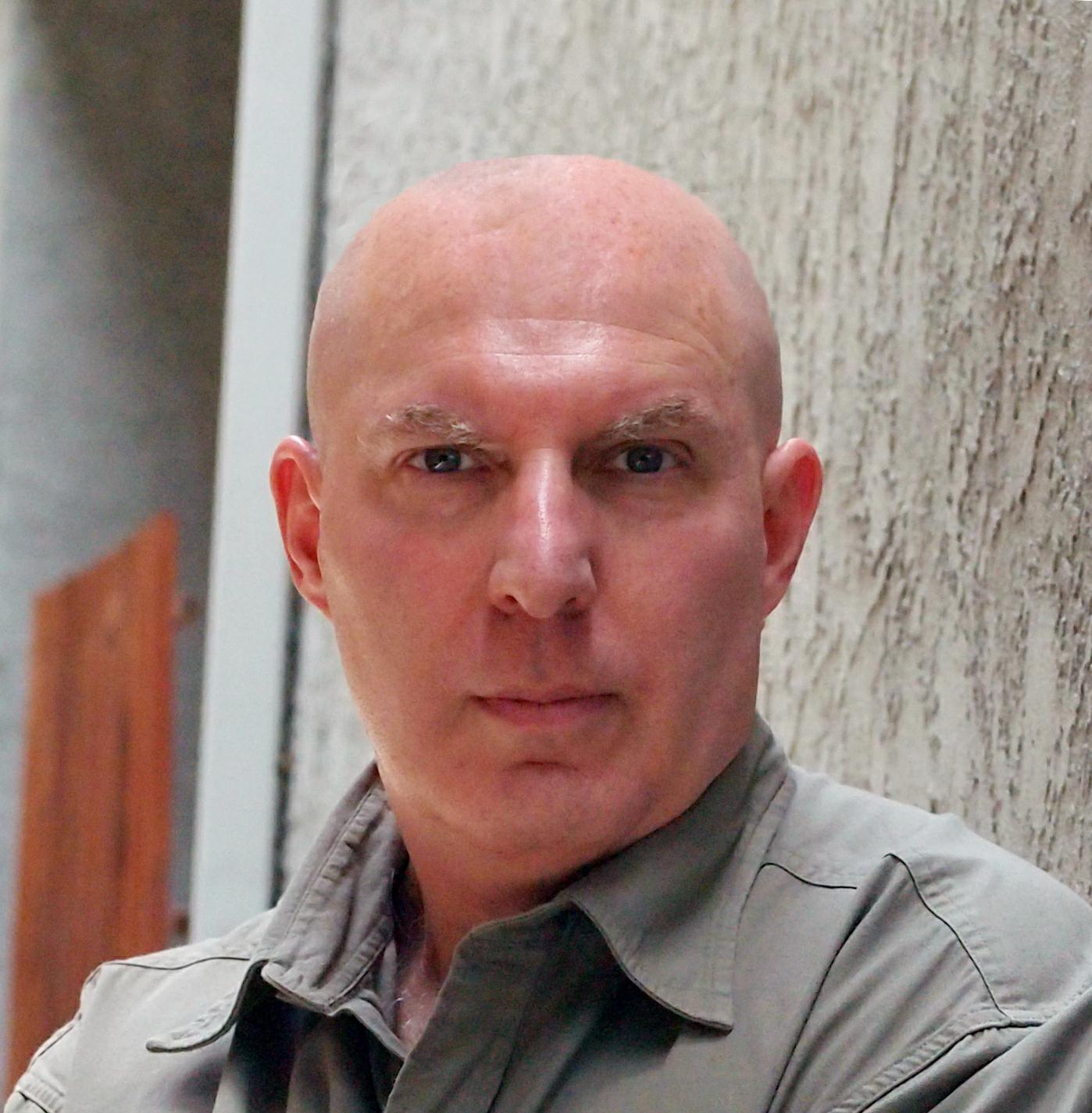
Ian Randall Wilson has published two novellas, Great Things Are Coming and The Complex, and two story collections. His fiction, poetry and essays have appeared in many journals including The Gettysburg Review and North American Review. He has an MFA in Fiction and in Poetry from Warren Wilson College. By day, he is an executive at Sony Pictures Entertainment in Los Angeles as the Vice-President of Marketing Contract Compliance. (This rather opaque title means that he makes sure all the names are spelled correctly on the Spider-Man™ movie posters.)


