

‘To willingly or unwittingly enter into a situation knowing the outcome will not be good (but doing so anyway).’
Urban Dictionary
Outside, spring had finally arrived. The sun flooded my room as I sat at my table, staring at the man on my computer screen. I wasn’t up for it—10 am Saturday sessions. But it wasn’t a case of being up for it or not. It’s something I needed to do. I didn’t want to be outside anyway, where my skin sticks out from a mile away.
‘Oh, what did they think of it?’ the man on my screen asked. I wasn’t sure if he was genuinely interested. His deep brown eyes and face held practiced sympathy.
‘I don’t think they liked it. No. I don’t think they got it,’ I said.
‘It must be very frustrating.’
Frustrating? No, disappointing. I was disappointed. Aren’t writers meant to be open-minded and sensitive people—able to absorb the world and observe multiple perspectives? So, if anyone were to get it or even attempt to, it’d be the group. Shouldn’t we be equipped to understand each other’s social perspectives?
I told the man on the screen my thoughts. He stared at me with such intensity and interest that I wondered if I’d said something else—something shocking; like a family member had died.
‘It’s that feeling you described in our last session,’ he said. ‘That feeling of wanting to belong—of being understood on a deeper level.’
‘Yeah,’ I said.
‘So, what exactly did they say?’ he asked.
‘I think it was Tim’s comments that got me.’
‘Remind me again, which one is he?’
‘The mixed-race one.’
He smiled.
‘Well…I don’t doubt he’s mixed-race,’ I added. ‘But he looks more white than anything else.’
‘I remember him,’ he said.
‘He didn’t understand why the main character in my story snapped. He didn’t understand why my main character was driven to confront the Irish lady. He thought, after all, nothing clearly racist had happened.’
‘Mhmm. And how did that make you feel?’
‘Confused. Frustrated. I think I started to question what I’d written. Wasn’t it clear that the character’s bad past experiences with white people had built up so much that the smallest thing from a white person tipped him off the edge?’
‘I appreciate how frustrating that is. I see how that mirrors your own experiences.’
‘Yes. You know—it’s not a direct comparison—but imagine a woman was walking home through a dark alley. Just imagine.’ He nodded. ‘Then she hears a sudden, loud noise. It’s just a fox, but she doesn’t wait to find out. She screams, kicks, lashes out at the first thing she touches, and ends up killing the poor animal. I wouldn’t blame her. I wouldn’t think her actions were unwarranted, considering all the news lately of women getting abducted while walking home. All that stuff on the news would scare any woman.’ I said and looked away from his stare through his camera lens, from God-knows-where. It’d become okay to open up to someone I’d never met in person.
‘Yes, it’s not directly the same, but I appreciate the comparison,’ he said. I felt his eyes on me. ‘Is that how you feel?’ Do you feel like lashing out?’
I looked out the window. The trees were no longer naked, while the people outside did the opposite—shedding layers as the days grew warmer. The sun had its way of lifting moods, coaxing smiles, and laughter.
I turned back to the screen. He’d been waiting for me to reply.
‘I think that’s why Harriet didn’t say much.’
‘Harriet? From your writing group?’
‘Yes, she seemed to think deeply throughout the session. I don’t know if she understood the feeling, or if she was trying not to say anything to contradict it.’
‘She writes about sexual harassment, right? And assault?’
‘Yes.’
‘I’m sure that brings up complex and overwhelming feelings. I can understand why you’d feel connected to someone with overwhelming feelings.’
‘No. I’m not saying it’s the same.’
‘I understand that, but it’s good that you’re acknowledging the complexity of your feelings. Processing them.’
‘I think what annoys me the most is that Tim blamed dementia for my character’s meltdown.’
‘Dementia? How so?’
‘Well, the character is old. I guess dementia is a rational explanation with no clear signs of racism, in his understanding,’ I said, laughing and crossing my arms. I looked out the window again, avoiding his stare.
‘You never answered my question,’ he said.
‘What question?’ I asked, still looking out the window. On the other side of the road, a man stood looking up to the sun, wobbling on his feet. I’d seen him many times on the high street. He was harmless. I guess he enjoyed a few too many drinks, which meant that sometimes he did stupid things, like pissing on a tree in the middle of the day on a busy high street. But all he ever did was embarrass himself—he was never cruel or harmful to anyone.
‘I asked if you feel like lashing out,’ he explained.
Last summer, my girlfriend Zsofi and I caught the metro back to our hotel from the Museum of Ethnography in Budapest. After much persuasion, we’d finally booked a holiday. What better place than the country she was from? Across from us sat a man in clothes that’d once been colourful, now dulled black with dirt.
Freshly drunk, he clutched a bottle of Dreher in one hand and a thick, rolled cigarette between the fingers of the other. He pushed his oversized, thin-rimmed glasses tighter against his face and swept his fringe into his greasy, combed-back hair—a failed attempt at grooming. Staring directly at us, he muttered.
At the time, I couldn’t fully make out his Hungarian, but I had trained ears for the word, Nigger, in all its variations.
A drunk like him, I’m sure no one cared much about. I’m sure he was a nuisance to everyone. He stunk, as if he’d just stepped out from the dirtiest depth of the earth. Why would anyone care if he was gone? I thought, gripping the hard cardboard museum poster tube in my hand. Who’d care if I suddenly swung it and hit him across his face?
Zsofi was red hot beside me. I held her sweaty hot hand, as he spewed all the filth in him, staring at her. Staring at us. She understood it all. But we both did nothing. I did nothing.
I turned to my screen. ‘No, I don’t feel like lashing out,’ I said.
‘You don’t?’ he asked. His voice was light, almost cheery.
I looked up at him. ‘I’ve never felt the need to,’ I said.
‘The characters in your stories seem to be angry,’ he said. ‘They seem to be lashing out at something.’
We didn’t speak for a while. I just listened to the noise from the high street. A bus tumbled past. There was only one man on the top deck.
I remembered that once I moved in with two of my university friends in Whitechapel. They were both women and we’d known each other for a year before I needed a place and asked to move in with them.
I thought it was odd that they interviewed me before accepting me as a third flatmate—as if I were a stranger, but heck, I needed a place.
Later, one of them told me a story. She was on a bus home after a late-night university session. And it was only her and another man on the top deck. ‘He looked normal,’ she said—until he began rubbing himself. She ignored him—sat on the opposite aisle, busy listening to music—when finally, he couldn’t help himself any longer and pulled it out of his trousers. She said without any apparent emotion, but I could see the pain in her eyes.
That’d traumatise anyone. I guess that’s why they interviewed me—you never know, it could be anyone. It didn’t matter if I was black or white. After she’d told her story, I couldn’t even think about pleasuring myself in that flat without feeling guilty.
‘What are you thinking about?’ The man on the screen asked.
I turned back to him and considered my thoughts. ‘You know, there was one thing that Tim said, that made it clear that he really didn’t get it.’
‘Oh. What did he say?’
‘I think he started off saying, When you watch a show, or a movie, whatever, you see a black guy driving and suddenly hear a police siren, it’s obvious what’s going to happen. It’s too obvious. Boring, even.’
‘What did it have to do with your story?’
‘He wanted the security guard that assaulted the main character to be black. He felt it’d be more interesting that way—like a betrayal from your own kind.’
‘How’d that make you feel?’
‘I told him that’s not the point. Betrayal isn’t the heart of the story,’ I sat up. Then I looked at him on the screen. ‘But maybe his suggestion could make it a better read. You know, different—away from the tired, exhausted stories of white men doing harm to black men,’ I said.
We both went quiet. On my right, next to the table lamp, was a clear plastic grinder. It was empty. I pulled out the drawer underneath and saw the empty grip seal bag, but I still had Rizla’s. I closed the drawer.
‘How long have you been in the group for?’ the man on screen asked.
‘I don’t know. Years. Five, maybe six.’
‘Why have you remained in the group for so long?’
‘I’m not sure. I don’t hate the group if that’s what you’re implying.’
‘No. Not at all. Clearly, there is something that draws you back. I just wondered if you think you are a different person in the group.’
‘Probably,’ I said and looked up at the ceiling. ‘Maybe, in some ways.’ I continued. ‘I don’t know.’
‘It’s worth thinking about this,’ he said. ‘When we meet next time, let’s talk more about this. It’s come to the end of our session.’
‘Thank you,’ I said.
‘See you next week,’ he said. ‘Take care.’ Then the video cut off.
I sat there for a while. Zsofi had gone out for a coffee and would be back soon. She’d want us to go out on a walk—to catch the sun because it had a way of lifting moods. She’d phrase it as if the walk was for her—to make her feel good. But she wanted me to feel better. So, I got up and went for a shower.
*
Later, I was sitting at my desk, watching the evening settle outside the window. Zsofi was watching a movie on the TV. We hadn’t managed to go out on a walk.
She was at a scene where Denzel was negotiating a heart surgery for his dying son, but he wasn’t getting the response he wanted from the doctor. He pushed the doctor through the double doors of the hospital entrance and pulled a gun on the doctor. ‘I’m not asking you anymore,’ Denzel said. ‘I’m telling you!’
I’d seen the movie many times and enjoyed it every time, but I couldn’t settle into it this time around. I pulled the desk drawer open again and confirmed that the grip seal bag was empty. ‘I’m heading out,’ I said.
Zsofi paused the movie and looked at me as I stood up and put on my hoodie. ‘Where’re you going?’ she asked.
‘Just for a walk,’ I replied.
‘Alone?’
‘If you don’t mind.’
She smiled. ‘Of course.’ She got up and kissed me. ‘Getting to the good bit of the movie. Do you want me to wait for you?’
‘No, it’s fine. Seen it many times.’
‘Okay, babe.’
‘I love you,’ I said.
‘I love you too,’ she replied, sat back on the sofa, and continued the movie.
He didn’t live far. In total, I made two turns, and I was at his flat. It’d been a couple of weeks since I’d been to his. I was trying hard not to do it anymore. Zsofi didn’t think it was healthy—every time something was on my mind, I smoked that stuff. Plus, she hated the smell of it, which clung to everything in our flat.
I rapped on his front door, but there was no answer. I continued knocking, and finally, he answered. I flashed him some money, and he let me in. He was a good guy, mostly. Sometimes we chatted about Lagos—I hadn’t been home in several years, and I was sure he’d love it there—but most times we laughed watching stand-up while high as hell. Kevin Hart’s Laugh at My Pain or Chappelle’s Show was often our choice. I didn’t need to explain the jokes to him; to my surprise, he just got it. I was up for some laughs that night. So, when I walked into his living room and saw another guy sitting on his sofa, I knew there wouldn’t be any laughing.
I’d seen him around a few times, but we never spoke. I had no reason not to like him. After all, we were the only two black guys in the room—so it seemed natural we’d be instant friends. After my dealer introduced us, I found out he was Nigerian too, though his accent made it easy to guess. So, I thought maybe he was cool, and we’d all watch Kevin or Dave together.
I sat next to him on the sofa, while my dealer went into the next room. We didn’t say much to each other, waiting for him to return.
He came back with three full grip-seal bags and handed one to each of us, keeping the third for himself. Then he sat down on the sofa, opened the third bag, and said, ‘Might as well hit it now?’ We nodded. Then he turned on the TV and put on Chappelle’s Show.
We were into it and had been laughing for a while when Zsofi called me. If I were indeed on a walk, it’d certainly gone on too long for Zsofi to believe I was still on it. I answered her call and told her I’d be back home soon.
‘That your woman?’ the Nigerian said, staring at the photo of Zsofi on the screen of my phone.
‘Yeah,’ I replied as I locked my phone. I could see the silent accusation in his eyes.
My dealer had ended up sprawled on the floor, away from us, laughing his arse off, unaware of the conversation between the Nigerian and me.
‘White girl?’ the Nigerian asked.
‘Yes,’ I answered.
‘Is it that good?’
‘What?’
‘Is it that good?’
He took a hit from the blunt in one hand and immediately a swig of his beer in the other. I knew not to mix this stuff. It gets you all messed up, and you end up talking and doing rubbish. You feel absolutely rubbish the next day too. I could feel a whirling storm inside me—a dangerous anger that I dared act on.
‘Don’t talk rubbish,’ I said.
‘Must be good then.’
‘Shut the fuck up!’ I said.
‘Are you crazy?’ the Nigerian said, standing up. My dealer looked at him, confused.
‘No, it’s you that’s crazy. What kind of question is that?’ I stood up and faced him.
‘What you trying to do?’ he asked.
‘Talk rubbish again, and you’ll find out.’
‘Definitely really good for you to be acting crazy like this,’ he said and laughed.
I held my breath and lunged at him. But I didn’t get to hit him before a glistening green glass bottle flashed before my eyes, followed by a blinding pain that sent me crashing to the floor.
When I woke up, the dealer was standing over me, and Zsofi was wiping my face with a hot towel. The Nigerian was gone. The bottle was beside me, and it was as intact as it had been in the Nigerian’s hand earlier and in the drunk’s hand on the Metro in Budapest.
‘How did you know where I was?’ I asked Zsofi. I felt an intense pain on the side of my head when I spoke.
‘Take it easy,’ Zsofi said, looking at me. I’d never seen her that worried. She placed the towel underneath my head. ‘A walk, yeah?’
‘I answered her call on your phone. I didn’t know what to do,’ my dealer said. ‘Scared the shit out of me. Thank God you’re good.
‘I’m sorry,’ I said and smiled at Zsofi.
She forced a smile back. ‘I don’t want you having any more of this stuff,’ she said, helping me to my feet.
I felt weak, barely able to sit on the sofa. I’d dared to act on my anger and was relieved that I’d done so. But I was certain that the Nigerian had gone away not thinking any differently than he’d done before he knocked me out. Even if the result of the fight was somehow reversed, I was certain that he’d still think the same after. It didn’t matter what people thought, and it was no use forcing your thoughts on anyone.
I could hear it raining outside—imagine relying on the British weather to lift your mood. I wasn’t certain I’d stop smoking. At least, I knew Zsofi telling me to stop wouldn’t get me to stop. Besides, I’d had a good laugh before the Nigerian opened his mouth. But I knew I’d try because I wanted to for her. I looked up at Zsofi, genuinely worried, and said, ‘Let’s go home.’
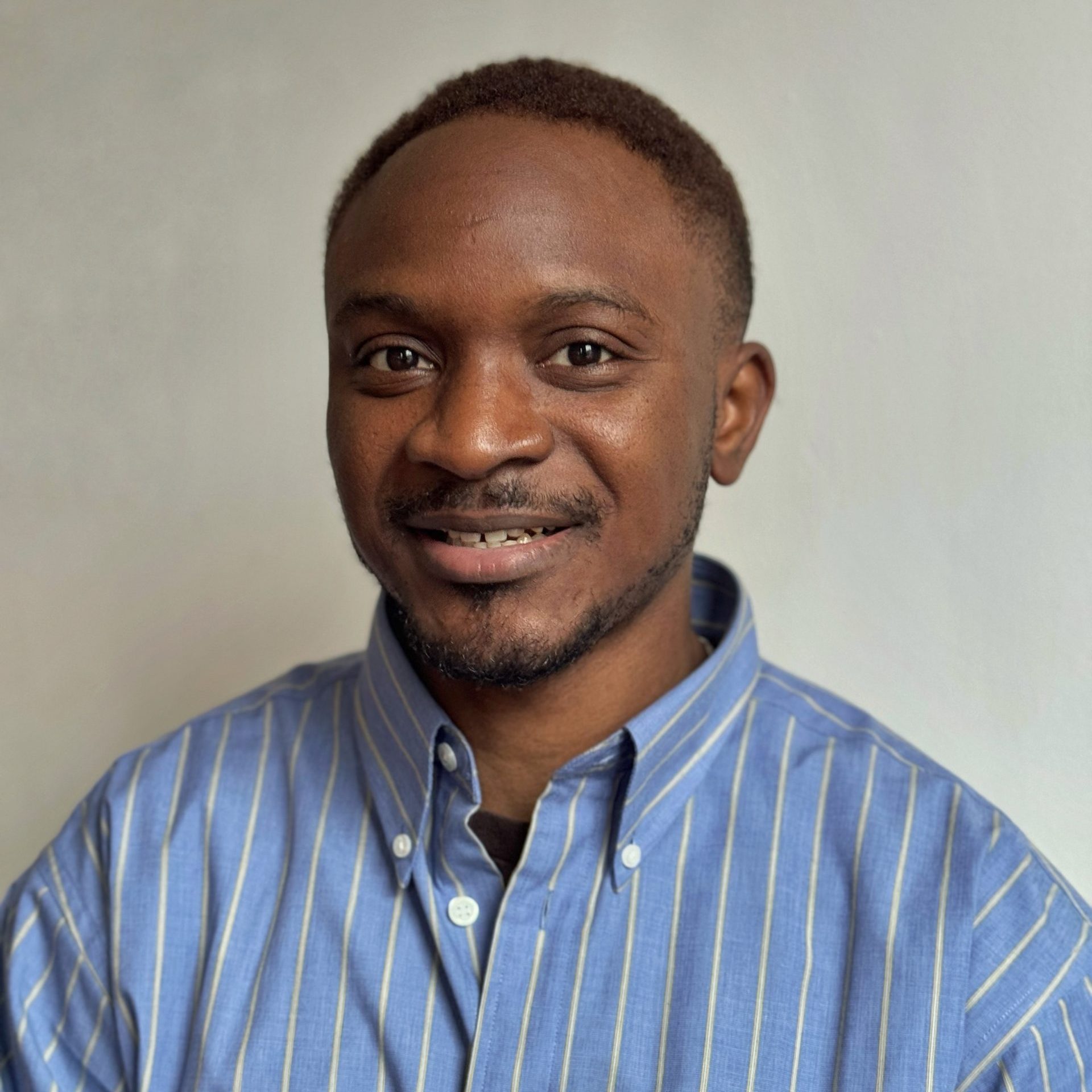
Tunde Oyebode is a Nigerian-British writer, architect and urban designer based in London. His fiction explores human relationships, cities, belonging and the African diaspora, through everyday life. His work has appeared in Stylist, Obsidian Magazine and Solstice Literary Magazine, among others, and has been recognised by the Solstice Literary Magazine Prize and the London Independent Story Prize. He enjoys cycling and photographing architecture.


