

In the beginning, they were like goldfish, barely visible as they floated beneath the surface of the tepid bathwater. It was Sunday in England, the day we had a bath. The gas-fired boiler never heated enough water, so I had to climb into my sister’s lukewarm bath, a betrayal of my childhood wishes. When we were small, we sat facing each other, our knees pulled into our flat chests, bubbles slowly dissolving around us.
“Cross your heart and hope to die,” she whispered, before stepping out onto the ice-cold floor.
Alone, I traced my fingertips over my small breasts, bud-like and hardly noticeable. When the water cooled, I got out, shivering as I dressed. I pulled on an oversized sweater that swallowed me whole. I always wore loose clothes—wanting to disappear and become invisible.
“You’re drowning in that,” my mother would say, her lips pursed.
As a child, my mother fascinated me. She was glamorous and isolated—like a place I wanted to travel to. I stood on tiptoes, trying to press closer into the mystery of her. I was five. She wore black sweaters that smelled of bergamot and sandalwood. Her breasts were high and pointed, corseted inside a Playtex Cross Your Heart bra. The bras were functional—almost architectural—with wide straps and sculpted cups designed to lift, divide, and define, engineered for presentation. Even as a girl, I sensed how women’s bodies were a spectacle, shaped to please the eyes that watched us.
In every photograph of her, my mother exudes sex appeal—green eyes and soft, wavy cropped blonde hair. In one, she’s wearing a bikini top and capris, one knee up, to reveal her delicate ankles.
I kept a sketchbook, stuffed down the side of the bed in my small bedroom, filled with soft pencil sketches of women’s bodies. I drew them from memory—curves and shadows, tracing lines that felt forbidden, trying to understand them and myself. I lived in terror of my brother finding them, knowing he would use them to shame and humiliate me.
When I turned eleven, my mother took me to the second floor of Austin’s department store on Queen Street. I could hear her pacing up and down outside the changing room while I tried on a training bra. Soft, white cotton—thin elastic straps and a hook and eye closure.
I didn’t know it then—but the lifetime of my mother’s breasts was drawing to a close, while mine was just beginning.
I learned about the lump inside her breast when my mother and father were arguing one night. The sound of their voices tore through the thin wall.
“I have a lump as big as a fist!” she shouted.
The lump had grown in its dimensions, secretly nurtured by my mother after she learned about one of his affairs. Cancer became a weapon. In exchange for her life, my mother left him with a guilt so profound it would outlive her. When she finally went to a doctor, it was too late.
When she was in hospital, my father picked me up from school. He drove to a restaurant with a sunny terrace. He ordered himself a pint of beer and a Britvic orange juice for me. Normally we were only allowed orange squash.
He spoke in a calm and measured voice.
“Your mother has gone to hospital. She has a little lump. The doctors are going to remove it.”
He made the operation sound simple, like having your tonsils taken out.
My throat tightened.
“Is it cancer?” I asked. It was the worst word I knew.
My father looked down, tapping his fingers against his legs, grasping emptily for something to say.
We never spoke about cancer or betrayal.
Later that year, my mother had a radical mastectomy. Then chemotherapy and radiation. Her soft hair fell out in handfuls.
The hospital fitted her with a silicone-filled prosthetic breast, designed to mimic a natural shape and weight, to be worn inside a sturdy strapped mastectomy bra. My mother hated it. In a fight with my father, she threw it across a French hotel room.
“You can give this to your fancy woman!” she shouted, her voice slurred with alcohol.
My sister and I huddled together under a blanket.
The cancer spread to the lymph nodes, finally slipping into the bloodstream.
Her body ravaged, she drifted into a haze of blue pills and alcohol, the curtains drawn in her bedroom. She wore cardigans—too heavy for the weather—shuffling through the house in a body riddled with pain.
By next June, she was gone. I was thirteen.
*
The next year, a boy reached his hand under my school uniform shirt. We were behind a school building. The air smelled like rain and damp brick.
“Do you want to go out with me now?” he asked flatly, pulling his hand away.
I nodded silently.
Breasts were powerful things. I began to check them constantly, holding my breath, feeling for newly formed lumps, wondering if my body had been landmined.
I’d learned early that the female body was both weapon and wound—desired, feared, and always under inspection, even by its owner.
I channeled my grief into running track, training obsessively for the 800 meters. Each night, I ran laps under a single floodlight, mist over the ground. My body was androgynous and fast, breasts small. Arms low, fists loose, I pushed hard—faster than thinking and feeling—the wind cold against my skin.
Running, running—toward nothing, away from everything.
*
After my mother died, my father cycled through women. One had dark eyes and thick black hair. She gave me a set of Matryoshka dolls—wooden bodies tucked inside bodies, each smaller than the last.
The tiniest was bright yellow and plain, not even a face.
My mother only had one body. Unlike the dolls, she was finite.
*
At sixteen, I bought my first sexy bra from a lingerie shop. It was black, lacy, with a thin underwire to push the breasts upwards. 34B. I felt seductive and feminine. In the mirror—my mother’s body.
My body fitted inside hers like one of the wooden dolls.
Seventeen. I borrowed my sister’s tiny floral bikini, with a thin halter neck. I cartwheeled across the sand with my first boyfriend. He marveled how one of my breasts fitted perfectly inside his hand.
After boys and cigarettes came my closest relationship: alcohol. I quit track and started running from anyone who got too close.
*
I became a mother at eighteen—an unplanned pregnancy with a cruel and abusive man. When I was pregnant, he slapped me hard across my cheek.
“You’re a dumb goddamned woman!”
Just before delivery, my breasts began to produce colostrum, a thin bluish milk. Deep red stretch marks formed; the areola turned dark brown. I felt like a girl inside a body that wasn’t mine.
I breastfed the baby, knowing it was healthiest—for him and to reduce my risk of breast cancer. A nurse showed me how to guide his mouth to latch. I watched with amazement but feared my milk would run dry.
I carefully pinned a safety pin to my bra strap—to remember which breast he last nursed from. If milk didn’t drain fully, the ducts could clog, leading to mastitis.
Swollen and heavy inside a soft nursing bra, my breasts no longer felt like mine. I fretted how they surrendered to gravity.
Lactation made me feel like a machine, tethered to a hungry mouth every few hours. At eighteen, I wasn’t prepared for that kind of physical dependency. Whenever I was away, milk leaked through my bra, leaving damp circles on my shirt. I didn’t know about nursing pads, so I stuffed my bra with tissue. I remembered how we used to pad our bras with balled-up socks to fake cleavage.
“Cor blimey!” the boys shouted. “Look at the knockers on her!”
They had other words for our breasts—Bristol cities and jubblies, Charlies and Babylons. To name was a way to own.
*
As a single mother, I worked my way through university. In graduate school, I studied how the female body is seen—on screens, in public, in private. I wrote papers about the complexities of inhabiting a feminine space—how women’s bodies are policed, shaped, silenced.
My thesis explored the idea of hysterical space—internal, unstable realms in literature where female characters drift through liminal, fractured worlds.
I didn’t know it then, but I was writing about my mother.
*
At thirty, I had my first mammogram—my risk higher because of family history. A softly-lit room, a large machine with two flat plates for each breast. With some lifting and nudging, the technician awkwardly positioned me. The compression was sharp and painful. I worried the machine might crush me.
I wondered how many women had stood here before me, breasts and fears pressed flat. The body rendered clinical, its story erased.
The first images were analog, captured on X-ray film and developed like photographs. I waited for the results, holding my breath as I opened the envelope: No abnormalities detected.
One year, after a screening, a technician asked me to wait. Wearing a blue hospital robe, I sat on the edge of a chair, feet on tiptoe, wiping away tears, my mother’s face in my mind. The clock ticked loudly. A radiologist reviewed the images and called for a physical exam. A nurse gently explained that my breasts contained fibroglandular tissue—dense so harder to read. She guided my hand to learn the texture, to memorize the knots.
“This is your baseline,” she said.
Every year, I return. In the waiting room, silicone breast models sit in a tray—firm with embedded lumps like tiny river stones. During the screening, I focus on the clinking sound of the machine as it shifts and locks into place, trying to push down the sorrow rising inside me.
The machine is digital now. Electronic sensors capture the images, which can be brightened and sharpened. But my fear remains unchanged.
*
At thirty-eight, I fell in love. He said we were the poster children for tantric sex. Our connection ran deeper than I was used to.
The first time he saw my breasts, I unhooked my bra and pulled my shirt over my head. He paused, looked at me, and said he’d take that image with him to his grave.
We were together for several years.
*
My period stopped at forty-eight, the age my mother died. Menopause softened my breasts, making them less firm and full. I gave up wearing underwire bras after my sister said they could impede lymphatic drainage. I switched to black wireless bras, designed for high-level support and a smooth silhouette.
During the pandemic, I dated a man briefly. He made my breasts the never-ending subject of his fantasies. One afternoon, after he’d drank too much, he pulled open my blouse, reaching inside as if my body belonged to him.
*
In a dream, I opened a restaurant—Ristorante Verde, the Green Restaurant. Why Italian? I was opening it with a man I was falling in love with. He designed a menu in graceful lines, botanical drawings in ink. My hand slipped into his.
The dream shifted. Because of my fear, I went to see a healer. I descended narrow stone steps to a garden-level studio. Inside: a small, dim room, a narrow bed. I lay down as the healer moved her hands above my abdomen, silent and focused, searching for buried pain.
Then, without warning, she slid her hands under my shirt.
“It’s part of the service,” she said.
I wasn’t wearing a bra. My breasts were smaller, belonging to a younger me. Her fingers moved across them, then froze.
“You’re riddled with cancer,” she said, alarm rising in her voice.
“Didn’t you feel this?” She guided my hand to a lump—large, solid, undeniable.
I told her I knew it was there. I had been trying to forget.
She moved to the right breast, her face darkening. Gravel-like stones filled the tissue—hard, pea-sized lumps like the kind I scatter in flower beds around perennials.
“You need to find a doctor,” she said. “Before it’s too late.”
I woke up gasping. My mind clung to the dream. Was it a warning? I kept touching my breasts throughout the day, searching for something beneath the skin.
*
At night, I run a bath. Warm water, bubbles. Afterwards, I wrap myself in an old silk robe, the belt tight around my waist.
This year, I’ll have my 25th mammogram.
My sister made me promise not to postpone.
“Cross your heart?” she asked.
I did. But this time, the promise wasn’t silence, it was survival.
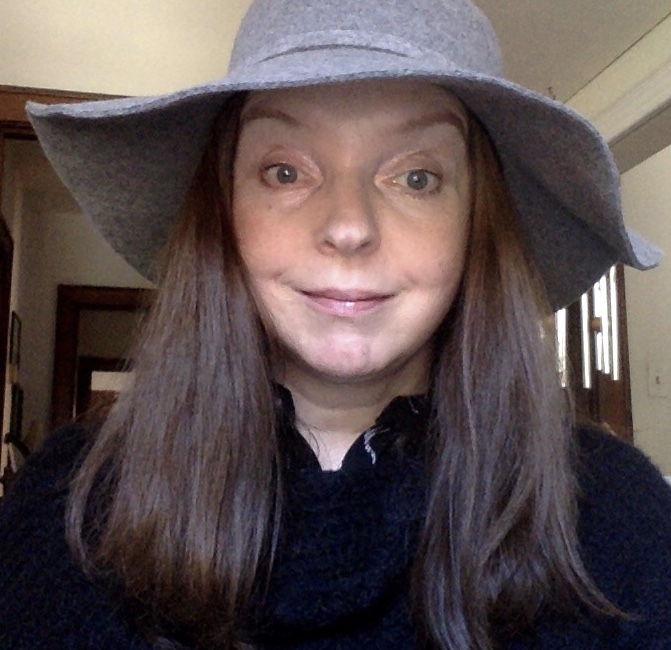
Sarah Harley is a writer and high school teacher from the UK who helps refugee students tell their own stories. Her essays draw on lived experience navigating childhood trauma and PTSD, exploring memory, place, and resilience. Her work has appeared in Mud Season Review, Sonora Review, Bluestem Magazine, and West Trade Review. More at sarahharley888.com.


