

My first psychedelic trip was at a hospital in West Haven, Connecticut, a few miles from Yale University. My husband and cousin were eating pizza in downtown New Haven, while I was hooked up to a saline IV drip, a wet washcloth draped on the back of my neck, watching the show Friends. Everything was luminous while simultaneously mundane.
I was participating in a clinical trial to study the effects of the psychedelic component of magic mushrooms, psilocybin, on migraines. The nurse told me not to text anyone or use my phone while I’m on the medication. This is a rule, so as to avoid any mishaps that I imagine equate to a “drunk dial.” But I picked up my phone anyway, ignoring the rules, and text my closest friends how much I love them.
“I’m tripping at Yale. It’s wild. I love you,” is the universal message I send out en masse.
At one point, I feel a swell of love and joy overwhelm me so fully that I cannot hold all the emotion inside and it spills out as silent, copious tears. I bite my lip, trying to hold back, but then give in to the current and let it move through me. I feel a ripple of nostalgia. On the TV, Rachel explains the layers of her Thanksgiving trifle, while everyone else pantomimes how delicious it is. I lie back on the hospital bed and rest, a kaleidoscope of neon shapes and colors dance behind my eyelids. The laugh track echoes in the background. My breath finds a steady rhythm and I nearly drift off into sleep, but I linger, instead, in a sweet state of in-betweenness. My body is warm and contained. I feel emotionally tucked in.
My second encounter with psychedelics, though, is an affecting, heart-pounding experience. I’m in the second phase of the double-blind trial, which, like the first phase, means I don’t know what drug I’m getting. I might either receive a dose of pharmaceutical-grade psilocybin, or a placebo, Benadryl. The first indicator I’d received the psilocybin is a blip and blur of my vision. A soft haze frames my perception. The world around me is muted tones and blinking sparks.
I can’t always trust my eyes. After years of migraine headaches, they betray me in ways I cannot predict. A bright flash; a sunspot when there’s no sun; a kaleidoscopic rainbow blotting out my sight; a need to squint on the cloudiest of days; a hazy crackle and fuzz known as visual snow. So, when my sight begins to warp and smudge, I am not sure if it’s the result of the migraine I’ve had all day—an unfortunate coincidence—or if I am actually beginning to trip.
“How are you feeling?” the nurse asks, approaching me to take my vitals, something required at time intervals I can no longer recall.
“I think I’m feeling it,” I say.
“Okay. Do you need anything?” She clears the tray in front of me, taking away the remnants of my Cheerios and milk from breakfast.
“Maybe I’m starting to feel a bit sick? Nauseous.”
I sit up hoping to fold myself in half and stem the waves of queasiness. I swallow and look out the window next to the hospital bed at the gleaming sun through the slats of blinds. My head throbs to the rhythm of my pulse, quickening with the passing minutes.
“Sometimes Benadryl can also cause hallucinations and nausea,” the nurse remarks. “Try doing some box breathing.”
So I sit there, inhaling for four beats, holding for four beats, exhaling for four. I lay back down and play the spa music I downloaded for the occasion and close my eyes. I have a mantra I use for panic attacks, “This is an illusion.” It tends to work when I repeat it in my head. I imagine it like a polished stone. My mind smooths over it, and I can iron out the crumpled, static feelings of my anxiety. I take out the fuzz and friction, replacing it with an idea that reminds me this neurosis is one thing I can actually control.
But the nausea pushes back, arguing against control. It wells up from my navel to my solar plexus and does not abate, and when it does lessen, it rolls back like a tide. I sit up and look at my blood pressure and pulse ticking up, up on the monitor. This is not going to be easy. This time, the psilocybin wants me to pay attention.
I’ve had only two encounters with psychedelics in a clinical setting, and both remind me of a waking dream—sometimes dark, often discomfiting, and sometimes sublime.
Unlike my first encounter, which was effervescent and wondrous, this one is creeping around me with melancholy. Colors are muted, dark and undulating, nothing like the vibrant and frothy vivacity of my first trip. This time, the hospital curtains, separating my room from the next, look like the wailing faces of Munch’s The Scream and the room breathes as it grows smaller and larger with no warning.
Somehow, this encounter is more profound on every level. I am on the precipice of a dose that takes me to the wide, infinite abyss, but does not allow me to fully release, or at least not crave the grounding of my body. I close my eyes and see shapes, patterns, the vast expanse of the universe full of stars and planets, almost a tear in the fabric of the cosmos, but before I fully step into this tear and allow myself to drift off, I come screeching back into my own body and fear the release, wondering if I will ever return. Wanting and needing to return, to affix myself back in this realm.
In reading Thoreau’s journals, I’ve gained new insight to my experience. He says,
The thought that comes to light, that pierces the empyrean on the other side, is wombed and rooted in darkness, a moist and fertile darkness—its roots in Hades like the tree of life. No idea is so soaring but it will readily put forth roots. Wherever there is an air-and-light-seeking bud about to expand, it may become in the earth a darkness-seeking root. Even swallows and birds-of-paradise can walk on the ground. [1]
Our most universal selves are rooted in darkness. Our ideas, our minds, and most soaring thoughts—like leaves—are deeply rooted. Like me, in that liminal place—feeling as if I could float into the ether, the dark expanse of sun and stars, but simultaneously rooted firmly in my body, being pulled back into the verso of the dark universe, the light of the room, the nurse, the doctor—my mind both floating and rooted, soaring and grounded. I was, whether mind, body, or both, flitting between the two and realizing that the darkness holds a beauty more profound than light. We are always vacillating between the binary of darkness and light but there is no difference.
I have had migraines for as long as I can remember getting headaches, which forced me to spend a good portion of my life in literal darkness. Most people think a migraine is confined to a long, painful headache. But the truth is, migraines typically last days, if not weeks. They are separated out into three stages: prodrome, headache, and postdrome.
Most people don’t understand this. The idea that a migraine is some fiction made up by hysterical women is an idea some people in my own family believe. Understanding that migraine is more of a state of being than simply a few hours of pain is unthinkable for many.
Joan Didion got her first migraine headache at eight years old, as she explains in her famous essay “In Bed.”[2] Mine started sometime around the same age, but I am not blessed with the memory to recall how or when. All I know is that I get terrible headaches and for years, they were attributed to sinus problems, allergies, neuroses. I simply thought headaches were the same for everyone. It confounded me that anyone could get anything done when they had a headache since mine relegate me to a dark room, curled into a ball, with an icepack pressed over my face for twelve hours. I didn’t learn that these were migraines until I was in college and my boyfriend’s mother told me that she also got migraine headaches.
“Migraines?” I thought. “Is that what I have?”
She gave me an Imitrex tablet and I took it. Within an hour the pain abated. It was a miracle, until it wasn’t. I learned that certain migraine medications come with a caveat that if you take them too often, they’ll cause more migraines. It’s a phenomenon called rebound headaches and it’s not fully understood why they occur.
Some of my worst migraines occurred during school. Friends would call me neurotic or fragile. It was strange, they said, for me to miss a day simply because I had a headache. I learned from an early age that people do not believe a girl’s narrative of her own experience, her pain. We are just dramatic, over sensitive, histrionic. How can we be believed?
Didion notes that she “simply had migraine headaches, and migraine headaches were, as everyone who did not have them knew, imaginary.” She says, “All of us who have migraine suffer not only from the attacks themselves but from this common conviction that we are perversely refusing to cure ourselves by taking a couple of aspirin, that we are making ourselves sick, that we ‘bring it on ourselves.’”[3]
The irony is that, as a child, I never wanted to be the center of attention. I wanted to fade into the background and be left alone. Staying home with a migraine actually served a purpose: quiet solitude, if a painful one. Migraines, from a young age, forced me to find a way inside my own mind and pain. I learned how to distract myself or dive deeper into that pain. I had to get through it; there was no other way.
When I engage with psychedelics, I am seeking a way forward or a way out from within my own mind, too. I travel within myself and search out depths I didn’t realize I had. I imagine all of us who have experienced psychedelics do the same. We become someone who finds infinity or at least glances over it, comes so close that we verify its existence. It’s a way to skirt death. To validate our immortality. To hold our arms up and skim the unknown.
In his book, Time Travel, James Gleick notes, “We create memories or our memories create themselves. Consulting a memory converts it into a memory of a memory. The memories of memories, the thoughts of thoughts, blend into one another until we cannot tease them apart. Memory is recursive and self-referential. Mirrors. Mazes.”[4]
The lens through which we conceive of ourselves is the same one that allows us to construct our perceptions of others. What we use to create memories is the same raw material we use to paste ourselves on the mark of infinity. So much of what we create—whether art or work or even offspring—is done to etch off a piece of ourselves and leave it behind. “I was here. I did this.” We are constantly grounding and constantly soaring. We are Thoreau’s leaves, rooted and fluttering in the breeze. Migraines bring us to that space by teaching us about pain. Psychedelics ferry us along by teaching us about disorientation. Mazes.
Some mornings, I’ll wake up tight within anxiety’s grip. Float through the morning in a fugue. How did I arrive at work? A wave of panic welling up from my solar plexus, the knowledge that I’m not quite present in any moment, removed. These feelings will wax and wane for days. I am the moon, in a cycle of knowing and unknowing. Dark and light. Sometimes, I’ll feel euphoric. A burst of energy overtakes me and at 10 o’clock in the evening, I’ll get out of bed, try on clothes, plan my week’s wardrobe. I don’t understand that I am in the beginning stages of a migraine until the headache wedges itself behind my left eye, my brow, spreading, spreading, until it almost feels like I can remove the wedge somehow. Release myself from the pain. If only I could find it.
This lead up, sometimes lasting more than a week, is called prodrome. And occasionally, I will see a bright spark of light in my vision, a star. A star is a sun. So of course, it grows and grows until I cannot see anything except light, a prism. Jagged scalloped edges dance and pulsate with geometric rainbows. An aura. A scintillating scotoma. A common prodrome symptom. A hallucination.
I am not a scientist, and I do not pretend to know why anyone gets migraines. But after receiving psilocybin twice, I see clear parallels between the experience of psychedelics and migraine headaches—specifically the prodrome symptom of migraine aura. I began experiencing aura when I was 31. I had been getting migraine headaches for more than two decades before I had my first aura.
My husband and I had recently moved from Los Angeles to Phoenix, and it was a rocky adjustment period. I have a difficult time navigating any type of major change, whether positive or negative, and I’m convinced the stress of the move may have triggered the episodes of aura, although I could be wrong. The thing is, no one, not even neurologists can give any clear answers as to why people experience migraines or auras.
My first aura was both ordinary and terrifying. I was home alone in the evening, sitting on the carpeted floor of my rented apartment’s living room, watching Friday Night Lights, when a bright, blank, shimmering void appeared in my vision. The longer I sat, looking at the illuminated screen of the television, the spot grew, leaving a blind spot in the center. It was scintillating. It’s this scintillation that would later come back to me when I was traversing my way through a psychedelic trip.

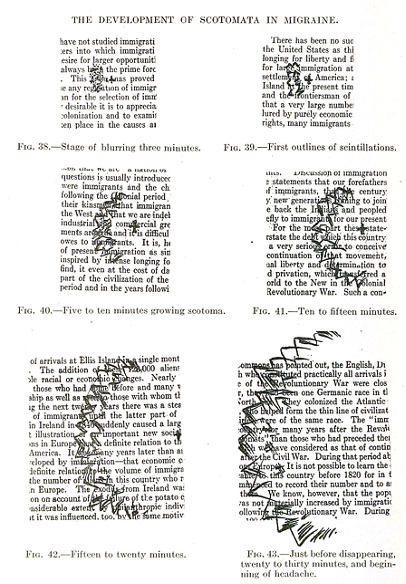
An artist’s rendition of an aura. Title: Diseases of the nervous system : a text-book of neurology and psychiatry Year: 1915 (1910s) Authors: Jelliffe, Smith Ely, 1866-1945 White, William A. (William Alanson), 1870-1937. Image in the Public Domain.
In reading Didion’s migraine essay, she says that the medication that gave her relief was called Sansert (or methysergide). She also mentions that it’s a derivative of LSD and that LSD was discovered as a result of searching for a cure for migraines.[5] This Venn diagram of migraines and psychedelics seems to widen the more I search for answers as to why my brain, on a monthly basis, erupts in its own, natural psychedelic show—whether it’s the glistening display of an aura or the existential crisis I sometimes experience before the onset of the pain. So, why do psychedelics help migraines?
A migraine headache itself lasts anywhere from 12-72 hours. Sometimes, I will achieve a day of respite only to be plunged back into another three-day painful abyss. The challenge with these extended, if rare, migraines is that I cannot take the medication for this many days, so I am often cobbling together a mixture of caffeine, ibuprofen, Zofran (anti-nausea meds) and paid sick days.
But once the headache subsides, the migraine is not over. Postdrome sets in, and it can be so disorienting that I retreat from social engagements, only to lie on the couch and zone out in front of the television. My postdrome knocks me into confusion and lethargy.
At this stage in the migraine, my anxiety is still raw, but I am also more creatively productive. I’m tired and have a hard time forming a thought to speak, but I am able to sit at my laptop and type out whatever is going on inside my head with lucid clarity. Right now, as I type these words, I am in a postdrome. It’s precisely in these moments of anxiety or discomfort that I do most of my growth. It’s also the moments I dread the most. I do not sit well with discomfort. My body does everything it can to speed through discomfort, anxiety. I imagine the levels of cortisol coursing through me are not doing me any favors.
When I am anxious, I shrink. I lose weight. I fold in on myself. I retreat from social life. I am not very productive—creatively or otherwise. But when I emerge, I see clearer, even if it’s brief, only to plunge me back into anxiety months later. A migraine attack is a microcosm of this cycle, in the span of 12-24 hours (Didion notes this as well).[6]
One of the most grounding activities that got me through the near constant and crippling anxiety of my second psilocybin experience, was the doctor sitting with me in the hospital room and simply making small talk. Most of the chatter was about my current state, how psychedelics work, how migraines work, and how the nexus of these states might have altered my perception—from one of pure bliss to one of impending doom. The doctor sat patiently, told me I was fine, and the act of talking about my situation, as if I was separated from it, brought unique relief. It was as if the act of analyzing my current state validated my existence. I was observing myself from a vantage almost outside of myself. Here I was—the room growing larger and smaller—breathing with life. The floor rolling like a swell in the sea, and shapes around me mutating in and out of perceived sentience, as I talked to the doctor about psychedelics and their theorized effects on migraines, the brain, and consciousness. I was in two places at once—another dimension and this one. It was no longer unsettling if I could ground in her attention and my analysis. We were entwined like a double-helix, spinning in infinity. Maybe this is what oneness feels like—here and there, thought and distance, perception and misperception. I felt like I was on the precipice of something I never quite reached.
To ground is to connect us to something that is alive. It is a quickening; a pulse. When we ground into a moment, we are seeking what is awake in that moment. Psychedelics ground us more than they release us into the void. They ground us in the collective. Psilocybin reminds us that this collective is all we have, and it is simultaneously everything. It’s shimmering and brilliant. It is dark and foreboding. It is the moment between breaths as much as it is the breath itself. Everything is a transition. Every moment is a threshold. There is no such thing as stasis. When we harness that knowledge, we are set free within our confinement to this earth and this existence.
Maybe the idea of a collective consciousness IS the verification of it. If we believe it, and it’s our collective, it must be true. Who constructs our reality if not ourselves? Mirrors.
Maybe this existence is one long liminality: an earthly purgatory between two dark unknowns. We enter the world from an embryonic darkness, and we exit back into darkness. Both states are a form of rootedness. Both are also a form of letting go, release. Neither state requires any consciousness or at least any that we understand. Maybe my psychedelic experiences were exemplifying this threshold between the ultimate unknowns of what we are before we are born and after we die.
We don’t know yet, to what extent psychedelics and specifically psilocybin may contribute to lessening pain or ameliorating migraine. The clinical trials underway are the tip of the iceberg and it’s likely that researchers will need to conduct many more studies. Already, though, sufferers of cluster headaches – a rare and particularly painfully debilitating type of headache- have been self-medicating using psilocybin for years.[7]
The initial psilocybin migraine trial consisted of ten participants, including me. We were all clinically diagnosed with migraines. According to the published results in the journal Neurotherapeutics, 80% of us had a reduction in migraine days in the two weeks following the administration of psilocybin.[8] And although we were only required to keep a migraine log for two weeks after the trial, I continued to keep mine, noting that I went without a migraine for more than five weeks—an unprecedented experience. I had never gone that long without a migraine.
The second time around, though, I did not have the same pain-relief success. Not only did the psilocybin have no positive effect on my migraine the day of the trial, but I continued to get migraines at regular intervals after the dose.
The official findings of the second trial are still being drafted by the doctor in charge. Psilocybin is, however, showing promise for migraineurs much like it is for those with major depressive disorder, Parkinson’s, terminally ill patients and even those with obsessive-compulsive disorder.[9] But will it be a panacea? Unlikely. Even when we find out to what extent it may help migraines, dosing and treatment schedules might take years to understand and perfect. For now, though, the promise is enough. The idea that something that can expand our minds might also be something that can quiet them—both from the inflammation of pain and the throbbing of depression or anxiety—is hope enough.
A migraine is a trip all its own. Migraines and psilocybin are two branches of the same tree. Didion reflects on coming to see migraines as a friend—an entity or experience that revives her from the numbing predisposition of modern life.[10] Awakening from a shroud of pain will do that. It will connect you to a current—a direct line to our mortal divinity. It will thrust you forward and say, “See this? This is your birthright.” This wonder and joy—it is flowing through space and time like a current. You can tune in anytime. You can hold your arms out and embrace all of it. Let the current flow through you, within you. It takes nothing but your careful attention; maybe a little more time than you were willing to give. Sit a little bit longer; look up more; whisper to yourself all the truth that no one else can show you.

Jacqui Higgins-Dailey is a student in the MFA program at the University of New Orleans and is published in Midway Journal, Harpur Palate, NPR, the ALA’s Office for Intellectual Freedom, and The Journal of Intellectual Freedom and Privacy. She is residential faculty at Glendale Community College in Arizona.


