

The scariest part was not that La Llorona was a monster, or that she came when you called her name three times in the dark, or that she could come into your room at night and take you from your bed like she’d done with her own babies. It was that once she’d been a person, a woman, a mother. And then a moment, an instant, a split second later, she was a monster.
Jaquira Díaz, Ordinary Girls
I find the train. La Bestia is resting.
Climb the rungs on the side of its orange car
and let my hair tendril the crossbars.
Pull myself to the sky
and settle. People bolt screaming.
Come back, I shout. Open my hands
to show them the stars.
No one returns.
I have no cradle to shush
sweet hush. I lurch, sing
lullabies of roses and jasmine
my arrurru a claw of strangled sound.
I become a watery ghost to cross
the border in the shifting shadows.
Rumors of cages and silver blankets
whisper. The children cannot sleep.
I move through the desert
paw the night
a coyote hunting for her pups.
Find them, I tell my blood.
Somewhere, there is a river
at least a path to follow.
I come to the Fortress of Happiness
and weave through the fence.
I’m here, I call.
No one answers.
I walk among rows of children.
They could all be mine.
Not you.
Not you.
And then a child cries, and I remember
everything I have been walking to forget.
Sour wasted bodies, water we couldn’t find
metal shrill heat of the patrol.
Everyone ran to hide.
I held the children close.
Shhh. No sound
No sound
For how long—
did my hands cover their mouths?
The weighted silence of stones.
Please. No.
In this fortress, I cannot stop remembering.
My hands pummel the air.
My hair twists its way
to the guards and strangles them.
Run, I tell the children. Run.
Wails tear the walls.
I wander behind them weeping.
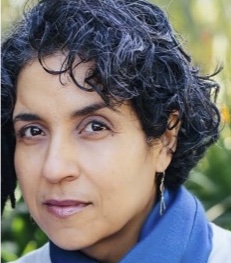
Marian Urquilla’s work explores the intersections of migration, spirituality, and identity. Her poems have appeared in The Acentos Review, Journal of Latina Critical Feminism, and West Trestle. A Salvadoran immigrant, she and her wife live in California’s East Bay.


