

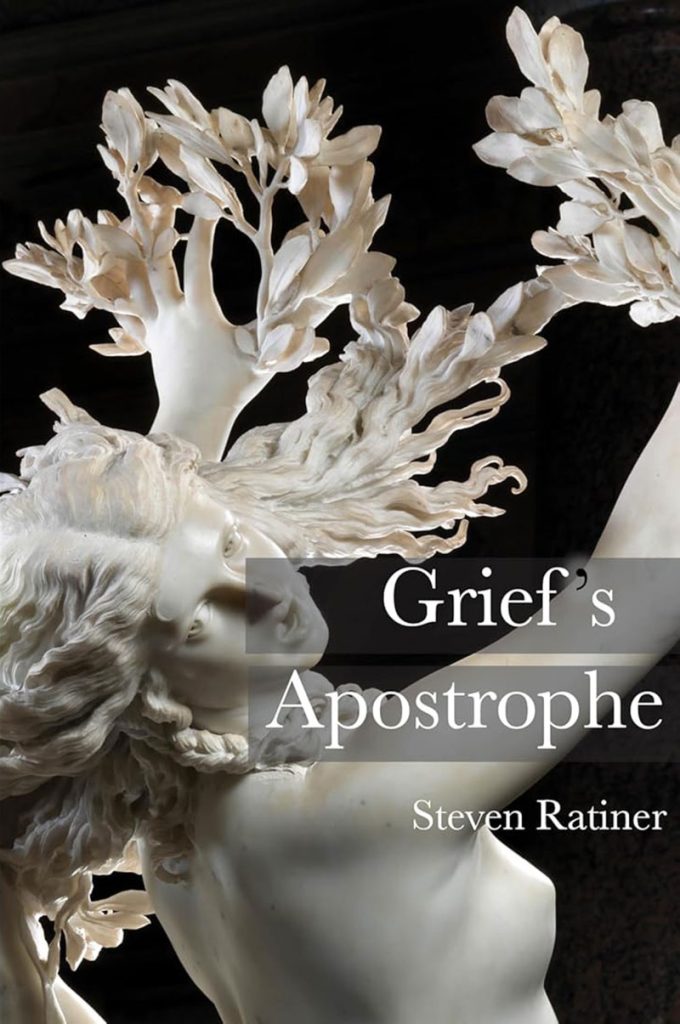
Grief’s Apostrophe
By Steven Ratiner
Beltway Editions
2025, 89 pages
$20.00
The three sections of Steven Ratiner’s artfully crafted poetry collection, Grief’s Apostrophe, take us on a journey through the pain of personal grief to broader social and historical tragedies and finally to the synthesis of grief into joys of everyday life. The introductory poem, “Typos,” demonstrates the careful attention to language that pervades this book. All forms of solace refuse themselves as language plays its tricks: “Seeking solace in the pastoral, but grove came out as grave.” Meanwhile the speaker stands there helplessly: “all I could do/was stand there, heart-stung composing/sorrow inside my head.” Yet, despite this initial stance, the poems that follow are unafraid of both speech and speechlessness.
The first section recreates the lives and deaths of those the poet mourns through short narratives and portraits as well as stuttering gaps of nearly inexpressible sorrow. “Learning the Business,” for example, shows the poet’s father in his prime, skillfully tying the image of this vital man who “…fished two hundred pounds of dry cleaning//from the murky slosh…” to the image of that same father returning from radiation when the orderlies lay him in his hospital bed “limp as laundry.” The mother who comforts her son in ‘Kigo” is also the mother who angrily spits on the ground at her brother-in-law for cheating her out of an inheritance and who, memory ravaged by age, confuses her son with other people. In addition to mingling memory and loss in brief narratives and lyrics, Ratiner skillfully points to the failure of language itself as a form of loss. Sometimes it’s those he is losing who can’t summon language. In “Fathering,” for example, he writes of a walk with his father “…he had a hard time//with the snow– He couldn’t say,/and the sky wouldn’t stop saying–.” In other poems, such as “The Old Words,” and “Parocheth,” their spare language seems to carry the sense that words themselves are inadequate for such deep grief. “Parocheth” also illustrates Ratiner’s technique of inserting moments of insight into fragmentary observations as when brief details of his mother’s death are interrupted by the sentence: We prepared ourselves and were/wholly unprepared….” In the final poem of this first section, “Ballroom Dancing with the Bestial Dark,” the poet acknowledges a kind of loss innocence: “…I’m death’s/wallflower no more,….”
Perhaps it is this very loss of innocence that allows the poet to weave his personal griefs into the world’s tragedies as we move to the second section. In poems like “O” and “Conspiracy of Nouns” the poet picks up the theme of language as fragmentary expression, while other poems, such as “The Burning Bush” and “Filial” deliberately conflate personal experience with Biblical stories to widen the context of the earlier poems. The tone of the poems also shifts a bit in this section. It’s tougher, critical, more sardonic as in the title “Selfie with God.” Here modern technology merges with the divine. Yet by now the speaker is wary: God “moves, unerringly. While I hold him/at arm’s length.” A three-year-old child, drowned and washed up on shore is a kind of Odysseus without the triumphant homecoming, and, sensitized to loss, the speaker mishears the reporter’s question as “Whose child isn’t this?” (“Drowned Turkish Toddler Washes Up On Turkish Resort Beach Near Bodrum”.) Sorrow at individual deaths turns to horror at mass deaths, including children whose schools are bombed “In this new blood curriculum–/with alarm bells clinging–” (“Soft Target”). Having danced with death, the speaker cannot unsee it. Shubert’s leider is “strung with barbed wire,” and hollow black eyes gaze “out between the taut black staves” (“Schubert (with the volume turned up”). “An advent calendar [is] shaped like a line/ of cattle cars.” However, in this section, the poet also introduces another new, more life-affirming theme in the erotic awakening of “Sunday School” and the fully realized eros of “She Loved” and “All Hallows” in which, after diving into their children’s Halloween candy, the parents make love on the couch “as/if we still desired every bit of this life as much/as we do the milk, the dark, the bittersweet.”
This notion of accepting the milk, dark, and bittersweet skillfully leads us into the culminating section of this collection in which grief is incorporated into everyday life, its joys and its sorrows. Once more, some of this is done through Ratiner’s deft use of language itself. Consider the line break in “Transcendental Postcard” which begins this section: “Wish you were. Here,”. The period after “were” turns a postcard cliché into a moment of poignancy, while the emphasis on “Here” brings us into the present, signaling that although grief is always with us, so is the immediacy of our lives. We do not abandon grief by celebrating life. Ratiner also weaves his tapestry by picking up the threads of what’s come before, echoing references not only to specific loved ones but also to mythology and culture. Just as Aeneas carried his father out of the battlefields of Troy, the speaker metaphorically carries his father wherever he goes-through Flatbush and Queens, academia and airports (“Aeneas and Anchises”). The poet does not seek to erase loss but to recognize “love’s continuance, grief’s/temporary reprieve” (“Carcinoma”). The resolution of this psychic journey is to honor both loss and life as stated in these lines from the stunning final poem, “Grief’s Apostrophe”:
I can set the cup down now,
push back from the table,
And return to the day that’s
always been waiting
having loosened the hold of–
no, none of these lost faces–
but grief’s apostrophe.
That phrase “grief’s apostrophe,” which is also the title of the book, demonstrates Ratiner’s skill, for it carries many meanings. An apostrophe is a signal of possession, a mark of something omitted, and, in literary terms, a form of address. It is the book’s final confirmation that we can carry our departed loved ones with us without being dominated by their loss. I have always puzzled over and silently questioned Keats’ famous line “Beauty is truth, truth beauty” yet in Grief’s Apostrophe, Ratiner’s poems merge the beauty of art with the harsh truth of mortality. This is a book that deserves a wide readership.

Kathleen Aguero’s most recent book of poetry is World Happiness Index from Tiger Bark Books. Her other poetry collections include After That, Investigations: The Mystery of the Girl Sleuth, Daughter Of, The Real Weather, and Thirsty Day. She has co-edited three volumes of multi-cultural literature for the University of Georgia Press (A Gift of Tongues, An Ear to the Ground, and Daily Fare) and serves as Faculty-at-Large in the Solstice low-residency M.F.A. program at Lasell University. Kathleen has received grants from the Elgin Cox Foundation and the Massachusetts Cultural Council including a 2026 Creative Individuals Grant.


