

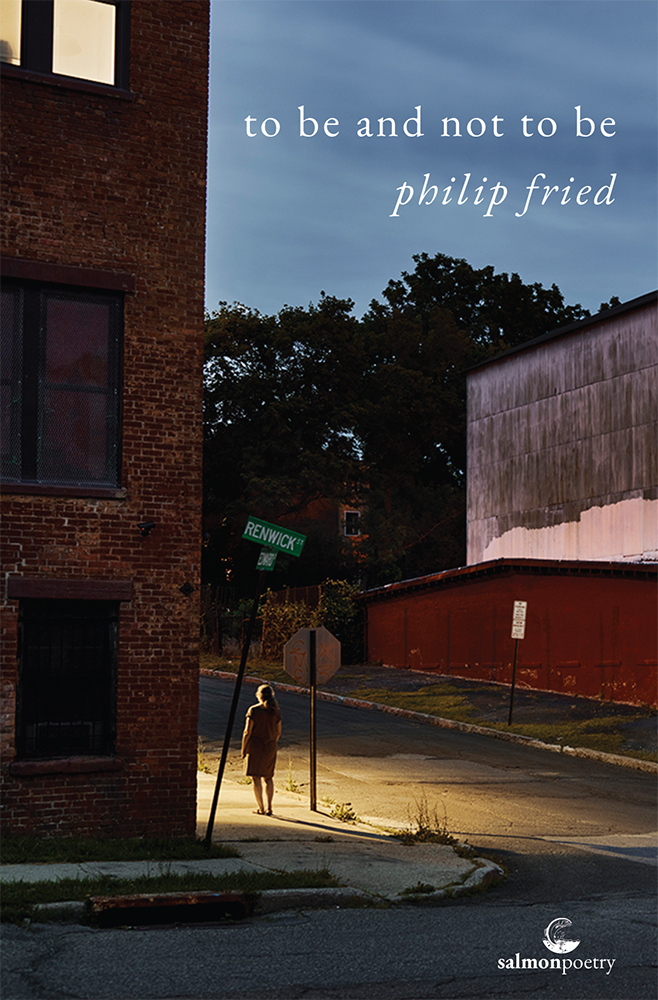
to be and not to be
By Philip Fried
Salmon Poetry
2026, 78 pages,
$17.95
Philip Fried’s ninth collection, to be and not to be, his seventh with Irish publisher Salmon Poetry, arrives at a moment of particular urgency, both for the poet and for the culture he addresses. Fried, who lives with Parkinson’s Disease, brings to these pages a philosopher’s equanimity and a satirist’s abiding sense of outrage. The double deterioration, of the poet and his country, might have produced a grim book. Instead, Fried has written one of the most intellectually exhilarating collections of the year.
Where Shakespeare’s Hamlet posed the question as an either/or, Fried’s titular and makes a wager: life and death, presence and absence, being and its undoing, are not opposites but dimensions of a single, complex reality. But this ontological proposition is not meant to console; it is the engine of the book’s ambition. Fried can treat mortality with wit, with mathematical precision, with political outrage, because his governing conjunction permits it. The word and is the key here, the representation of the boundary explored in the book’s final sequence, “At the Dimensional Border,” a tour de force.
Readers who have followed Fried through Early/Late: New and Selected Poems (2011), Interrogating Water (2013), Squaring the Circle (2017), and Among the Gliesians (2020) will recognize his signature moves: the poem-as-thought-experiment, the ventriloquism of both celestial and mundane voices, the running argument with an uncooperative universe. But the stakes are higher now, or maybe the poet simply grasps them more clearly. Facing his own illness alongside what he calls “locust swarms of hokum, ” Fried writes with a complex defiance that includes the refusal to indulge any sentimentality whatsoever, even in its milder and least saccharine forms.
The book’s first section, “Murder Most Foul,” sets the terms with Shakespearean bravado. In the title poem, the speaker searches for meaning in his affliction and finds Hamlet as his guide: “I’m Hamlet chin-wagging at Yorick’s jawbone, / me talking to myself deceased, / one proper noun worn down to pronouns.” It is a remarkable conceit: Parkinson’s rendered as the conversion of a self into its own remnant and mourner, and it establishes the philosophical borderland the entire book inhabits: between presence and absence, subject and object, the speaking self and the skull it addresses. Right from the start, we are drawn into an inquiry that is not only Fried’s but our own, as beings who watch the body’s slow demise with something between horror and curiosity.
Fried is a kind of Gnostic. He posits another dimension, entertains it with intellectual rigor, and questions the divine management of this one. An earlier poem, in Early/Late: New & Selected Poems, describes God as “the catastrophe we strive to cap,” a line that could serve as epigraph to all his work. He is emphatically not looking for “A voice that will console you into oblivion.” Tough-minded and suspicious of sentiment, Fried’s poems earn their emotional authority through intellectual honesty and a cultivated appreciation for the absurd.
The book’s final sequence is glorious. Nineteen thirteen-line poems that Fried calls “not quite sonnets,” (the designation is too modest) constitute a sustained meditation on what physics calls the holographic principle: the theory that our three-dimensional reality is the projection of a two-dimensional surface at the edge of everything. If you want to understand how one might move from this world to whatever comes next, Fried proposes, consider first how three dimensions emerge from two, and then, by analogy, perhaps a glimpse can be had of how, in Paul’s words, “we shall all be changed.” One could spend an entire evening with the first poem in this sequence (as I did recently;) its intricacies and echoes are seemingly endless, its abstractions anything but evasions. There is terror in the sequence, and sorrow, regret, laughter, and anger. That Fried can produce the full range of human emotion through language borrowed from mathematics and geometry is not a parlor trick; it is the hallmark of a genuinely original artist. Playful as the series is, existential dread suffuses it. And redeems it. The final poem, which first appeared in the Journal of Humanistic Mathematics (who knew?) seems, on reflection, to be exactly the right place for it.
to be and not to be is the work of a poet writing with the urgency of diminishing time and, consequently, with the freedom urgency confers. Standing, like Keats, on the shore of the wide world “Till love and fame to nothingness do sink,” Fried asks the further question, “What then?” Then he answers it, not with false comfort but with philosophic play, moral imagination and amor fati. This is an astonishing, wry, and ultimately profound book of poems.

Richard Hoffman is the author of nine books, including the memoirs Half the House and Love & Fury; the story collection Interference and other stories; the essay collection Remembering the Alchemists and other essays; and five books of poems: Without Paradise; Gold Star Road, which won the 2006 Barrow Street Press Poetry Prize and the New England Poetry Club’s Sheila Motton Book Award; Emblem; Noon until Night, winner of the 2018 Massachusetts Book Award for poetry; and People Once Real.


