

Everyone has a story about that moment, the one often experienced alone… even when in the company of others, the instant when one of your life-strands is forever changed. This is mine.
In the late 60’s, a perfect and dangerous time to be 21, a group of invisible patrons, inspired by the seductive idealism of that era, and perhaps a little bit by the romantic notions of Robert Rimmer’s book, The Harrad Experiment, spent the better part of a year interviewing art students around the country. Their intention… putting 14 of them together with an equal number of free-spirited mentors, life and supplies on-the-house, with the single objective that we begin to work in a medium that was unfamiliar to us… presumably to determine how darkness was illuminated. I was tagged and became part of that tribe. I sold my BSA 500 Goldstar motorcycle to buy a very old VW with painted white angel wings, refrigerator tubing for brake lines and clothespins for throttle adjustments, and moved into a barn in an arts-centric commune in western Massachusetts called The Cummington Community.
We listened to Dylan’s The Times They Are A-Changin, did improvisational theater, built salt kilns, used barns as canvases, and I constructed what I imagined to be a darkroom with my only reference being David Hemming’s English-loft workspace in Michelangelo Antonioni’s 1966 film Blow-Up. Unlike the loft, my selected space was an unused and crooked donkey shed walled with opaque black silage plastic from a local farm supply to eliminate the light. My plumbing was a green hose, that had seen better days, hooked up to the main barn where we all lived on a single open floor. My mom had given me an ancient Russian enlarger she had purchased for 50 cents at a local church flea market… unique in that would set a negative on fire for any exposure lasting more than 9 seconds. My safelight was a caver’s headlamp with red cellophane… saved from a caramel apple wrapping.
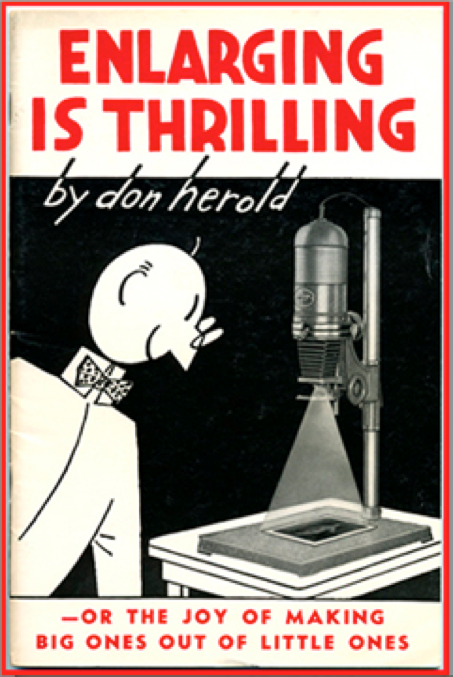
On a run-a-way to New York, with fellow barn-mates, Martha and Tony, I had made exposures with my very first used camera, the exact same model, both precious and cheap, that Hemmings had photographed Veruschka on purple seamless in Blow Up. I was eager to see if it worked. I also had a manual, Enlarging Is Thrilling – Or the Joy of Making Big Ones Out of Little Ones, by Don Herald; a book printed in 1945 to serve as a manual for the Federal Model #269 enlarger in a suitcase for $39.50.
After processing my first roll of film in a tall Galliano bottle that I found behind the barn, I set up the donkey shed for printing. Selecting a frame, I placed the negative in the Russian enlarger’s negative carrier and exposed one of my 10 precious pieces of Agfa Portriga 111 paper, held flat to a board with masking tape, until I smelled the smoke. A deep breath in the darkness, I immersed my first paper exposure in a baking tray that held the Dektol developer. Nothing… and a lifetime of seconds later… my first photograph, of a carefully dressed man, eating alone in a Hayes-Bickford, at the intersection of 8th and 34th in Times Square, emerged. In that very moment, in the midst of my satori, i knew without hesitation where the rest of my life would be centered.


Christopher James is an internationally known artist and photographer whose photographs, paintings, and alternative process printmaking have been exhibited in galleries and museums in this country and abroad. His work has been published and shown extensively, including exhibitions in the Museum of Modern Art, Metropolitan Museum of Art, George Eastman House, Philadelphia Museum of Art and the Institute of Contemporary Art-Boston. Represented by the Lee Witkin Gallery in New York City for over two decades he has also shown at Pace-McGill (NYC), Contrasts Gallery (London), Michelle Chomette (Paris), Hartje Gallery (Berlin), and Photokina (Germany). He has published extensively including Aperture, Camera (Switzerland), American Photographer, Solstice (for fiction), and Interview magazine and in books such as The Antiquarian Avant Garde, á Prova de Aguà: Waterproof, Human Documents, and Handcrafted: The Art and Practice of the Handmade Print (China).
All three editions of his book, The Book of Alternative Photographic Processes have received international critical acclaim and are universally recognized by artists, curators, historians, and educators as the definitive text in the genre of alternative process photography and photographically integrated media. A significantly expanded 900 page / 700 image, 3rd edition was published in 2015. Christopher, after 13 years at Harvard University, is presently University Professor and Director of the MFA in Photography and Integrated Media program at Lesley University College of Art and Design. He received his undergraduate degree from Massachusetts College of Art and his masters from the Rhode Island School of Design and is also a painter, graphic designer, author, and a professional scuba diver.


