

Nothing survived the Annunciation
except rocks and the hard shadows
of cypresses.
Fright in her eyes, she smiles,
trapped in the interior of a painting,
her hands dirty before she is dragged away
in the deathly air.
What is beauty
if not the roundness of her arms.
Or the young Tobias, at war
with the demons, seeing
the archangel rise from the water,
and feeling the protective warmth
of the Archangel’s stare,
believing then that God might
have pity on him and Sarah,
rooted in their own fates
like black cypresses.
The Tuscan sun darkens
the shoulders of the mourners,
where the earth leaps into the grave,
and the face and hair dissolve.
Just a glance at a wilted flower,
the wings of an insect in flight
that plunges through red glow
of the sun—nothing can save
us from this fate.
When I open a pomegranate, orange
seeds spill on my toes and on stone.
When you drown, the water spreads
in circles, and the light steps away
from you.
Only memory comes close to immortality,
but its images are broken.
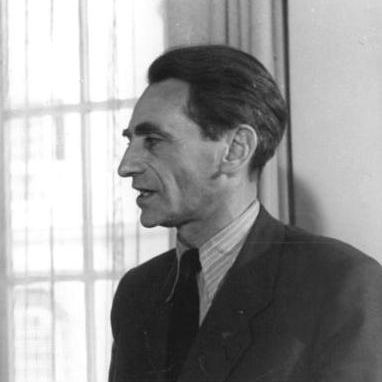
Mieczysław Jastrun was born as Mojsze Agatstein in 1903 in Korolowka, Austria-Hungary (now Ukraine), and died in 1983 in Warsaw, Poland. A lyric poet and essayist of Jewish origin, he survived the terrible years of the Nazi occupation in Poland. During his lifetime he published a dozen volumes of poetry, including A Human Matter, A Meeting in Time, Protected Hour and Memorials. He concerned himself most often with the subjects of philosophy and morality and shunned Jewish themes in his poetry (with the exception of a few poems). However, as a poet who published his poems in resistance periodicals, he couldn’t turn his back on the horrors of the genocide; nor was he able to escape historical necessity and despair in even his most mystical writings. Jastrun is considered to be one of the most important Polish poets of the years between the two world wars. He translated French, Russian, and German poets (including Rilke) into Polish. His work is included in Postwar Polish Poetry: An Anthology, selected and edited by Czesław Miłosz.
The poem, Analogy, written by Mieczysław Jastrun is from a group of new translations by Orlowsky and Friedman.

Jeff Friedman’s newest book, The Marksman, will be published by Carnegie Mellon University Press in fall 2020. He is the author of seven previous poetry collections, including Floating Tales and Pretenders. Friedman’s poems, mini stories and translations have appeared in American Poetry Review, Poetry, New England Review, Poetry International, Hotel Amerika, The Bloomsbury Anthology of Contemporary Jewish Poetry, Flash Fiction Funny, Flash Nonfiction Funny, Solstice Literary Magazine, New World Writing. The New Republic and numerous other literary magazines. His rewards include a National Endowment Literature Translation Fellowship in 2016 and two individual Artist Grants from New Hampshire Arts Council.

Dzvinia Orlowsky is Pushcart prize poet, translator, and a founding editor of Four Way Books. She’s published six full-length poetry collections with Carnegie Mellon University Press including her most recent, Bad Harvest, a 2019 Massachusetts Book Awards “Must Read” in Poetry and Convertible Night, Flurry of Stones (2009) for which she received a Sheila Motton Book Award. Her poem sequence “The (Dis)enchanted Desna” was selected by Robert Pinsky as the 2019 co-winner of the New England Poetry Club Samuel Washington Allen Prize. In 2014, Dialogos published Jeff Friedman’s and her co-translation of Memorials: A Selection by Polish poet Mieczysław Jastrun for which she and Friedman were awarded a 2016 National Endowment for the Arts Literature Translation Fellowship. Her co-translations with Ali Kinsella from the Ukrainian of Natalka Bilotserkivets’s selected poems, Eccentric Days of Hope and Sorrow, (Lost Horse Press), was a finalist for the 2022 Griffin International Poetry Prize, the Derek Walcott Poetry Prize, ALTA’s National Translation Book Award in Poetry, and winner of the 2020-2021 American Association for Ukrainian Studies Translation Prize. Her and Ali’s co-translations from the Ukrainian of Halyna Kruk’s poetry is forthcoming from Lost Horse Press in 2024 and her new poetry collection, Those Absences Now Closest, is forthcoming from Carnegie Mellon University Press in fall, 2024. Dzvinia is a contributing poetry editor at Solstice Literary Magazine, founding director of Night Riffs: A Solstice Literary Magazine Reading and Music Series. and Poet-in-Residence at the Solstice MFA Program for Creative Writing.


